Rodrigo Kühni Fernandes
UX Researcher and Designer specializing in human behavior,
affective science, and next-generation mobility experiences.
Rodrigo Queiroz Kühni Fernandes
I am a Senior UX Researcher and Designer with over a decade of experience bridging academic rigor and industry impact. Currently leading research on autonomous driving and ADAS technologies at Woven by Toyota, I specialize in transforming complex human behavior data into actionable design insights.
My work spans mobility, education, and affective science — combining qualitative and quantitative methods to uncover what truly matters to users. From children’s emotional design to next-generation vehicle experiences, I bring a flexible, human-centered perspective to every challenge.
Work History
2009: Design Intern at FIF HOUSE, Thailand
2010: Design Intern at CLUB CREATIVE, Thailand
2010-11: Intern at QUINA Comunicação, Brazil
2011-15: Product Designer at Fabk, Brazil
2020-24: UX Designer at Study in Japan South America, Japan
2024-P: UX Researcher at Woven by Toyota, Japan
Education Background
2008-2013: Design Bachelor at UFPE, Brazil
2013-2014: Master in Design at UFPE, Brazil
2015-2016: Research Students at U.Tsukuba, Japan
2016-2019: Ph.D. in Kansei, U.Tsukuba, Japan
2019-p: Post Doc. Research at U.Tsukuba, Japan
Skills
Japanese N2, Ads, Adobe, Canva, C++, CSS, Decision Maker, Design, Design management, Drawings, Empower, English, Figma, Google Material Design, Innovate, Japanese, JavaScript, Management, Mock Up, Planning, Portuguese, Prototype, Schematic Wiring, Spanish, Strategic, UI Design, User Experience, User Research, web design, Wireframes ++

Works
“Actively Integrate Research and Design to create Innovative Experiences”
UX Research
“Impact-driven UX Research bridging industry practice and academic rigor”
Publications available on my ResearchGate profile
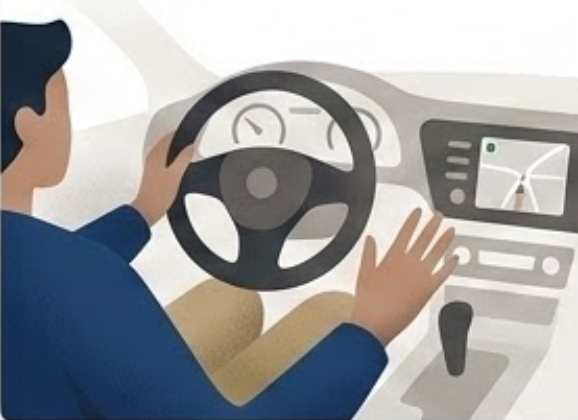
Auto-Parking Natural Interaction Study Driving Simulator Series
Date: 2025-2026
Roles: Research Lead / Study Designer
Highlight: Designed and led a multi-session driving simulator series to observe natural user interaction and Identify Improvement opportunities.
About
Understanding how drivers naturally interact with Automated Parking (AP) and Panoramic View Monitor (PVM) features presents a unique research challenge — traditional lab settings and retrospective interviews often fail to capture the spontaneous, split-second decisions that define real activation behavior. Driving simulators offer a controlled yet ecologically valid environment to observe these moments as they naturally unfold, without the safety constraints of on-road testing.
This study leveraged a structured series of simulator sessions to observe how participants discovered, approached, and activated AP/PVM features across varying parking scenarios. By capturing natural interaction patterns — including hesitation points, visual scanning behavior, and activation sequences — the research identified critical friction points in the user journey. Findings directly informed improvements to activation step design and served as a creative foundation for interface iterations, bridging the gap between observed behavior and actionable design direction.

AD/ADAS Feature Usability — Iterative Remote Research Series
Date: 2024-2026+
Roles: Research Lead / Moderator
Highlight: Designed and moderated multiple iterative rounds of remote usability studies evaluating key AD/ADAS features.
About
Evaluating the usability of AD/ADAS features presents a distinct methodological challenge — many interactions are infrequent, context-dependent, and emotionally charged, making them difficult to assess through traditional in-person testing alone. Online usability methods offer a scalable complement, enabling broader participant reach and the ability to test across diverse user segments without geographic constraints.
This ongoing series of remote usability studies examined key AD/ADAS features across multiple research cycles, using moderated sessions to probe user mental models, pain points, and behavioral expectations in depth. Iterative study design allowed findings from each round to directly inform the next, creating a continuous feedback loop between user insight and feature development. Identified pain points contributed to concrete feature redesigns, shortening the distance between research evidence and product improvement.

AIS – Affective Impressions Scale
Date: 2017-2019
Type: Psychometric Scale
Highlight: Winner of Kids Design Award Japan on Research Category
About
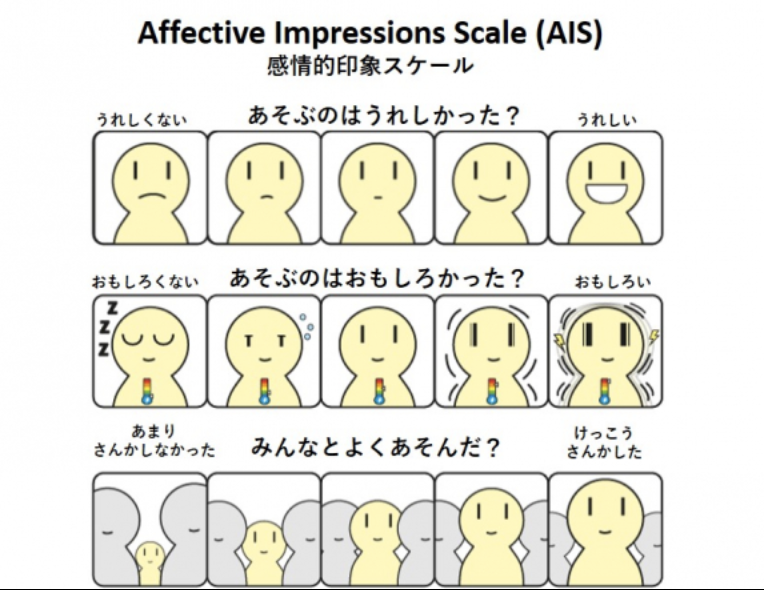
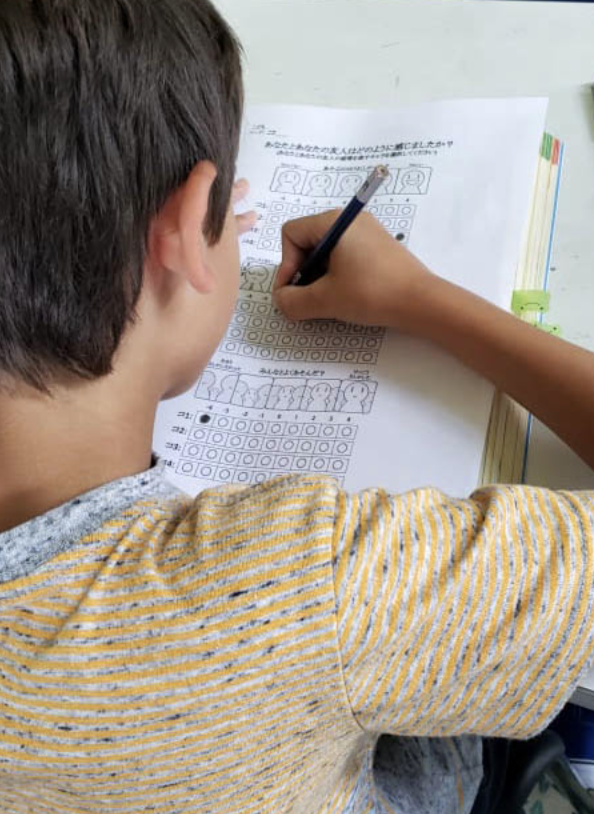
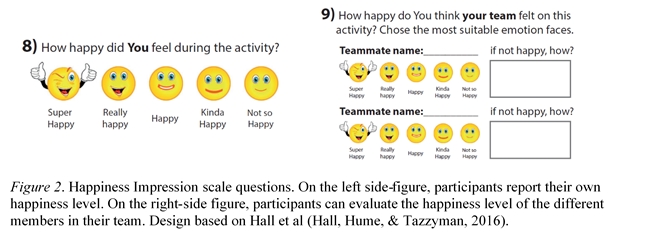
Child-Dedicated scale for reporting emotions and evaluating the feelings of peers. The AIS evaluates how well a participant can evaluate the feelings of others (Accuracy) and how synchronized group members are with themselves (Affective Synchrony – AS) in three dimensions:
Happiness (Joy), Energy (Arousal), and Participation (Dominance).
Winner of the Kids Design Award.

Global AD/ADAS Competitive Benchmark
Date: 2025-2026+
Roles: Research Lead / Manager
Highlight: Led a three-region competitive benchmark identifying best-in-class AD/ADAS features and strategic investment priorities.
About
As Advanced Driving and Driver Assistance Systems rapidly evolve across global markets, understanding what “best-in-class” looks like — and why — requires more than feature comparison. User expectations, regulatory contexts, and cultural driving behaviors vary significantly across regions, making a single-market perspective insufficient for strategic product decisions.
This research initiative conducted a structured benchmark study across three major regions — North America, Europe, and Japan — evaluating AD/ADAS features against competitive offerings and user expectations in each market. Beyond identifying feature gaps, the study established a consistent evaluation standard designed for longitudinal tracking, enabling year-over-year comparisons as the competitive landscape evolves. Outputs highlighted the most strategically valuable features to prioritize, grounding investment decisions in cross-regional user evidence rather than assumption.
Future Mobility Attitudes & Next-Generation Driver Personas
Date: 2026+
Roles: Research Lead / Strategist
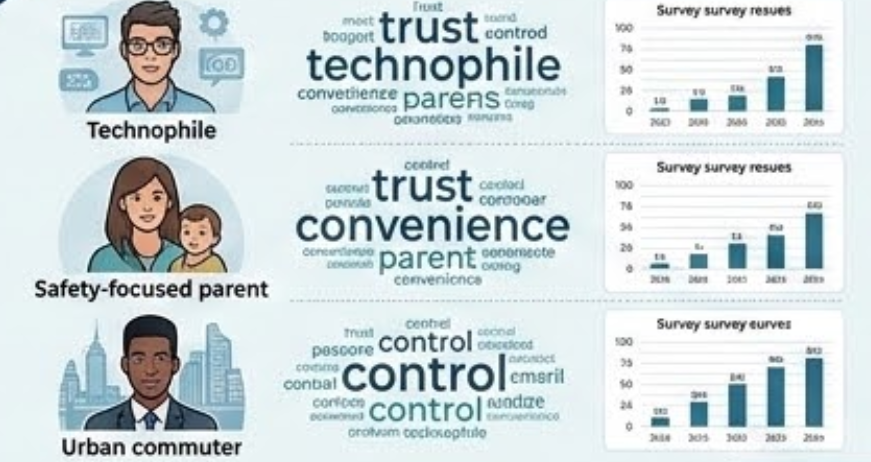
Highlight: Conducted a mixed-methods research initiative combining large-scale surveys and unmoderated interviews to map evolving driver attitudes toward future mobility.
About
The rapid evolution of vehicle technology — from electrification to automation — is fundamentally reshaping what drivers expect from their next car. Yet product teams often rely on existing user data or internal assumptions to prioritize features, without a current, evidence-based picture of how user values and priorities are actually shifting in real time.
This mixed-methods research initiative combined large-scale surveys with unmoderated interviews to map users’ current perspectives, aspirations, and concerns about their next vehicle. The study captured not just feature preferences, but the underlying values and anxieties driving them — providing a richer foundation for strategic prioritization. Findings directly influenced the reprioritization of AD/ADAS features according to perceived user value, and gave rise to a set of next-driver personas that have since guided the conceptualization of new features across the development team.
Design Management in the Toy Industry
Date: 2017
Type: Journal / Master Thesis
Authors: Rodrigo Fernandes & Toshimasa Yamanaka
About
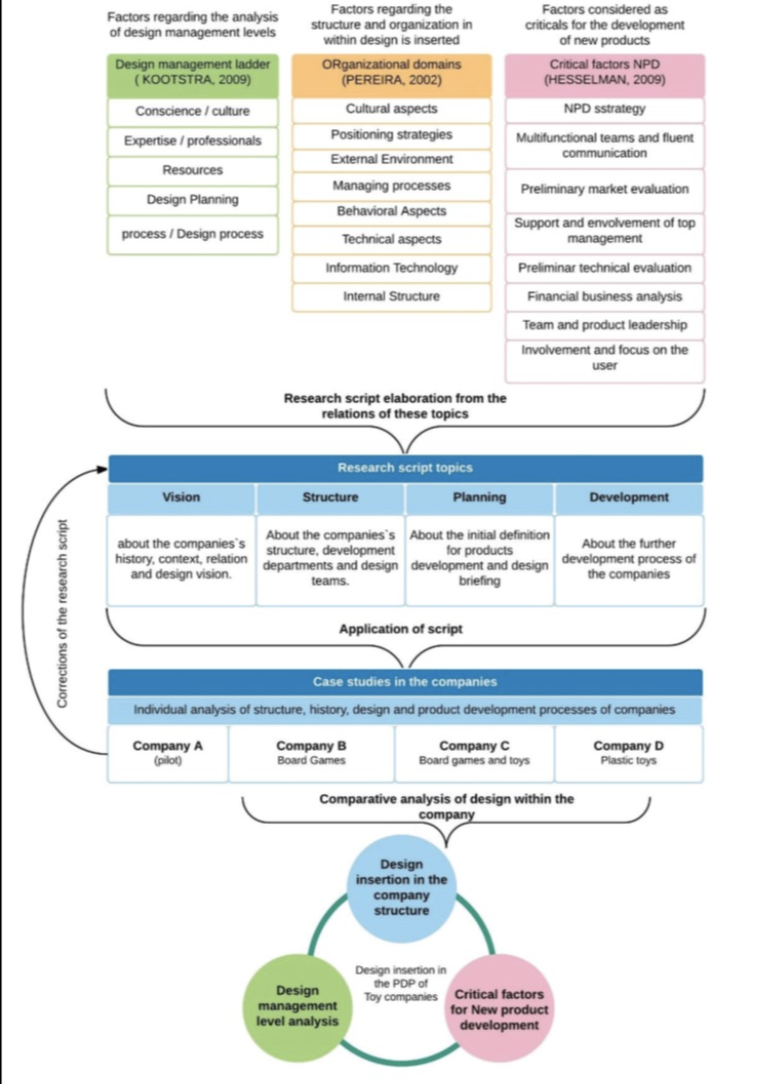
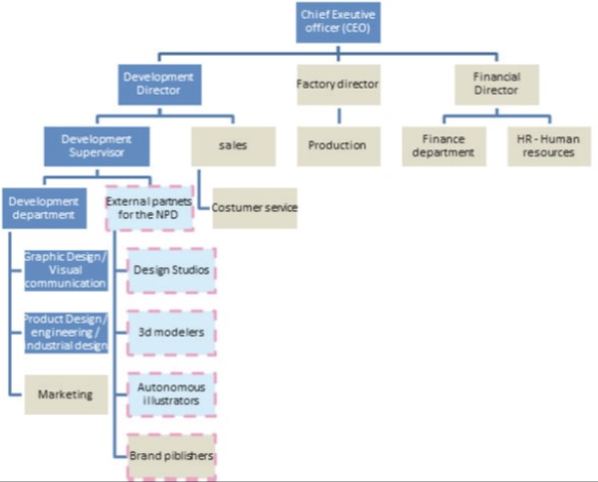
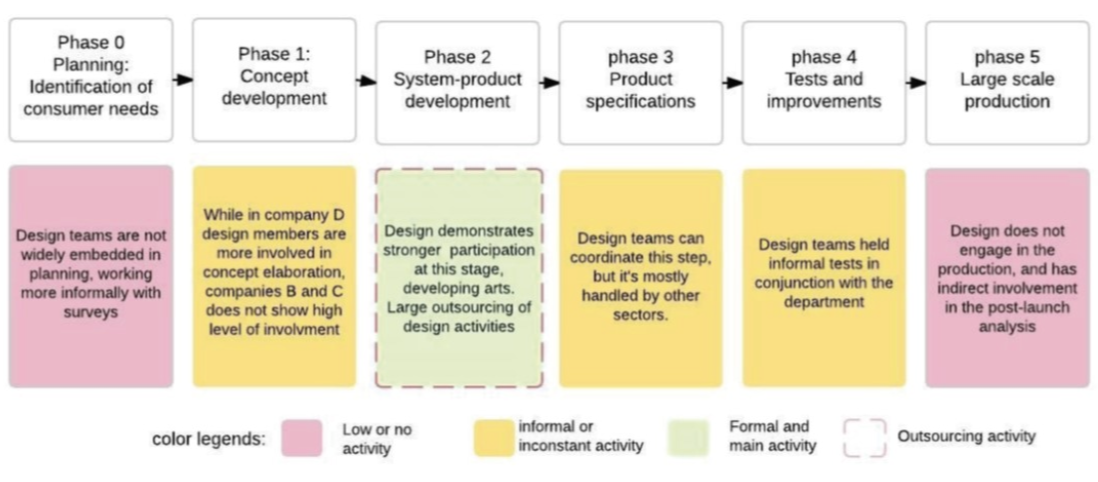
Case study research about the integration of design and of users in the New Product Development (NPD) process of Brazilian toy companies. The research highlighted that designers are not usually included in the initial stages of product conceptualization, prejudicing the development of novel concepts. Furthermore, infant users were also often disregarded in the design process.
In-car Anti-Motion Sickness Device
Evaluation Framework
Date: 2025-2026+
Roles: Research Lead /Co-Developer
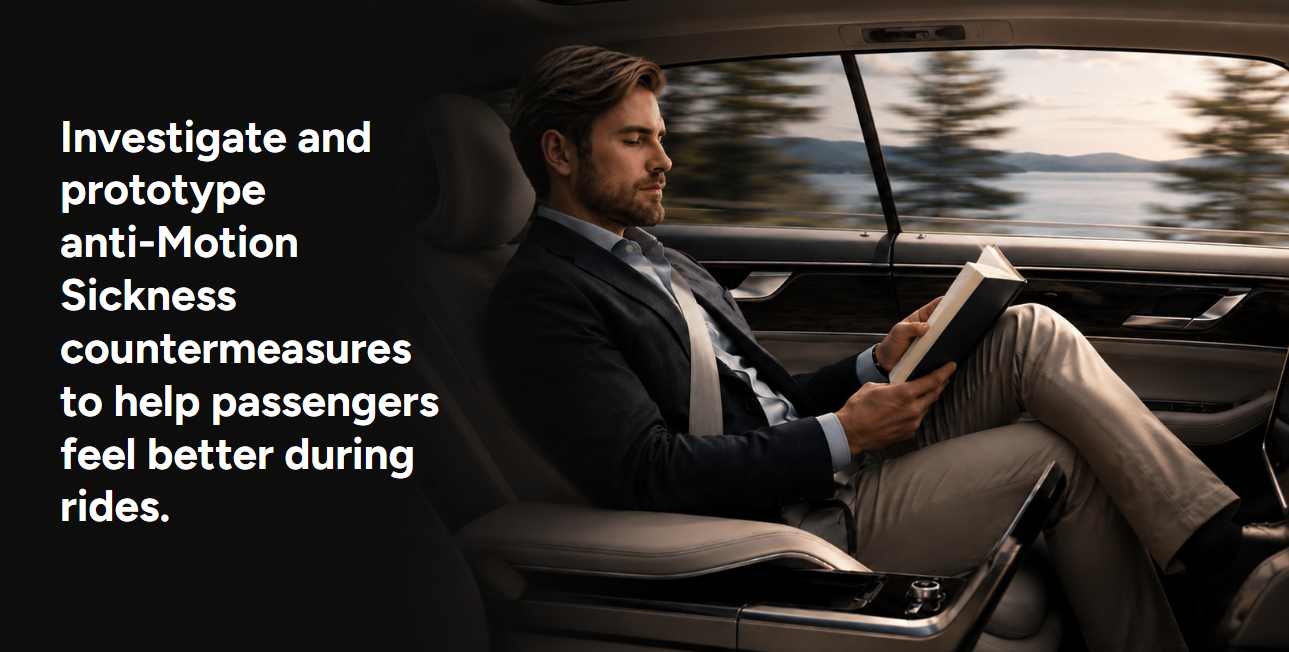
Highlight: Established a rigorous simulator-based evaluation framework for in-vehicle motion sickness interventions, enabling reliable and reproducible testing.
About
Motion sickness in autonomous and semi-autonomous vehicles represents one of the most underexplored yet critical barriers to user acceptance of AD technology. As passengers increasingly shift from active driver to passive occupant, the physiological and psychological discomfort associated with reduced vehicle control becomes a meaningful design problem — one that requires rigorous, reproducible evaluation methods before any intervention can be validated.
This research established a structured evaluation framework for assessing anti-motion sickness interventions within a driving simulator environment, enabling controlled and repeatable testing of candidate solutions. By standardizing the measurement approach first, the study ensured that subsequent intervention testing could generate reliable, comparable results. The work supported the development of in-car interventions that are currently progressing through the patent process, contributing to a foundation for passenger-first autonomous vehicle design.
Behavior Research for Students in Japan
Date: March 2023
Roles: Research and Strategy Plan
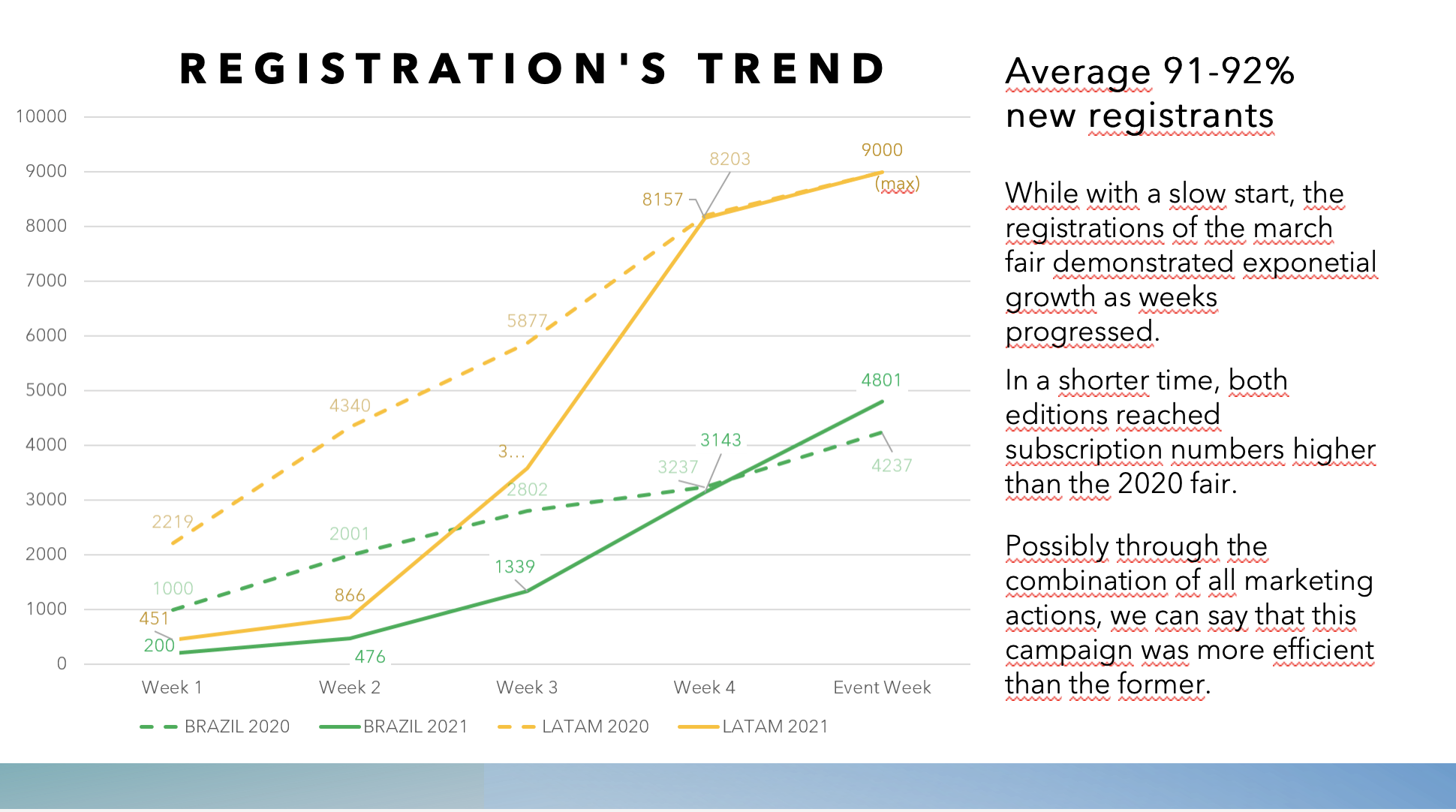
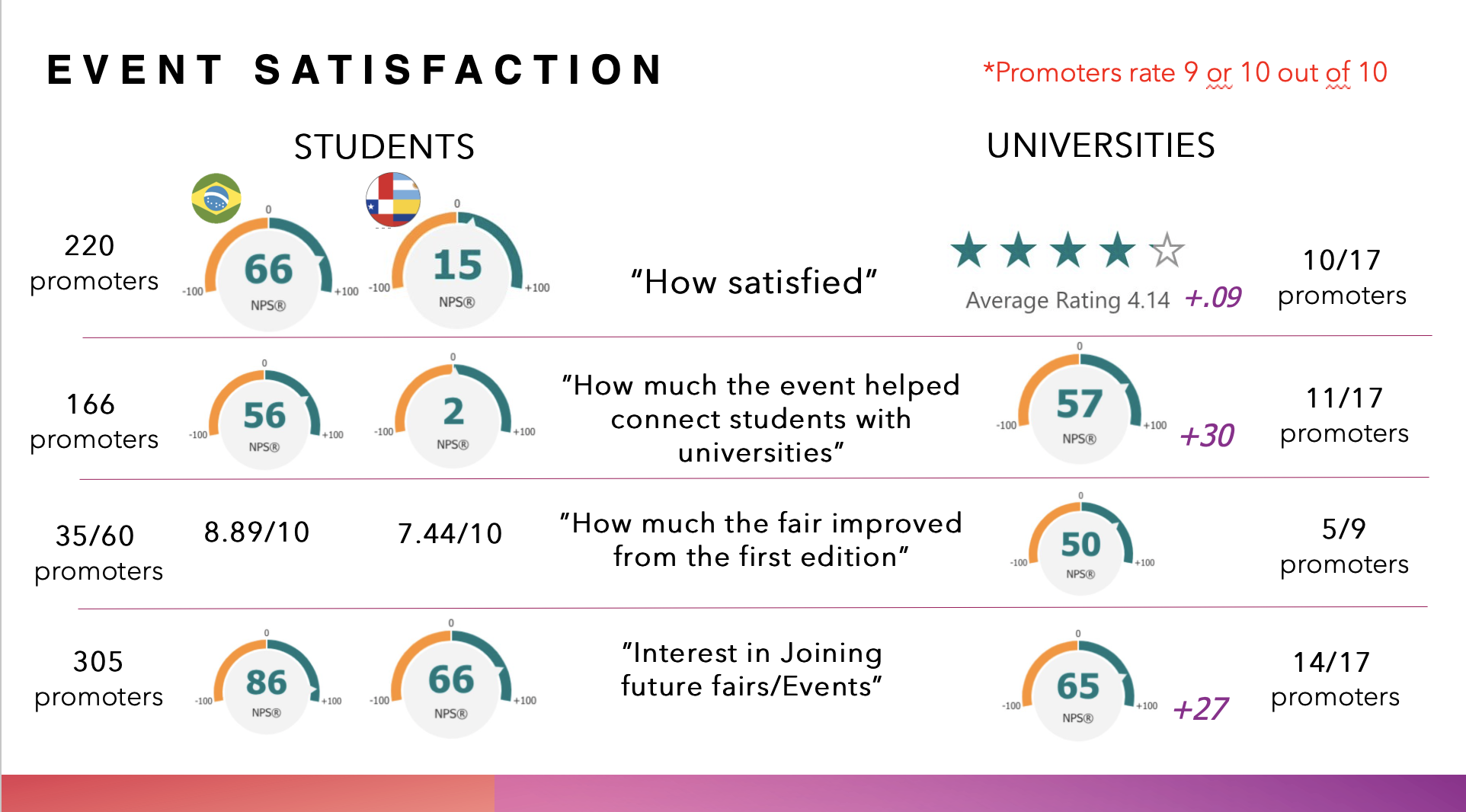
Highlight: 40% Increase in South American students after review of their experiences
About
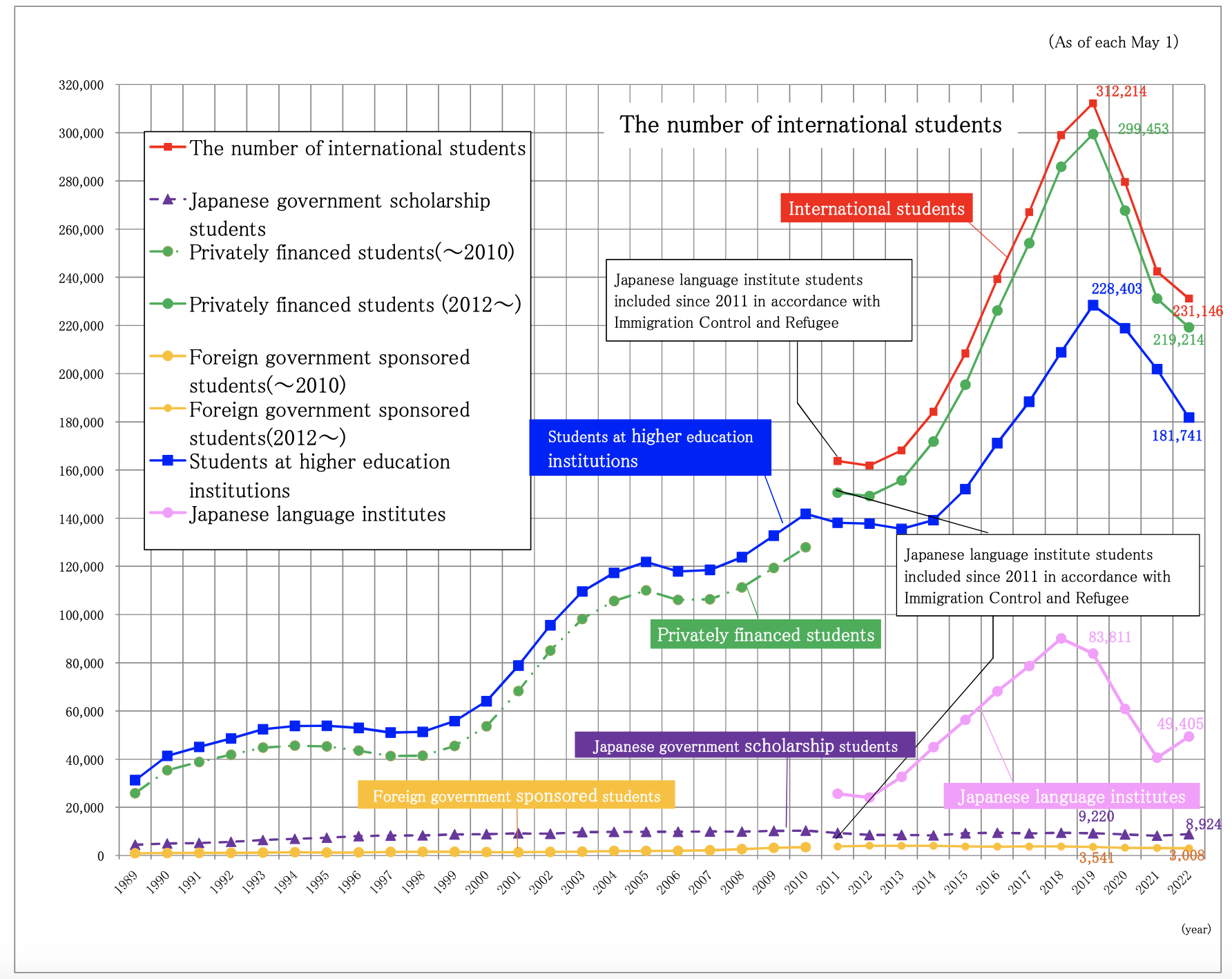
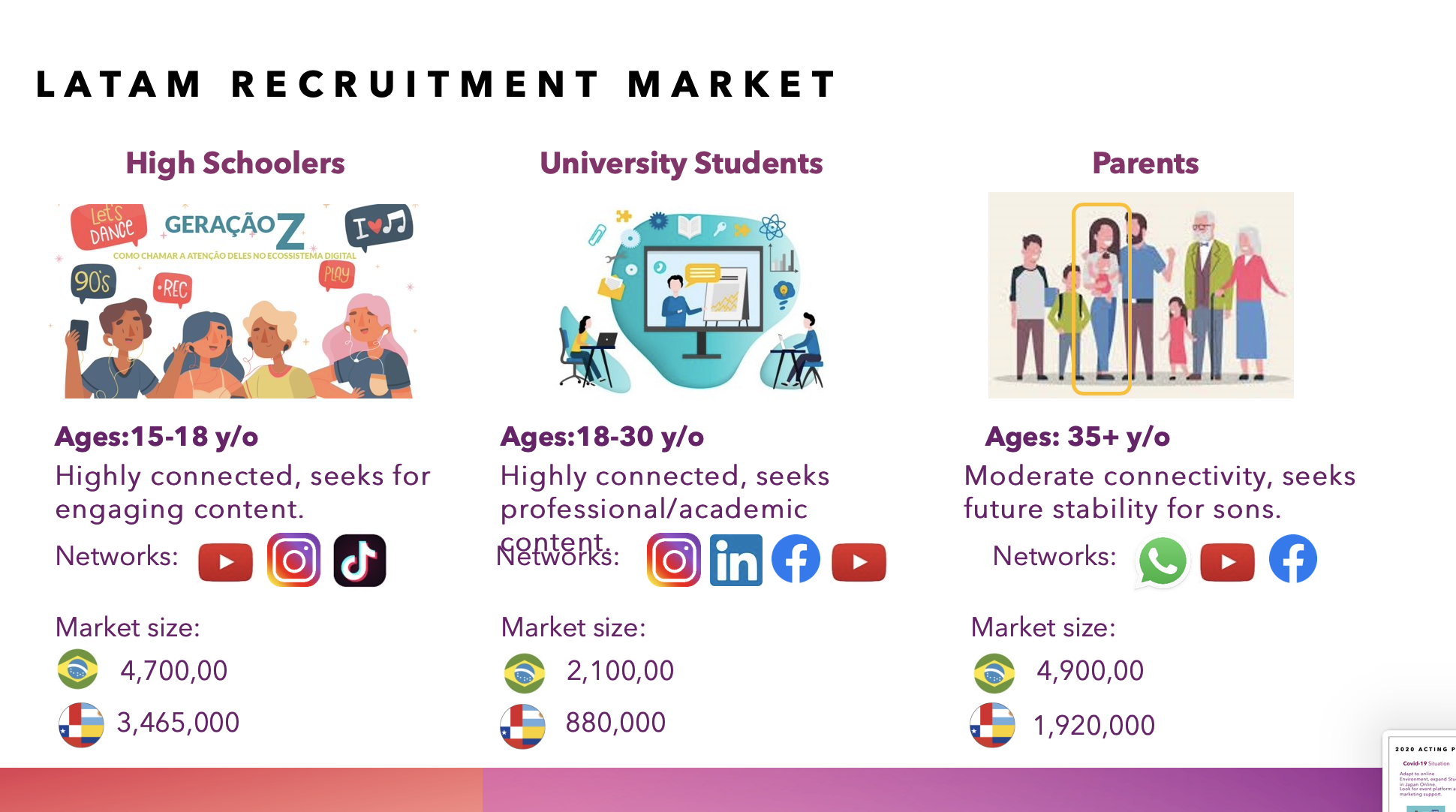
The number of South American Students have been stagnated in Japan for the past 10 years. While the Covid-Pandemic Also affected the recruitment of Students for the years of 2020-2021, it opened a possibility to reevaluate the scenario.
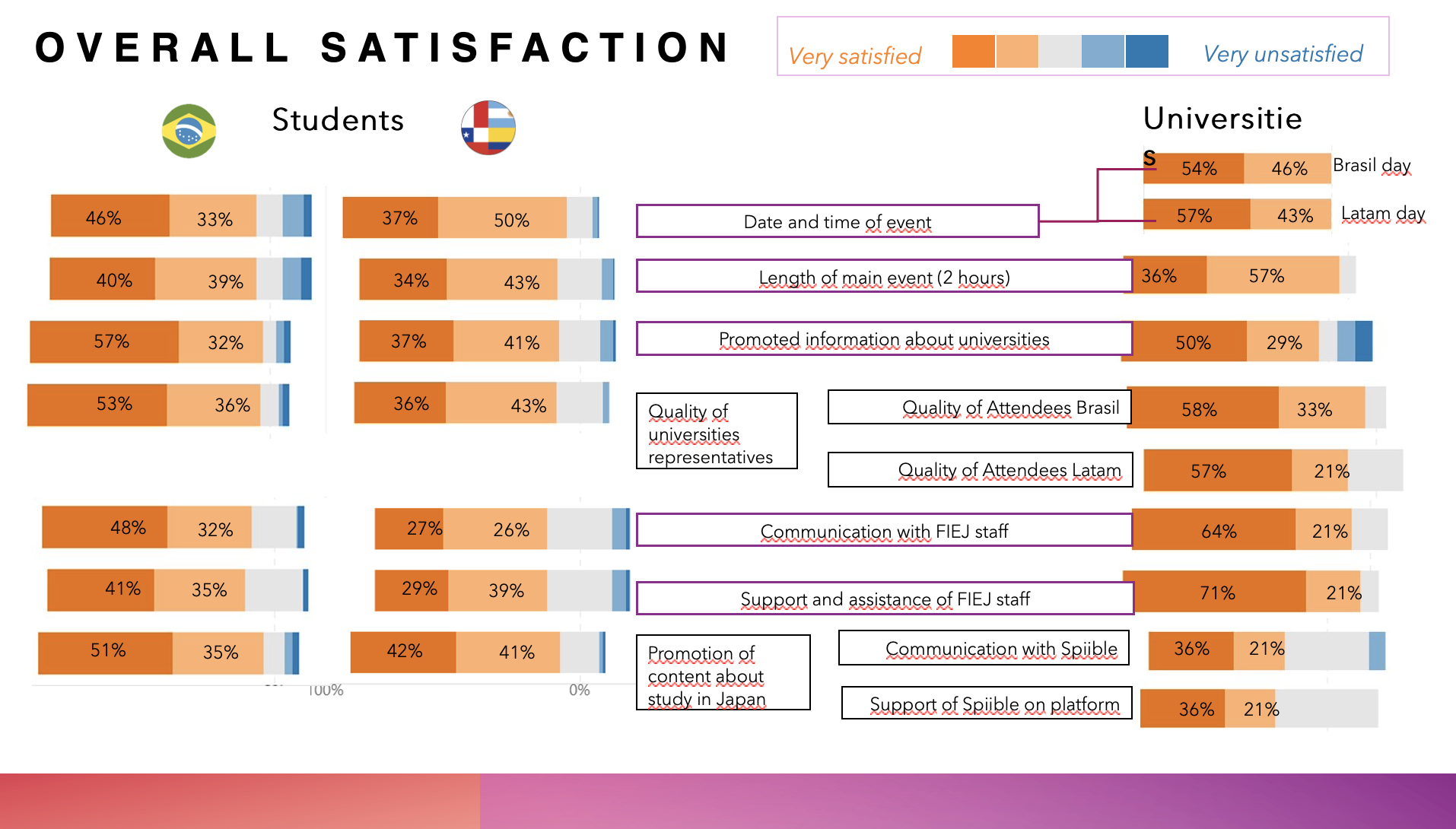
By evaluating the experiences of students keen on studying in Japan, we formulated a comprehensive action plan. This strategy includes a heightened investment in digital media PR, personalized virtual study fairs, and specialized study-related content. This approach has enabled us to connect with new audiences, thereby influencing current student enrollment and setting the stage for sustained growth in the years ahead.
Interactive Design vs. Design for Interaction
Date: 2019
Type: Book Chapter
Authors: Rodrigo Fernandes, Toshimasa Yamanaka
About
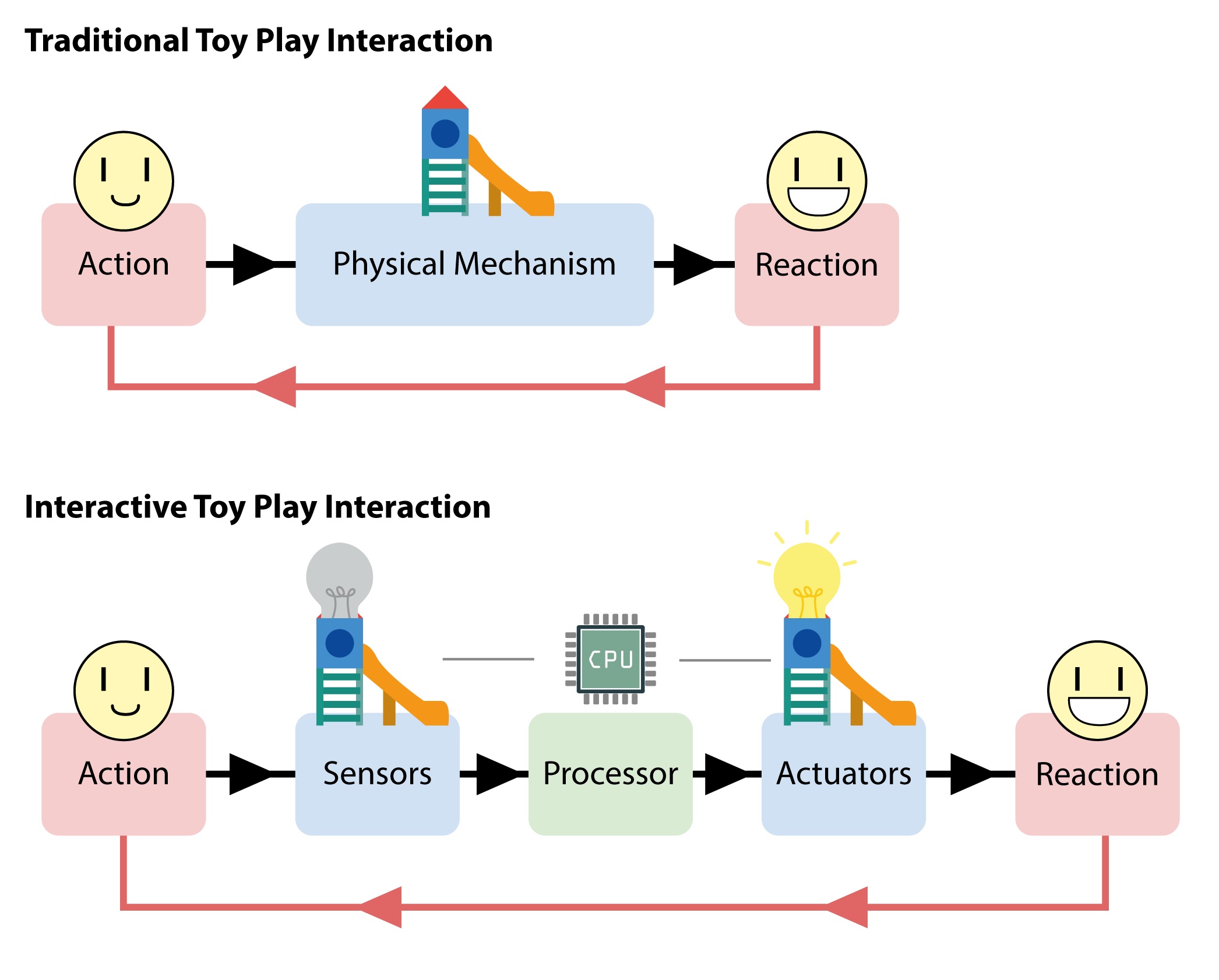
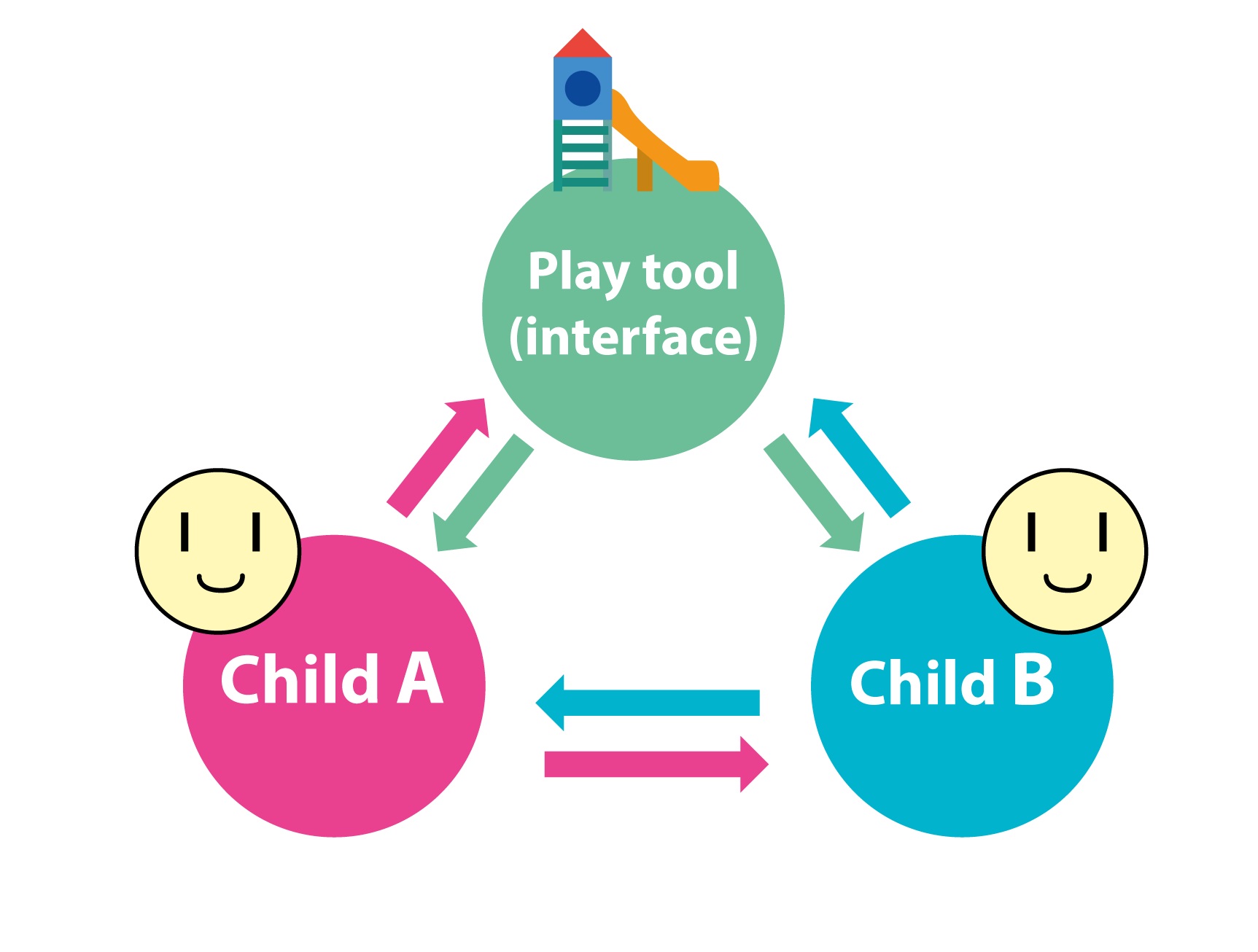
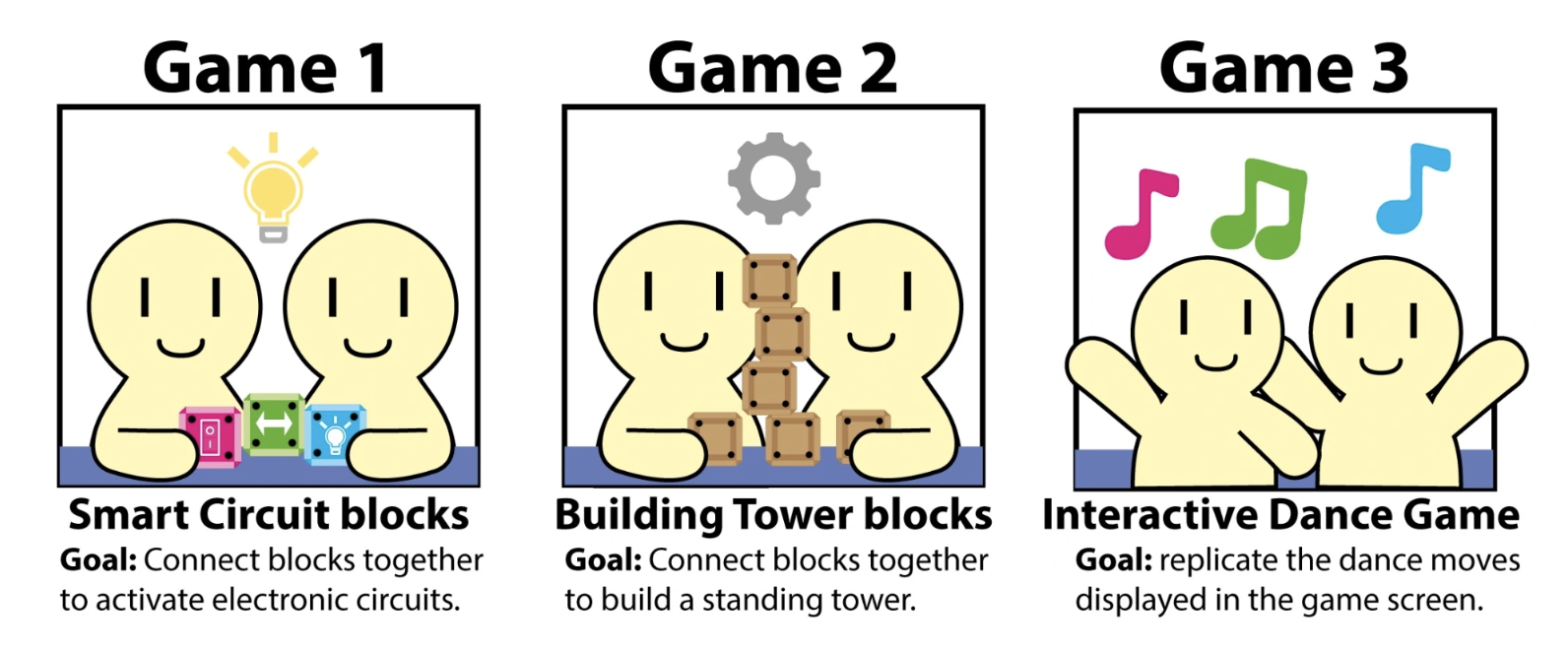
Discussion about developing new design guidelines for children based on three promoted play experiences. How to develop toys/games that promote interactions between children?
More Research
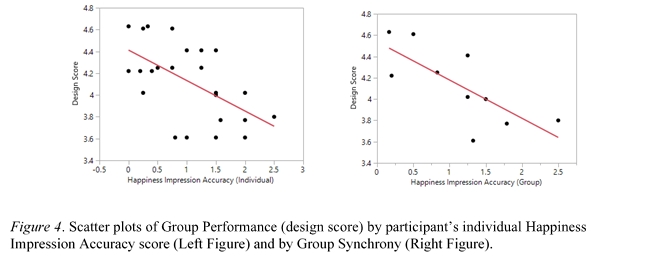
Happiness Synchrony predicts the Group-work Performance of Children
Date: 2019
Authors: Rodrigo Fernandes & Toshimasa Yamanaka
About
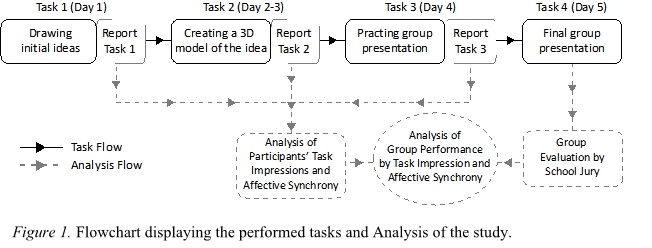
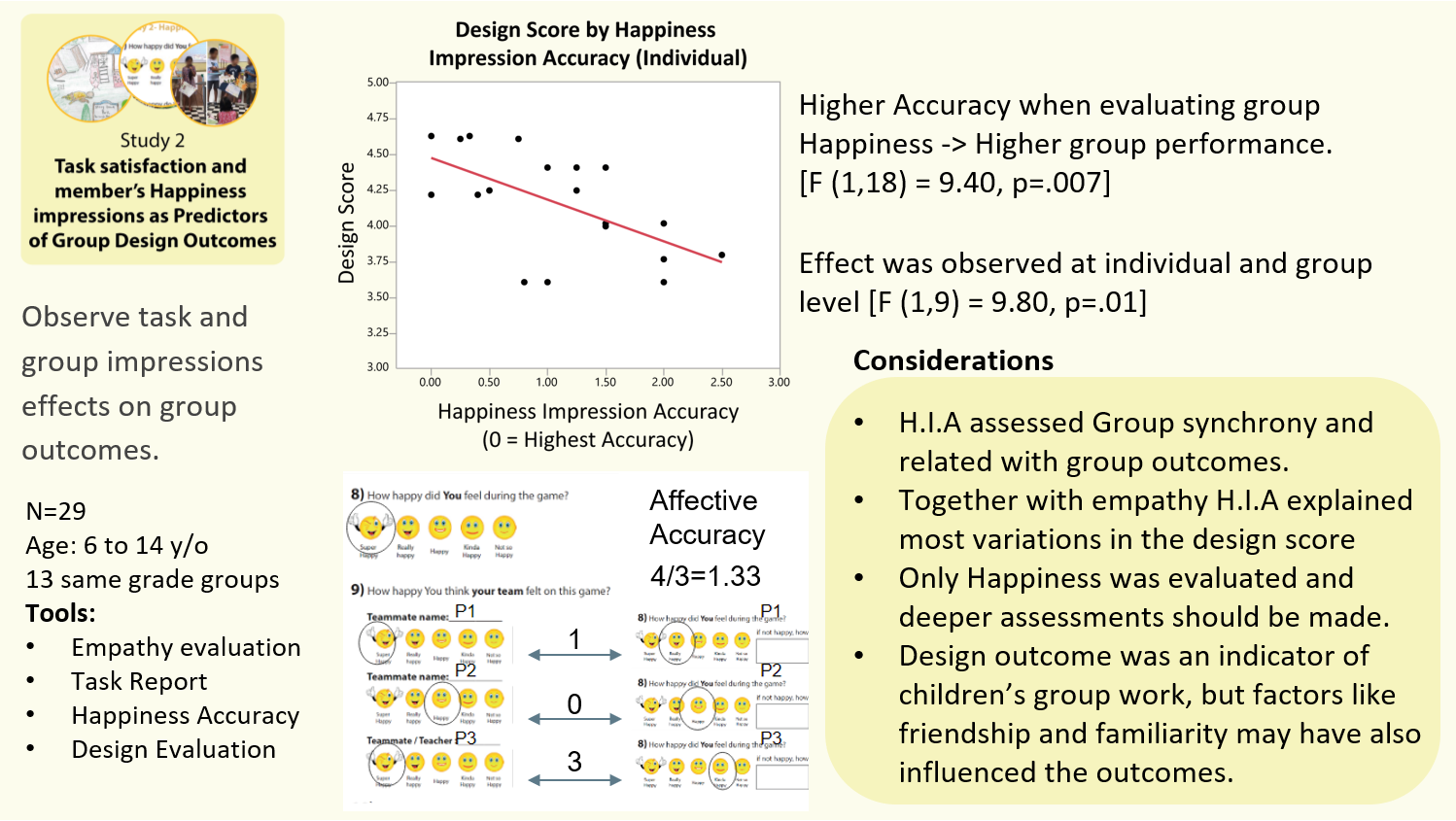
In a design competition for children, we observed which variables would lead to better group performance. Results indicated that participants who were better at evaluating the happiness level of their group members throughout three tasks achieved better design scores in the competition.
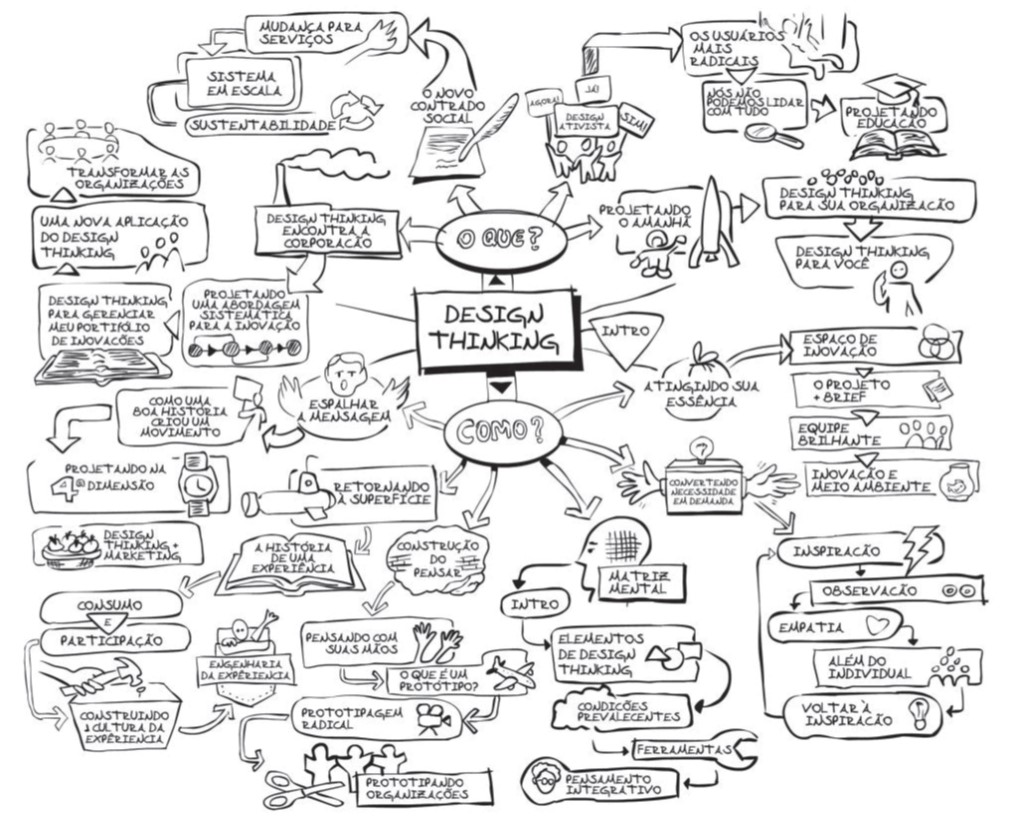
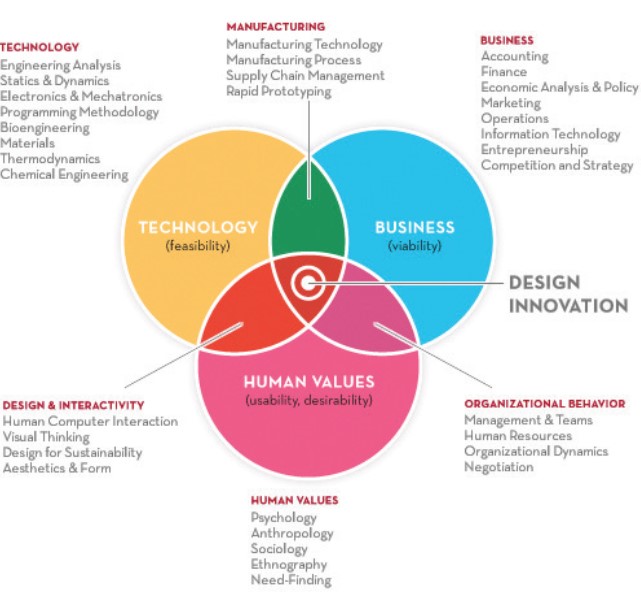
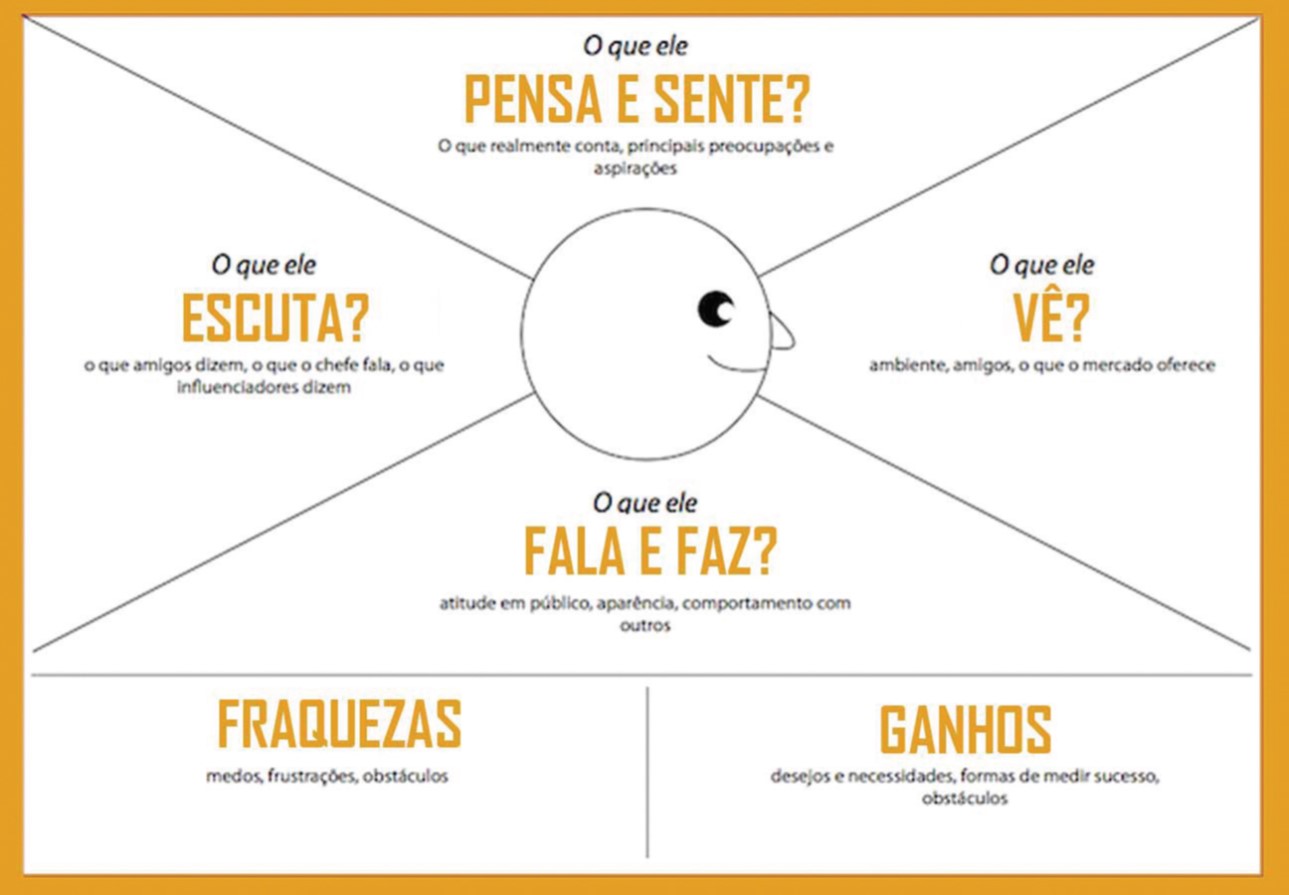
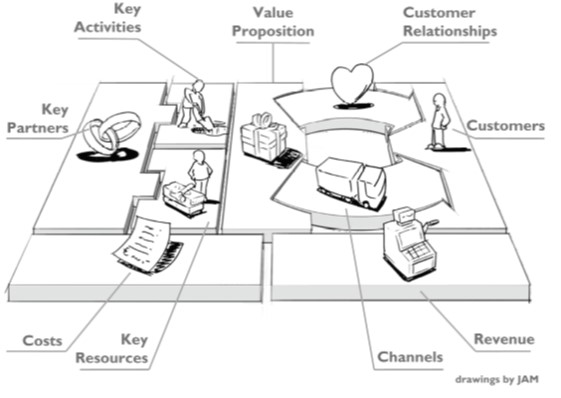
Design Influence in the Business Model Canvas
Date: 2017
Type: Journal (PT-BR)
Author: Erica Ferreira, Rodrigo Fernandes, Veronica Vargas
About
Literature Review and theoretical discussion about the venture of designers in the business / management fields, generating innovative approaches and tools like the Business Model Canvas (BMC).
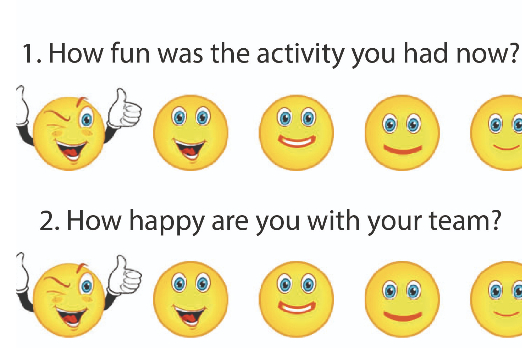
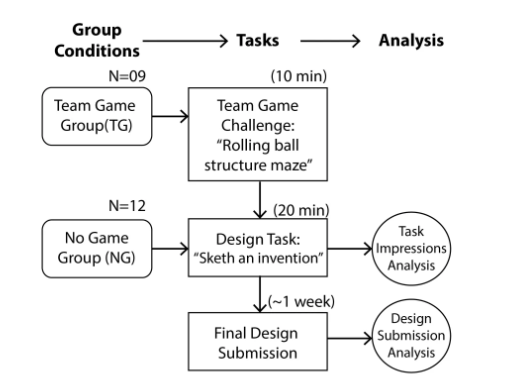
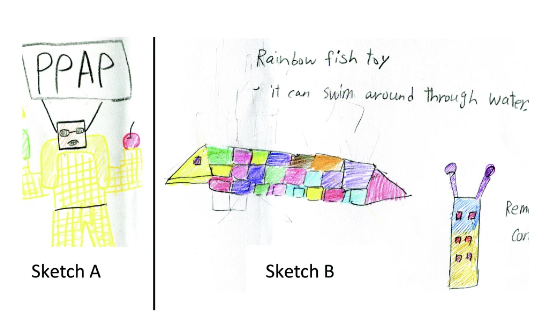
Group Games Effects on Children’s Impressions of Sketch Tasks and on their Design Outcomes
Date: 2019
Type: Journal
Author: Rodrigo Fernandes, Toshimasa Yamanaka
About
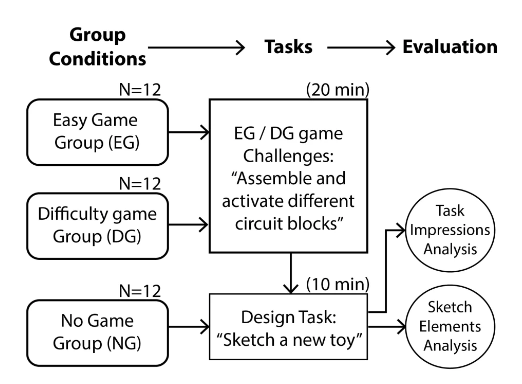
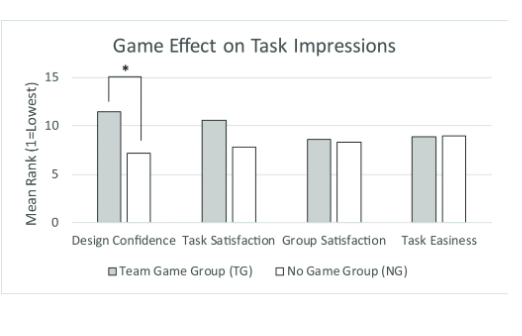
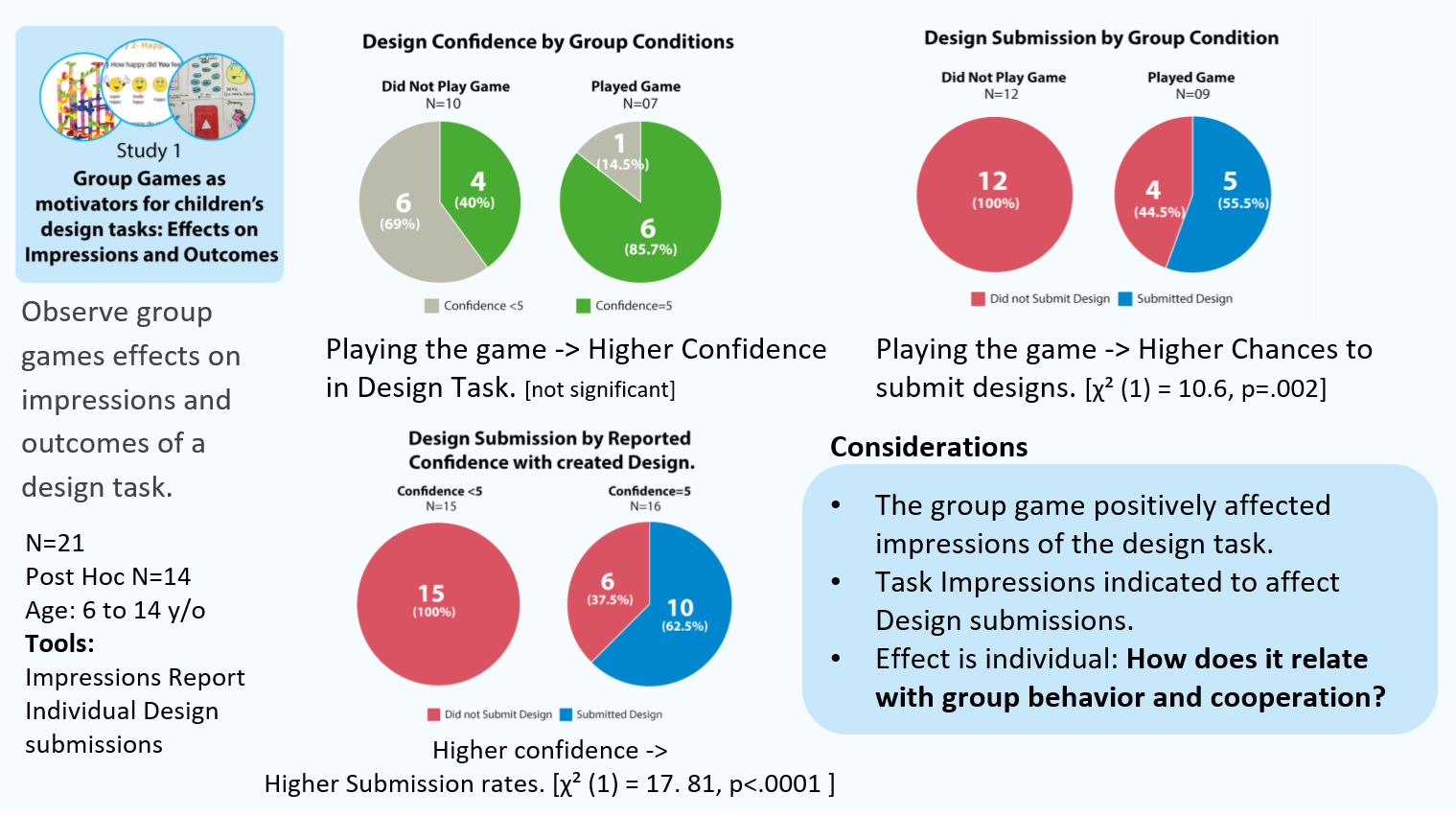
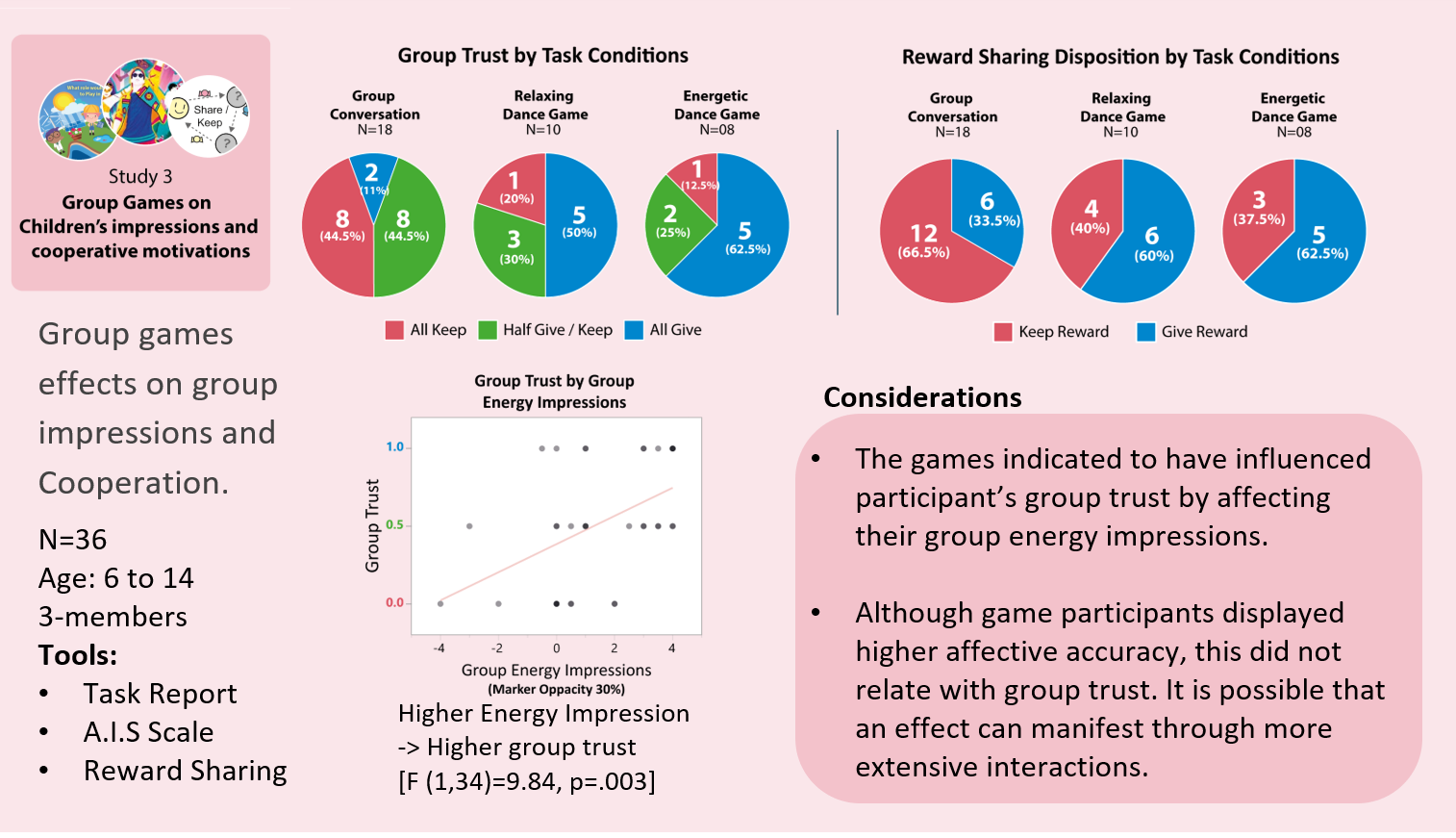
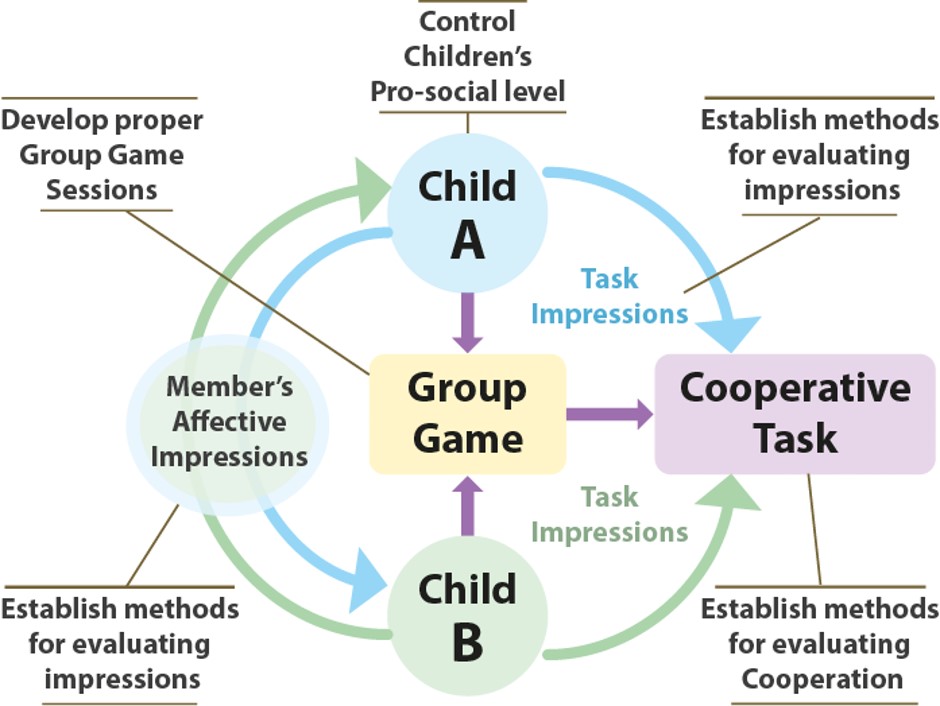
Two studies that aimed to understand how playing group games affects children’s motivation and engagement levels with a subsequent design task. Results displayed that, after playing group games, children become more confident with their design works and are more likely to voluntarily submit them to a competition.

The Kansei of Play Thesis
Date: 2016-2019
Type: Ph.D. Dissertation
Author: Rodrigo Fernandes
About
3-year Ph.D. research about the effects of group games on children’s impressions and, consequently, on their dispositions to cooperate. Results showed that children understand each other’s feelings better when playing group games, and that might be a strong factor for increasing their cooperation.
U. Interaction
Organized Workshops and Interactive Experiences

AD/ADAS Strategic Futures Full-Department Design workshop
Date: March 2026
Venue: Woven by Toyota
Roles: Research Synthesis / Workshop Facilitation
Highlight: Synthesized a 360-degree evidence base spanning user research, prior studies, academic literature, and market growth projections for a targeted set of AD/ADAS features
About
Strategic product decisions in complex technology domains require more than data — they require synthesis. When teams are working at the frontier of AD/ADAS development, the ability to integrate user voices, prior research, academic literature, and market trajectory into a coherent, actionable picture becomes a research challenge in itself.
This initiative conducted a 360-degree market and user overview of a targeted set of AD/ADAS features, synthesizing evidence across four dimensions: direct user feedback, internal research findings, published literature, and market growth projections. The resulting synthesis was structured as a workshop-ready presentation and delivered to a full-department audience, providing a shared foundation for the ideation of novel concepts. By bringing diverse evidence streams into one accessible format, the workshop created alignment across teams and catalyzed the conceptual development of next-generation features.
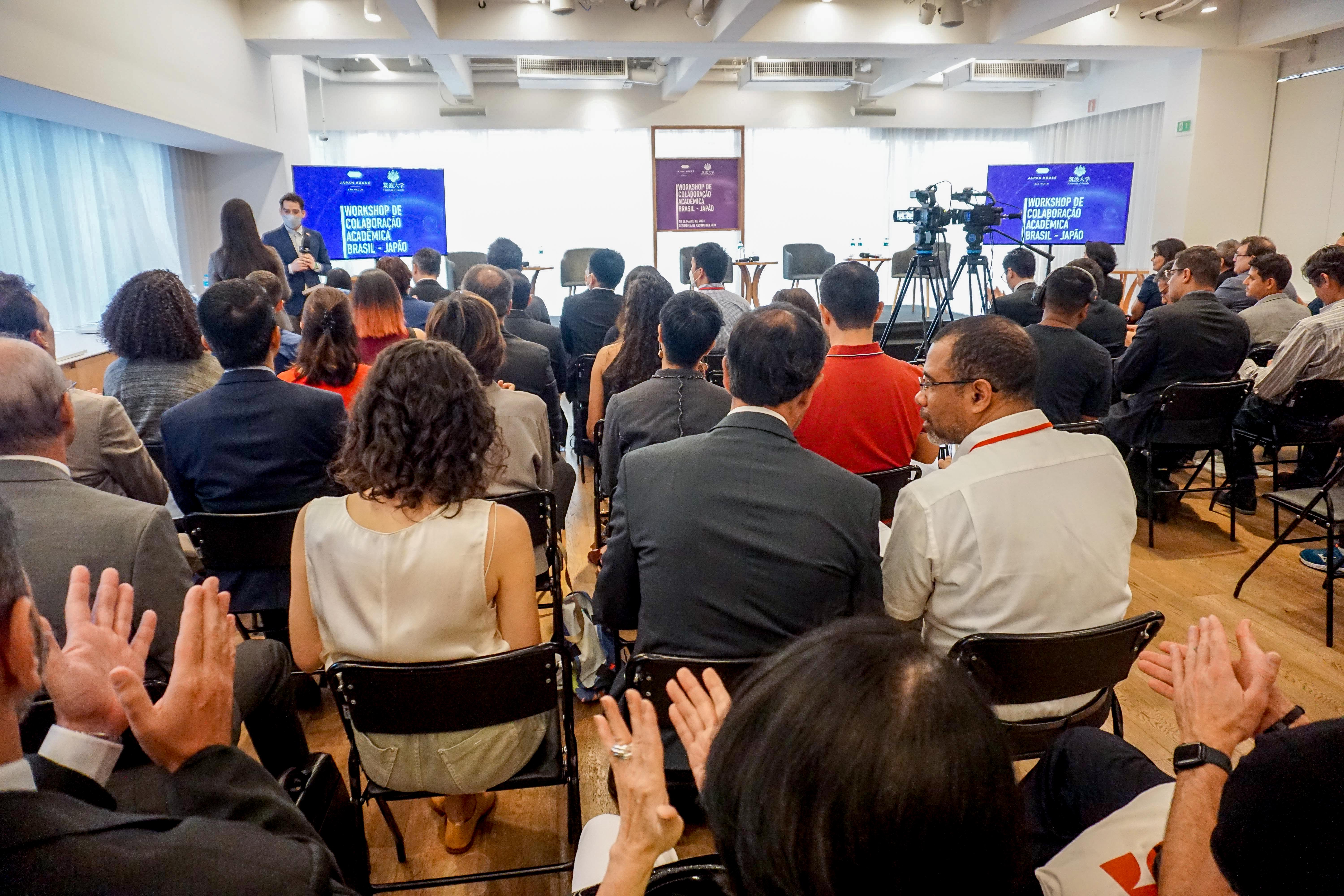
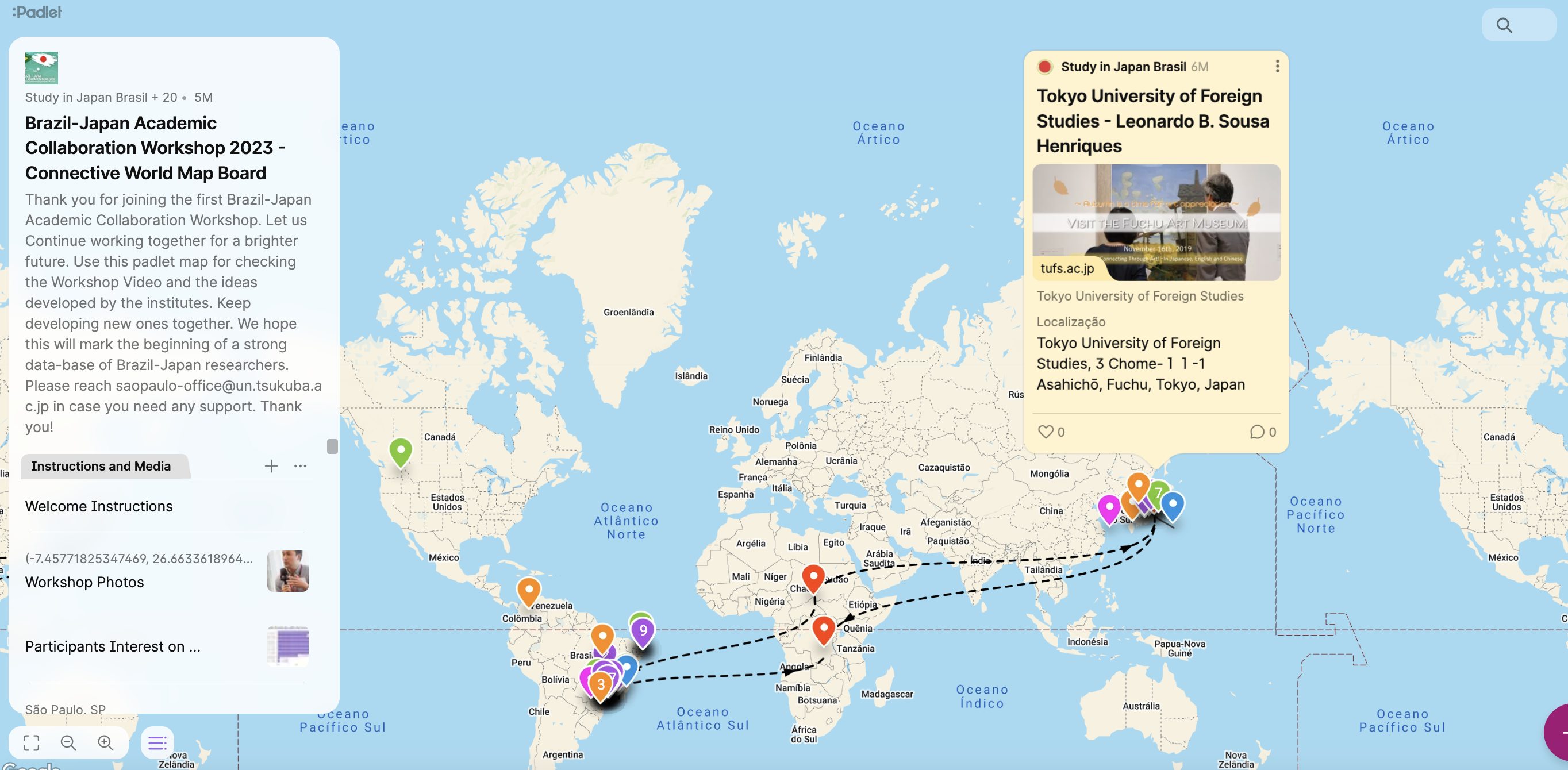
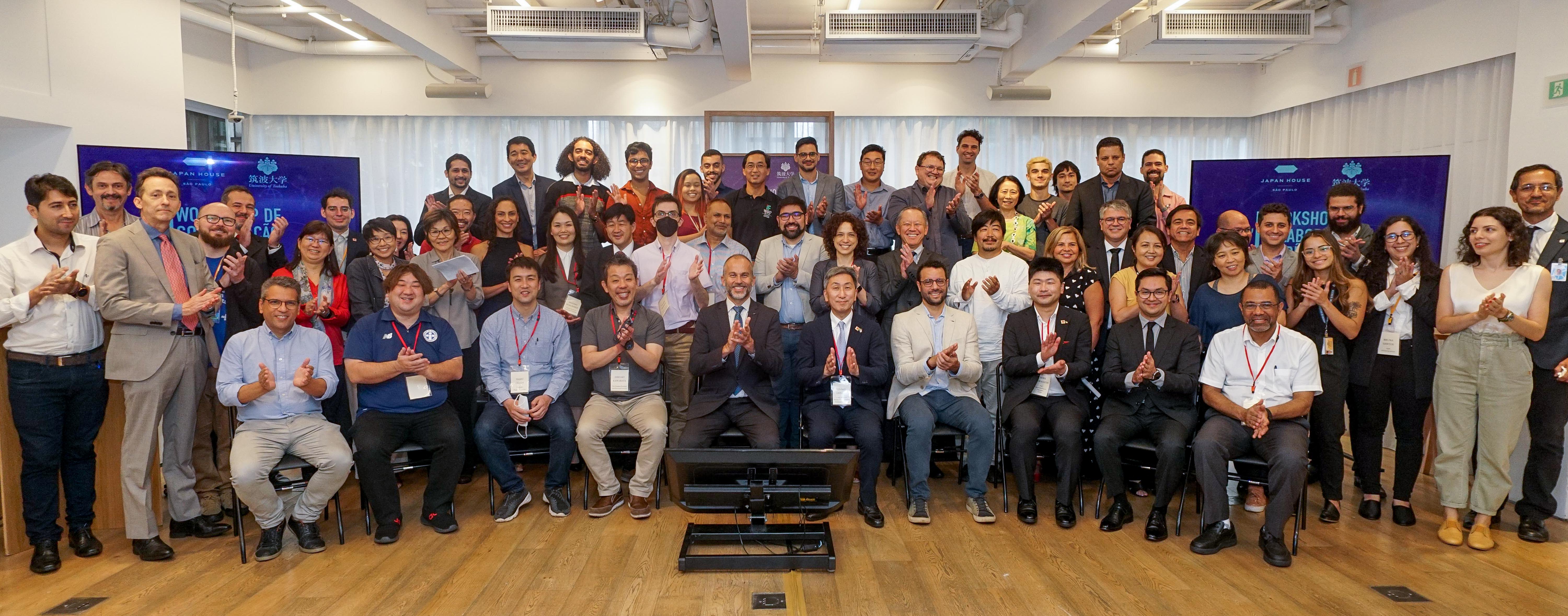
Brazil-Japan Academic Collaboration Workshop
Date: March 2023
Venue: Japan House – SP, Brazil
Roles: Concept, Organization, and Design
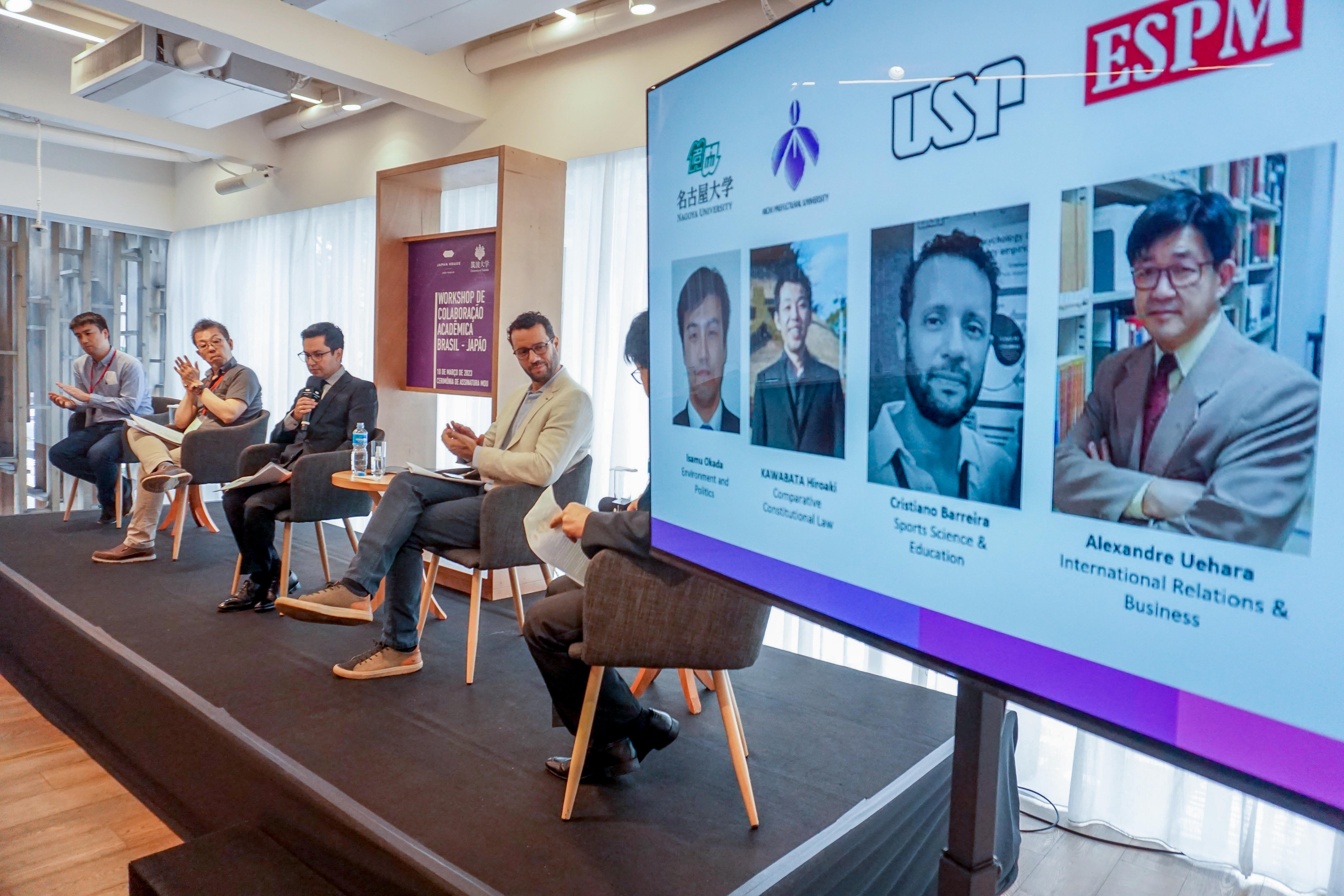
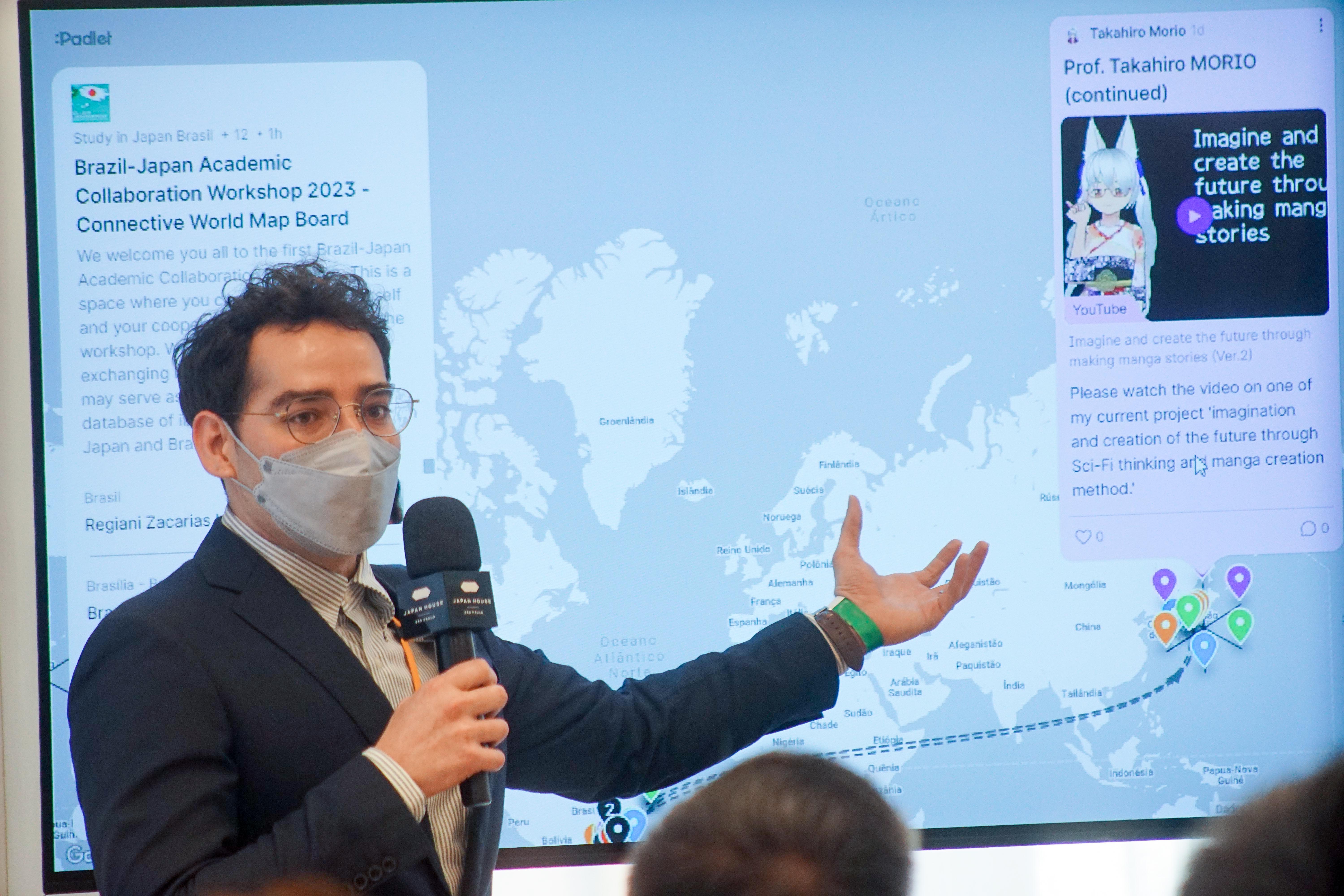
Highlight: 120+ participants from over 50 institutions from Brazil and Japan. Unique Format
About
Academic Workshop with for promoting collaborations aimed at the Sustainable Development Goals (SDG) between Japan and Brazil. Over 100 researchers from all over Brazil Joined
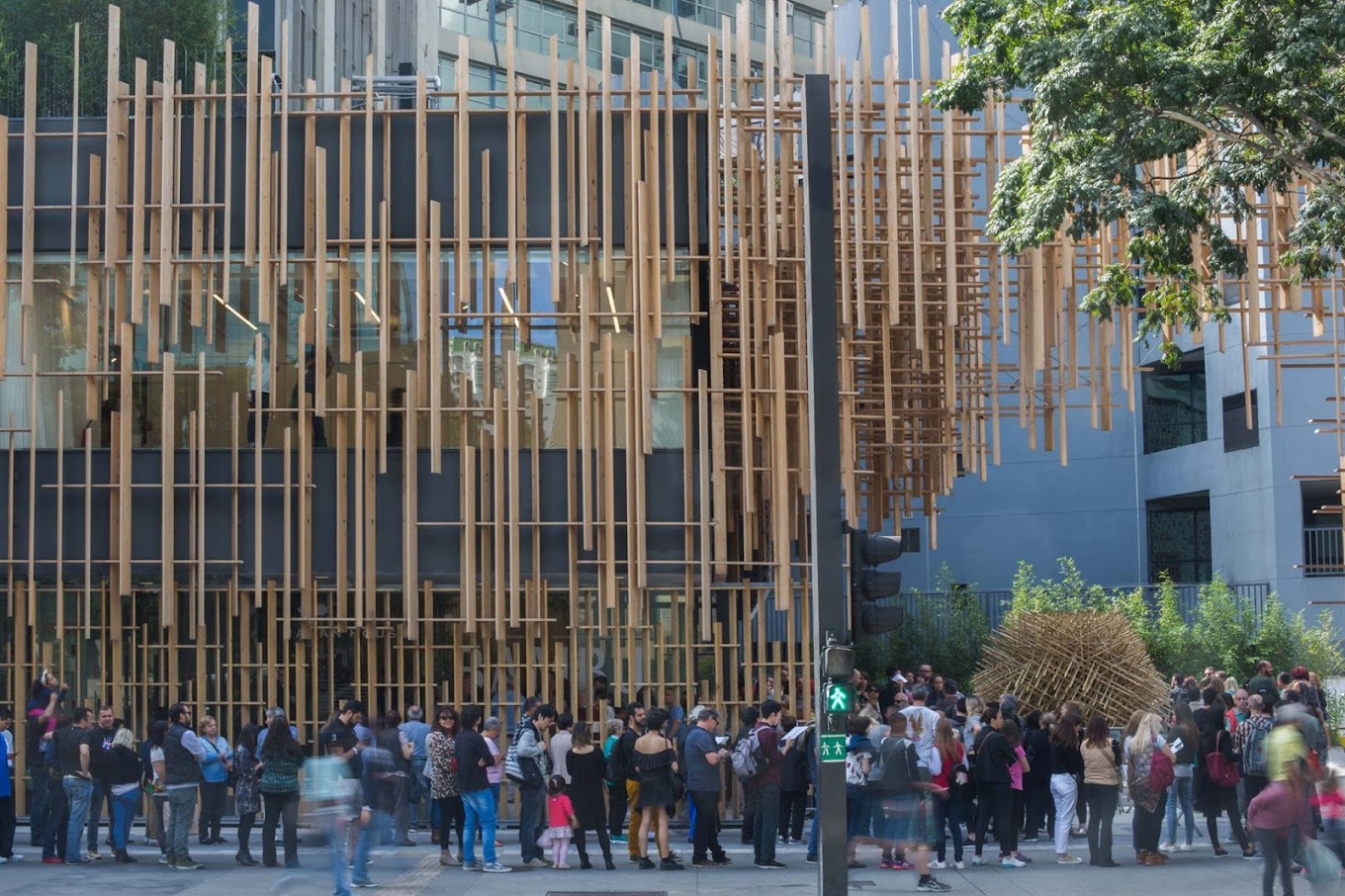
Study in Japan 2023 Fair
Date: March 2023
Venue: Japan House – SP, Brazil – Youtube
Roles: Concept, MC, Organization, and Design
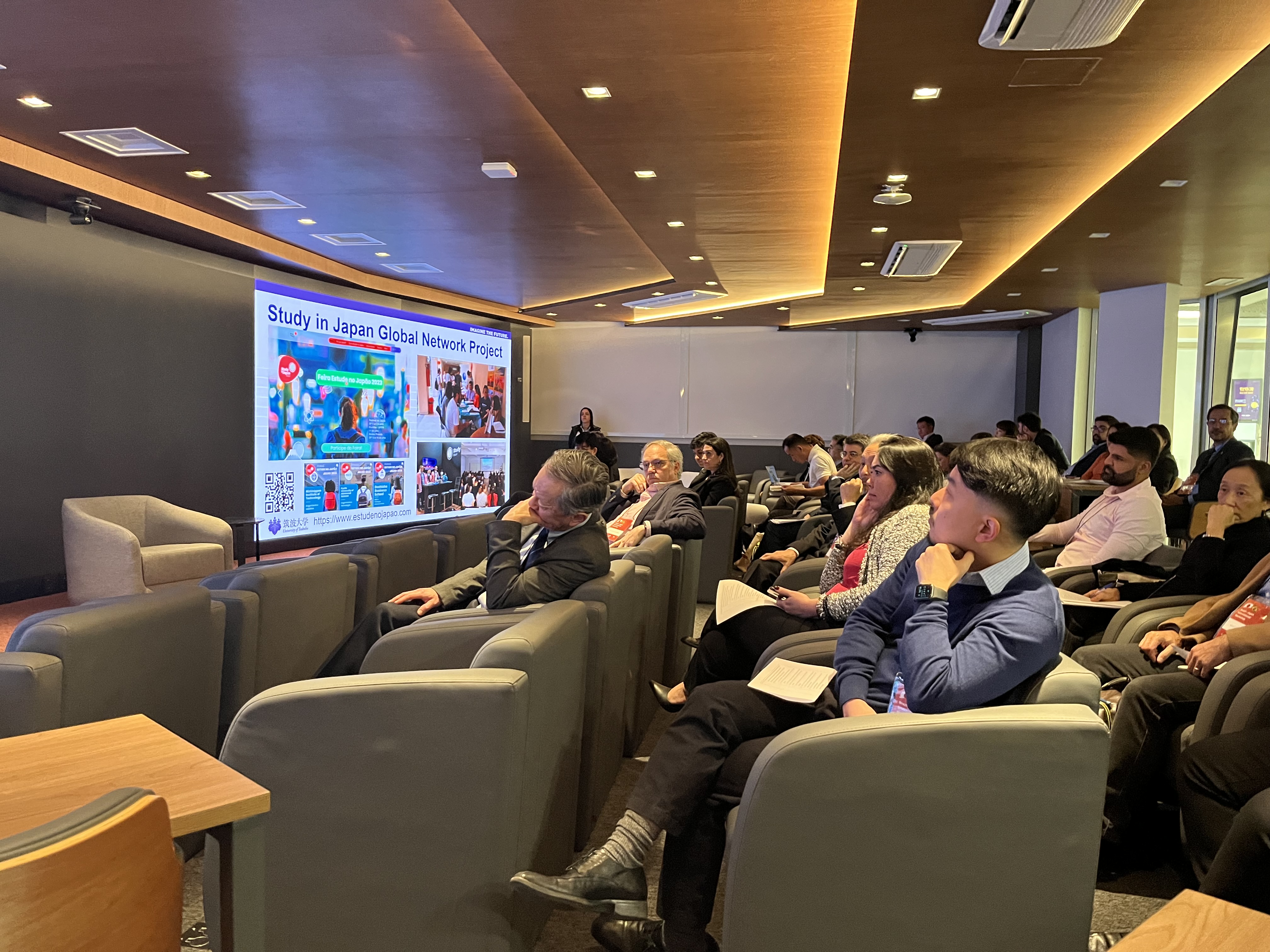
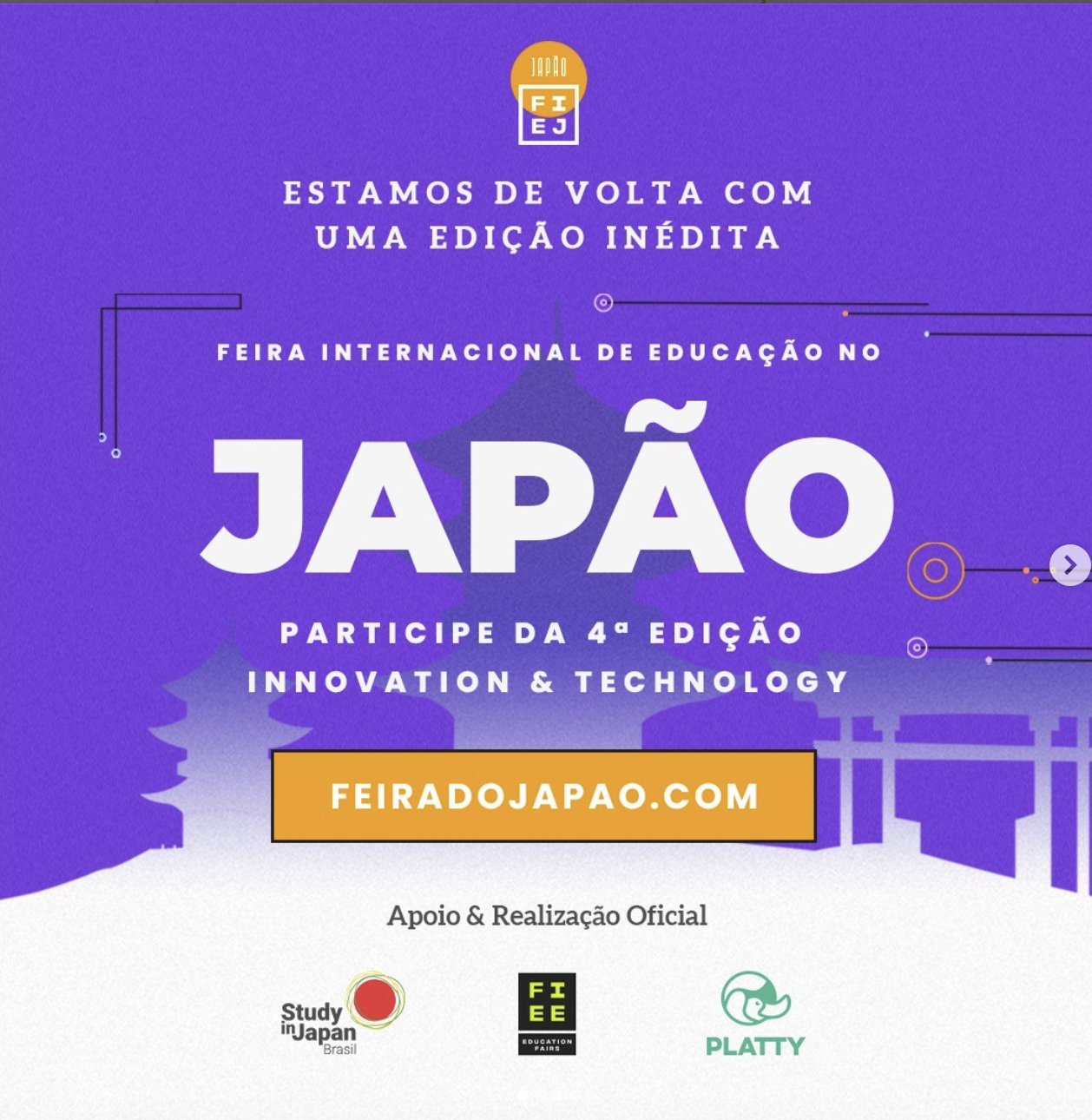
Highlight: Largest Onsite Study fair in South America – First Hybrid
About
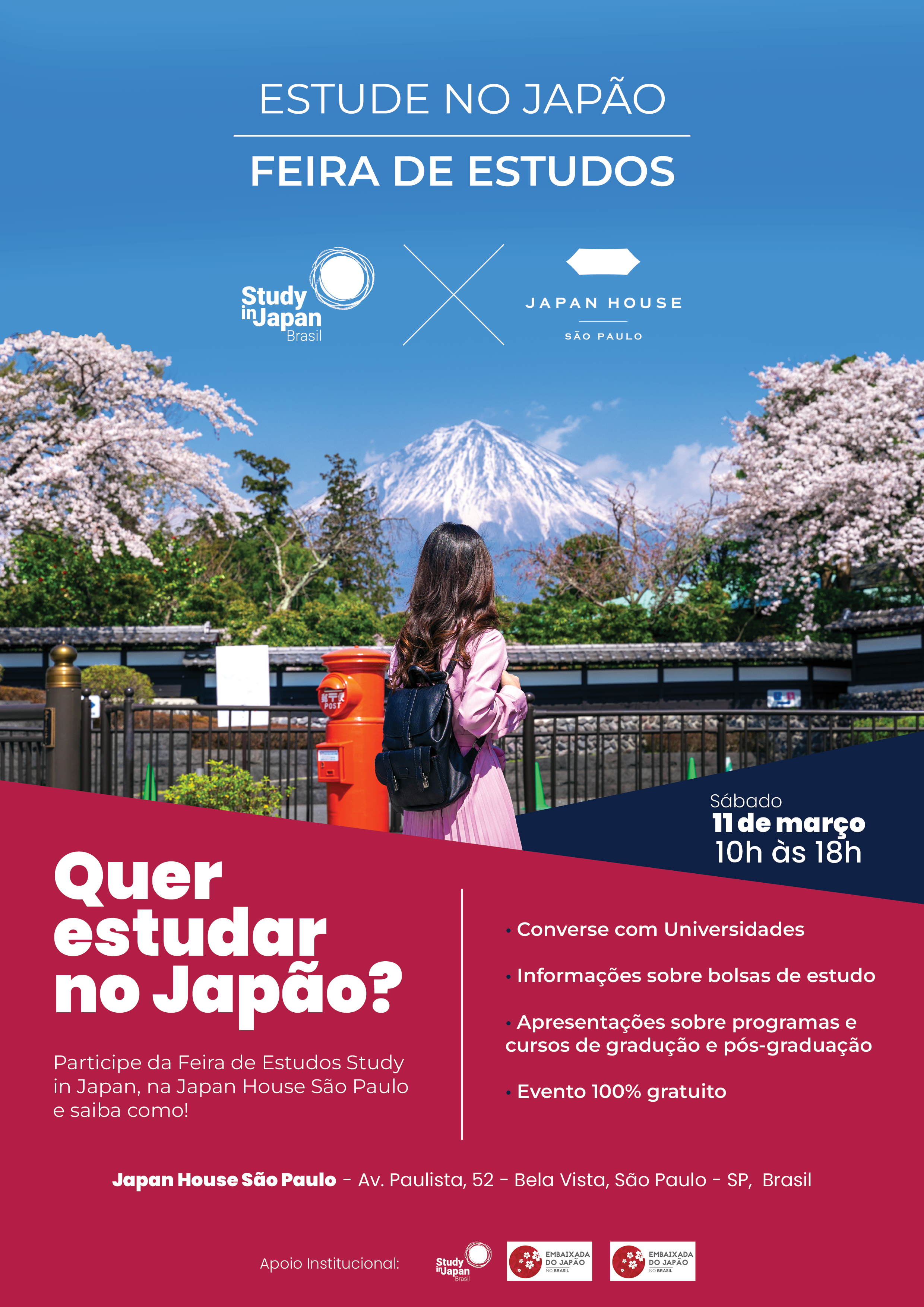
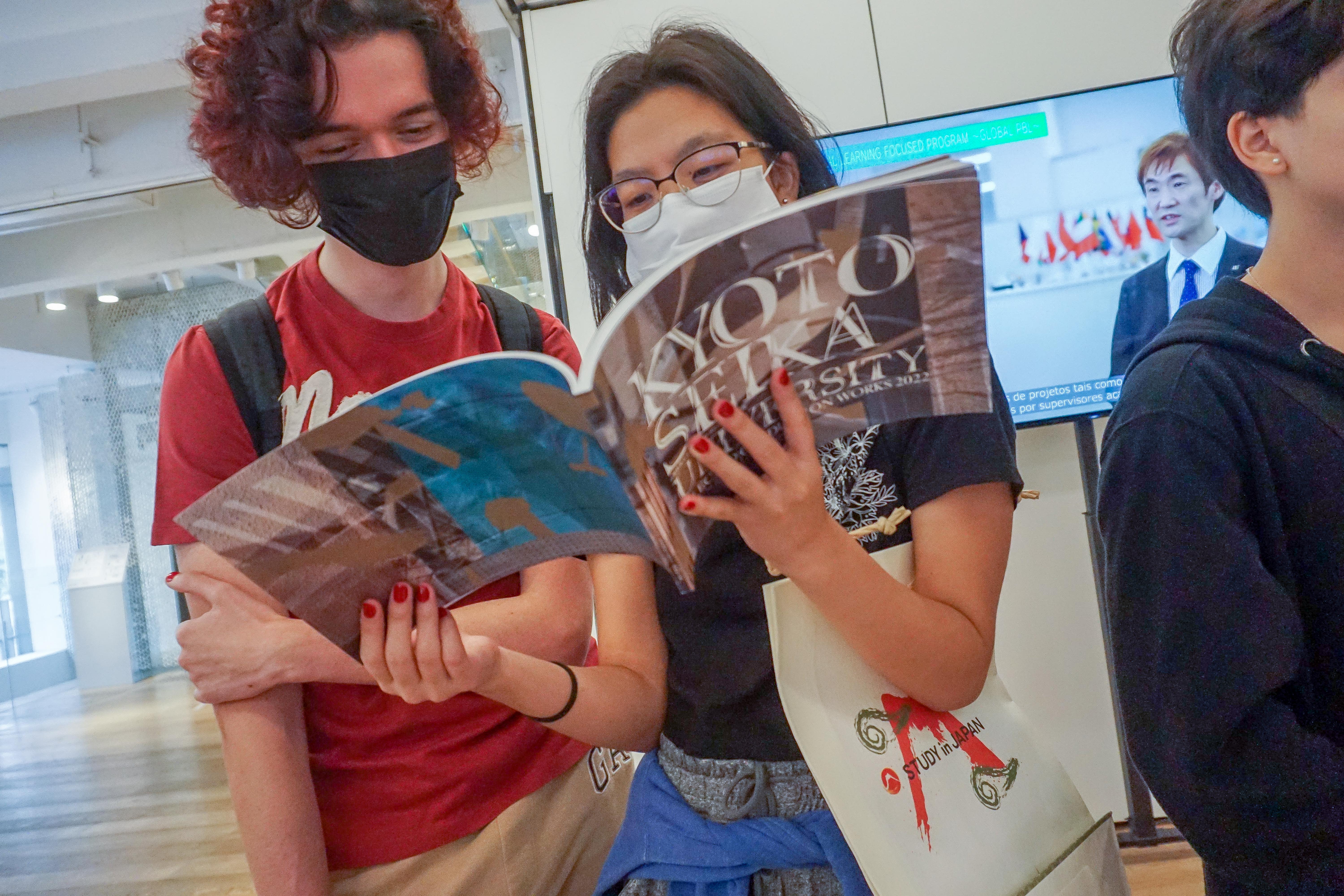
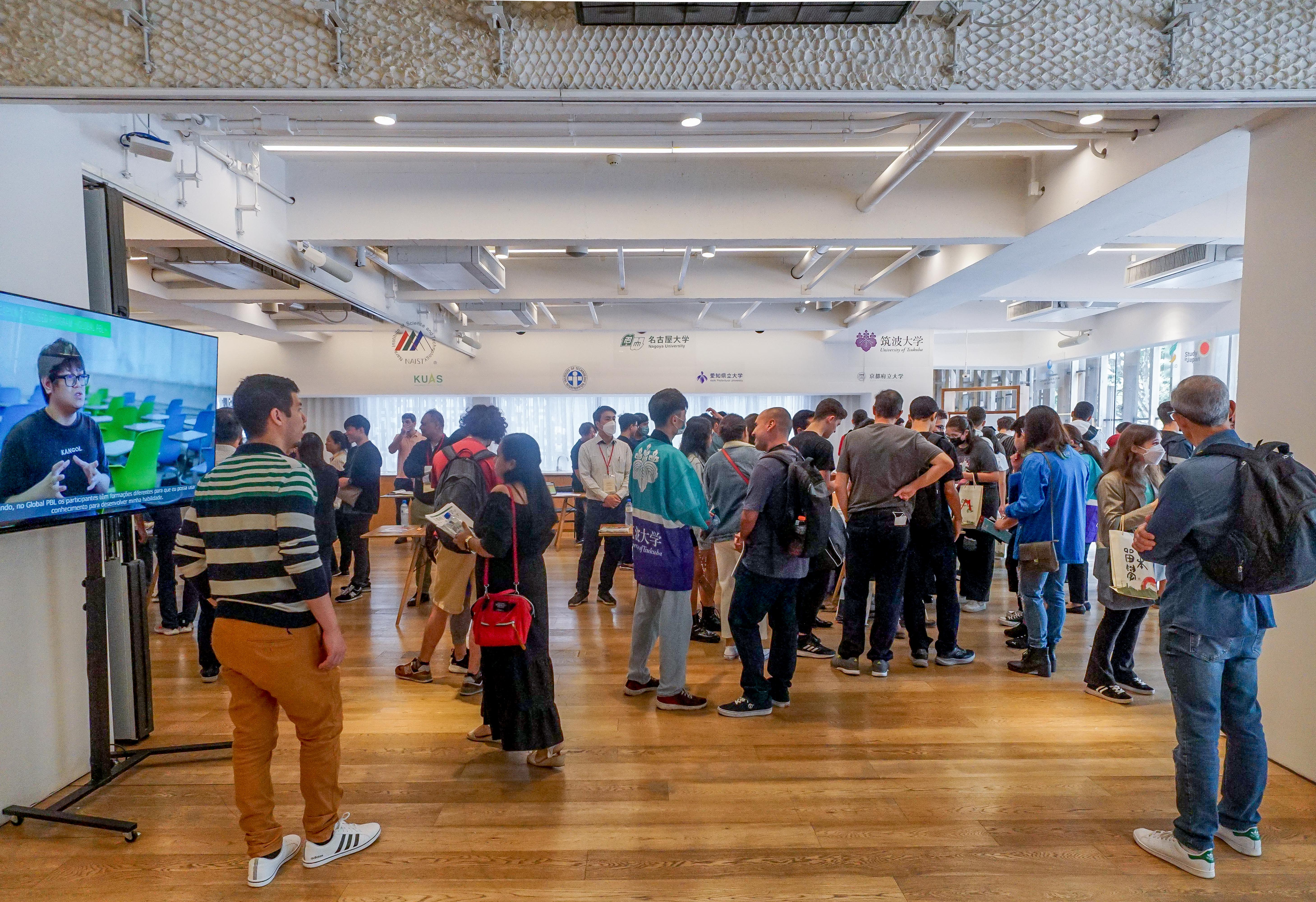
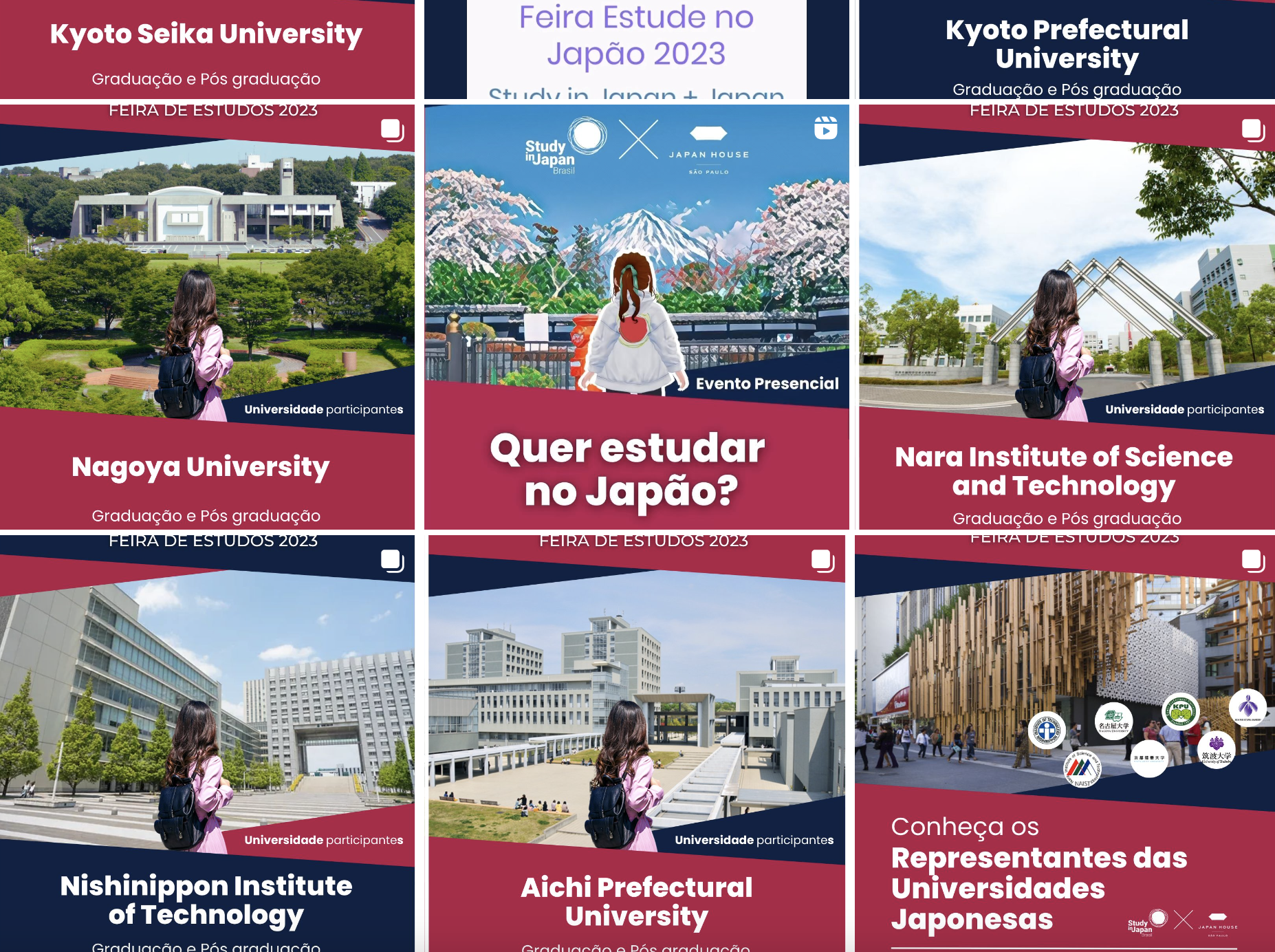
How to conduct Study Fairs after the Pandemic? In 2022 we have developed the first Hybrid Study in Japan Fair in collaboration with Japan-House São Paulo. with More than 10 institutes coming from Japan, the one-day fair gathered more than 1300 attendees and 1600 online viewers from all over Brazil, breaking records for Japan House and Study in Japan.
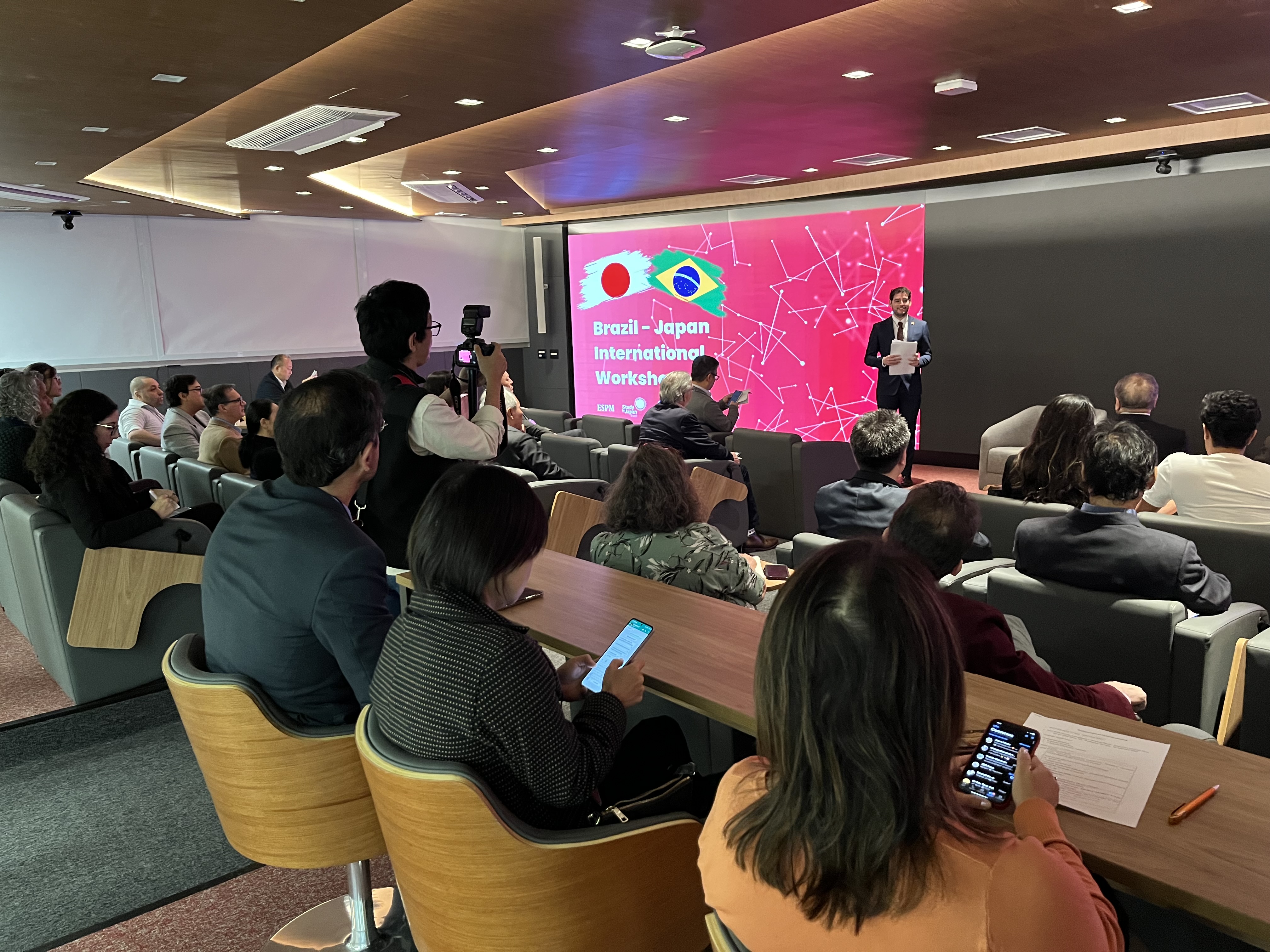
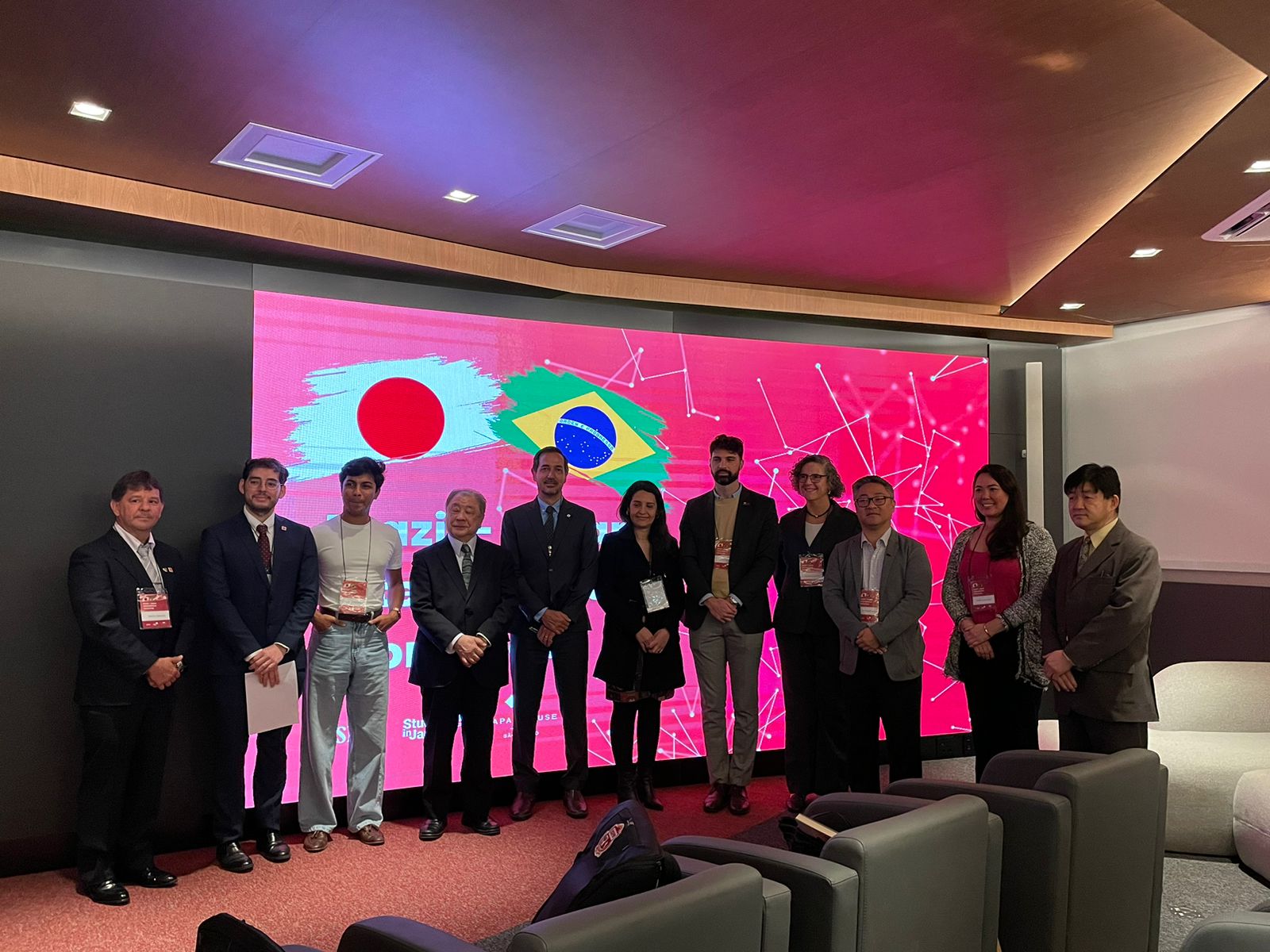
Brazil-Japan Internationalization Workshop
Date: July 2023
Venue: ESPM – SP, Brazil
Roles: Concept, Organization, and Design
Highlight: Cooperation Matchmaking event with over 20 institutes
About
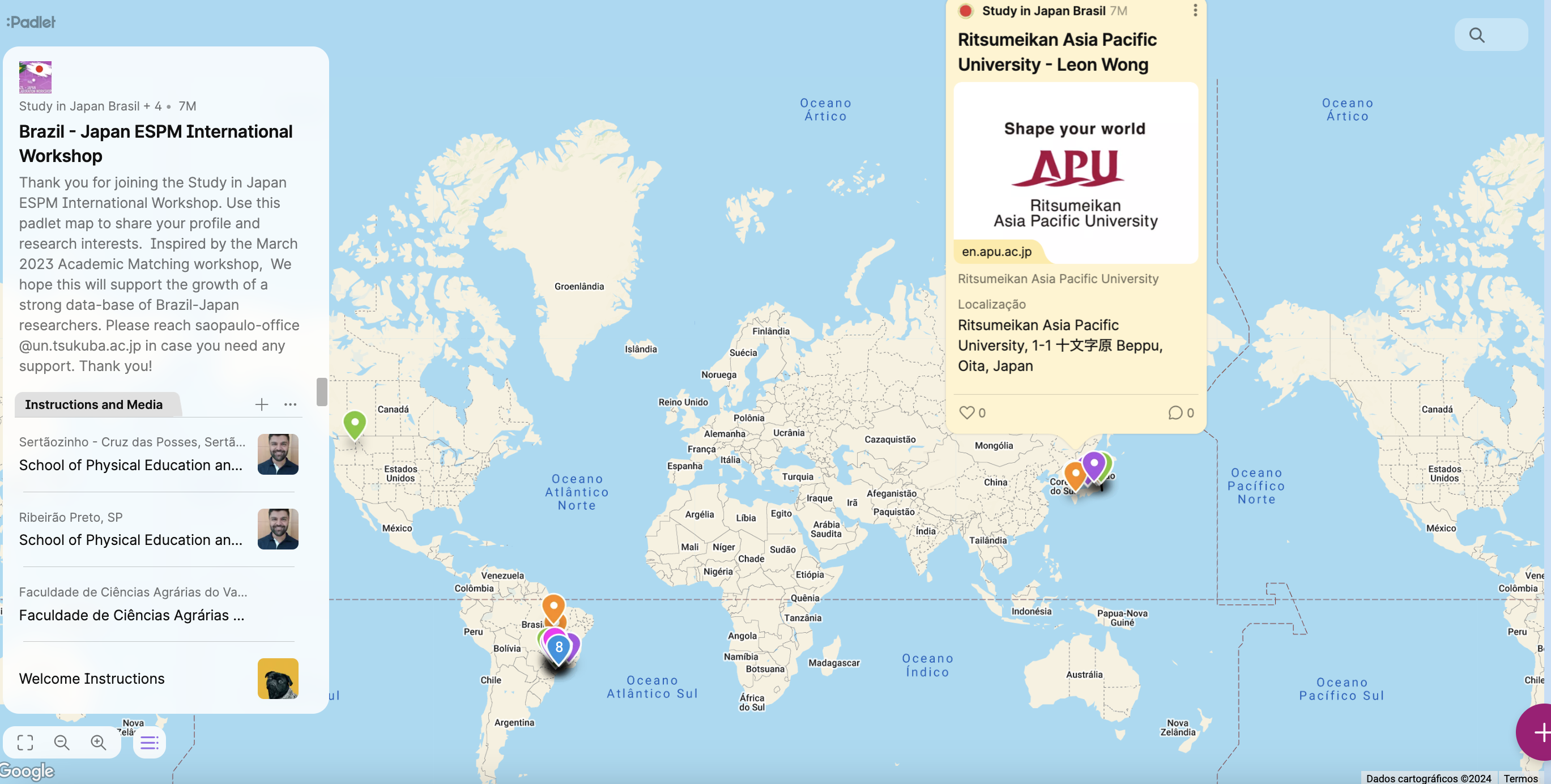
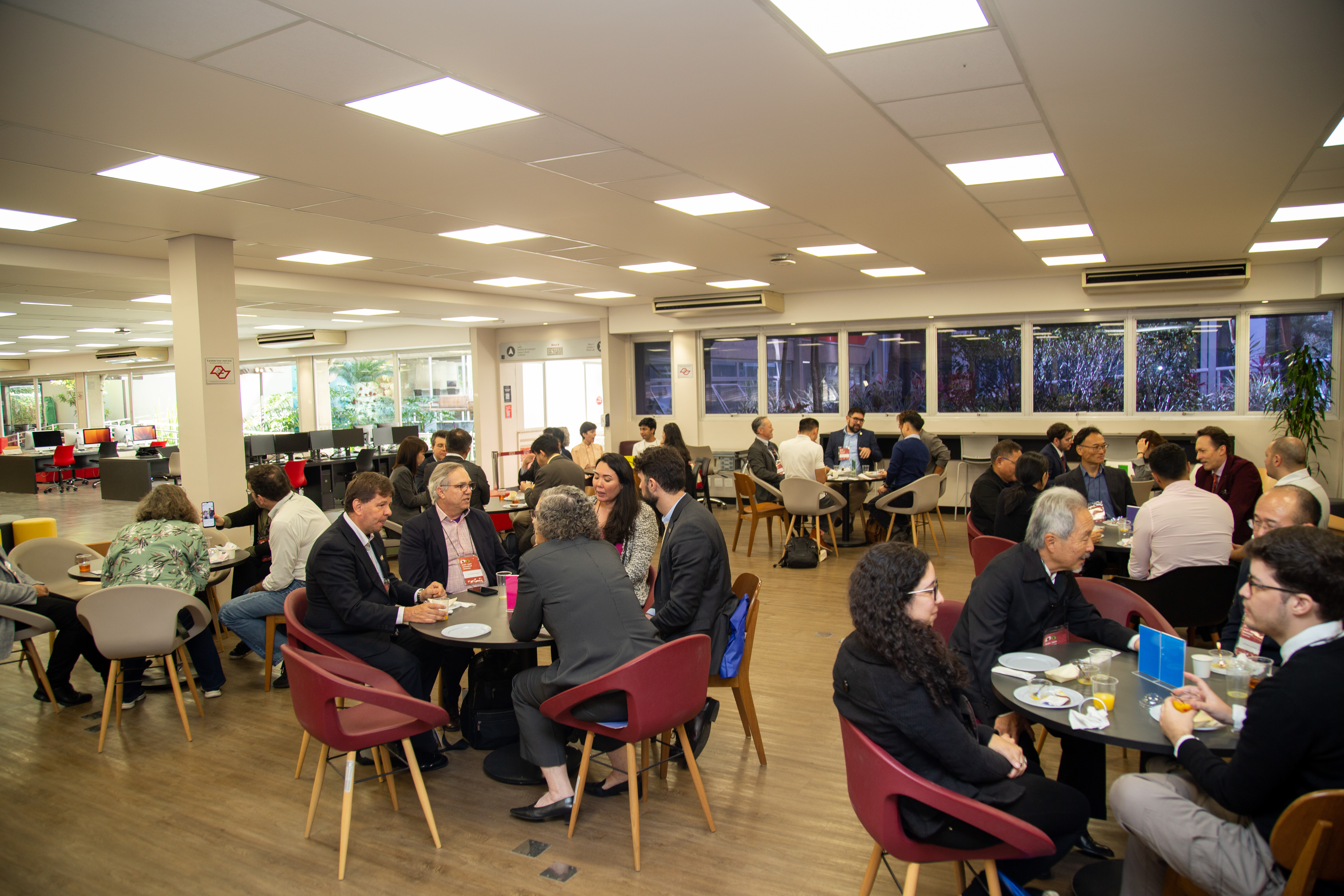
Following the Japan House Brazil-Japan Academic Workshop, a new experience was created at Brazil for promoting cooperative activities. During the morning, over 20 institute presentations were made. They were followed by a matchmaking cocktail party event, where Brazilian and Japanese representatives rotated table to discuss their initiatives


Study in Japan Virtual Fair
Date: 2020-2024
Venue: Online
Roles: Concept, Organization, and Design
Highlight: Largest Virtual Study in Japan Global Network Fair led to 50% increase in the region recruitment.
About
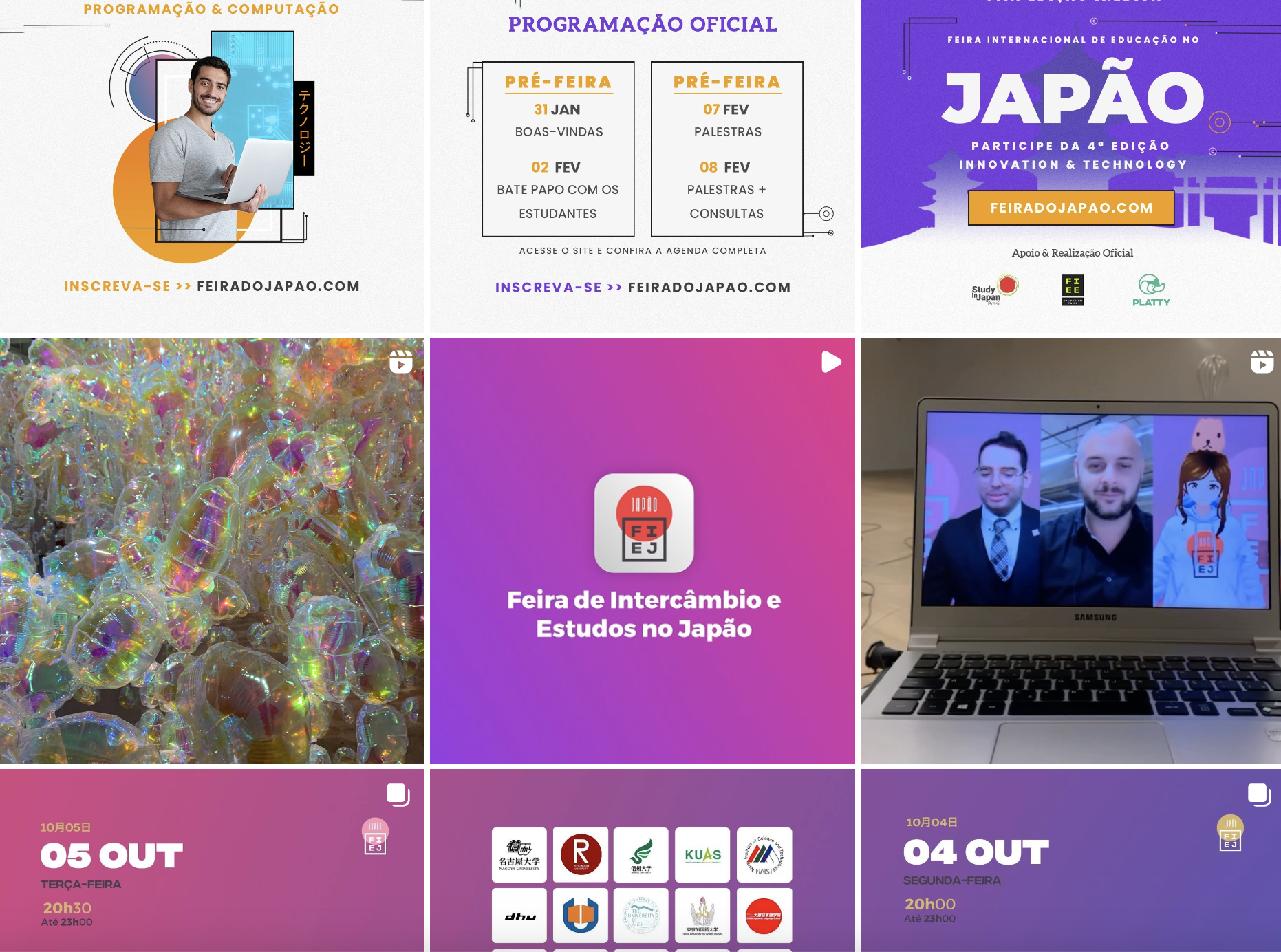
The Covid-19 pandemic led to many challenges regarding international student recruitment. Amid a forced digitalization, there was also a fatigue for interactions through software such as Zoom. Through a complete Experience redesign, a unique digital fair was created, which had the participation of over 50 institutions from Japan, 50 students, educators, and influencers. The fair was a large success attracting international attention and raising the bar on student recruitment methods.



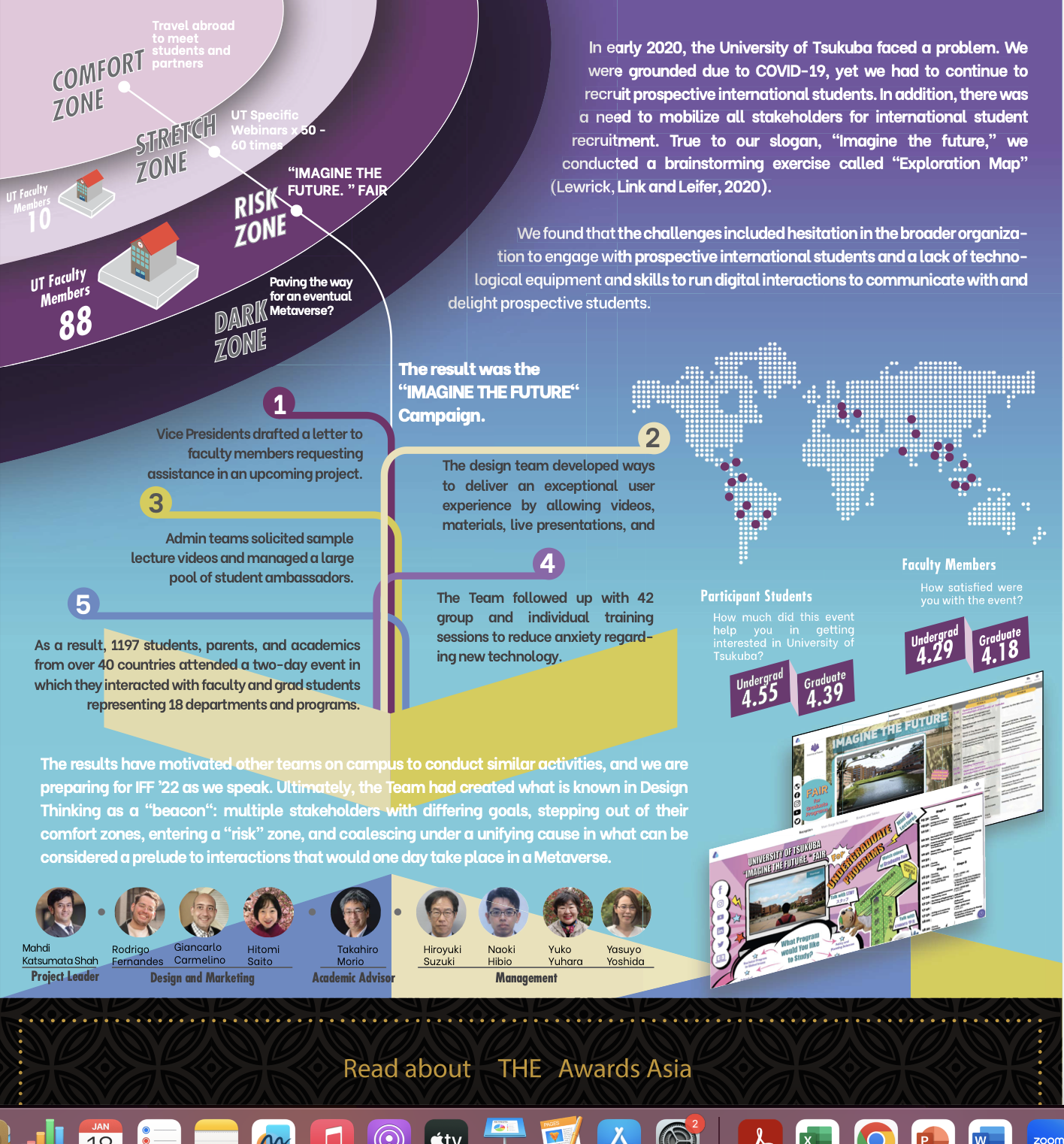
Imagine the Future Fair – IFF Tsukuba
Date: 2021/2022
Venue: Online
Roles: Concept, Organization, and Design
Highlight: Shortlist Times Higher Education Best Student Recruitment Campaign 2022
About
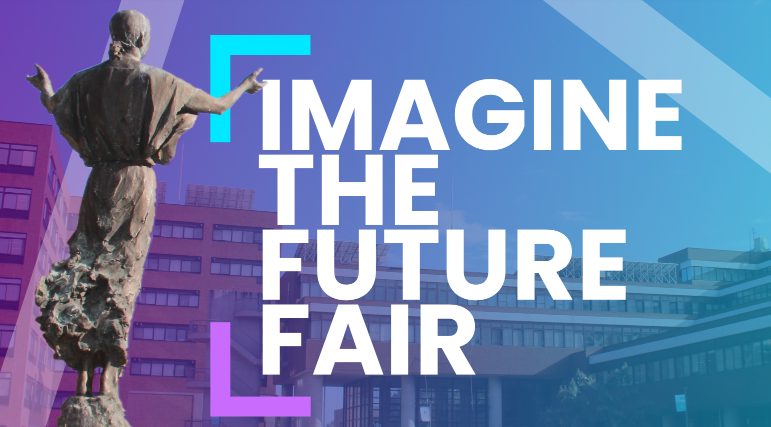
In early 2020, the University of Tsukuba faced a problem. We were grounded due to COVID-19, yet we had to continue to recruit prospective international students. In addition, there was a need to mobilize all different departments of universities. The Imagine the Future fair came as a novel study fair that integrated more than 40 university departments in order to pass information to students from all over the world. More than 4,000 students joined IFF.
More Interactions
TEX 2019 International Workshop
Date: Sept 2019
Venue: Shiojiri City Hall, Nagano, Japan
Roles: Concept, Team Leadership
Highlight: Novel Project to promote Shiojiri Lacquerware
About
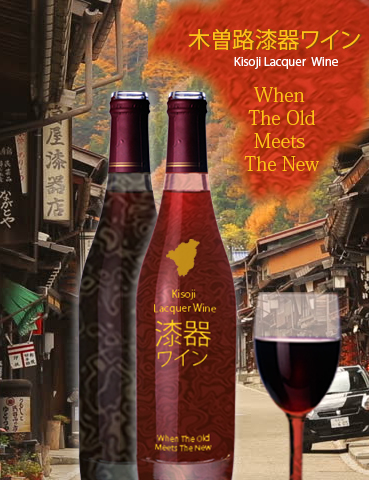
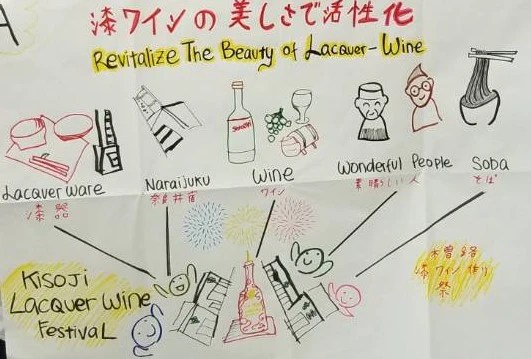
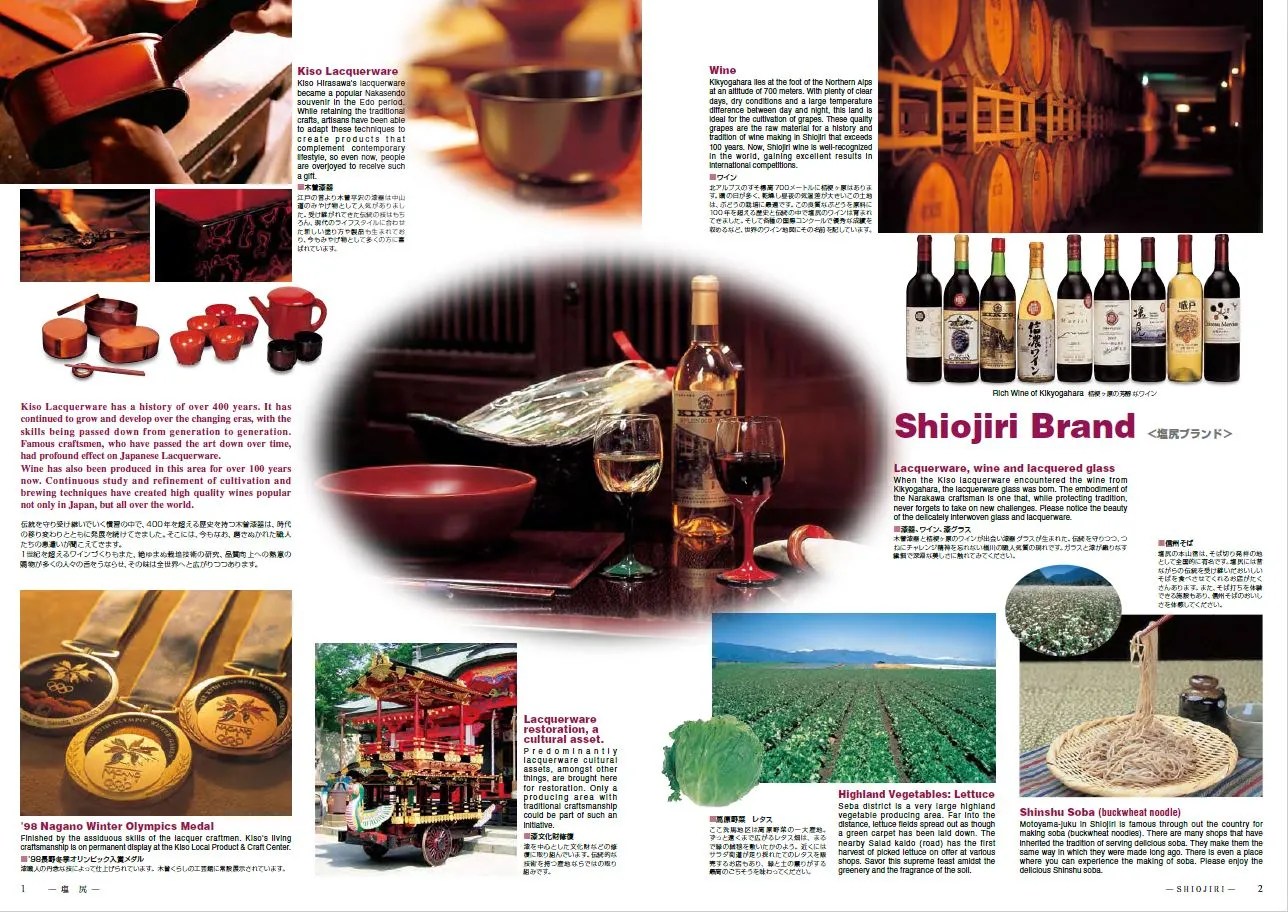
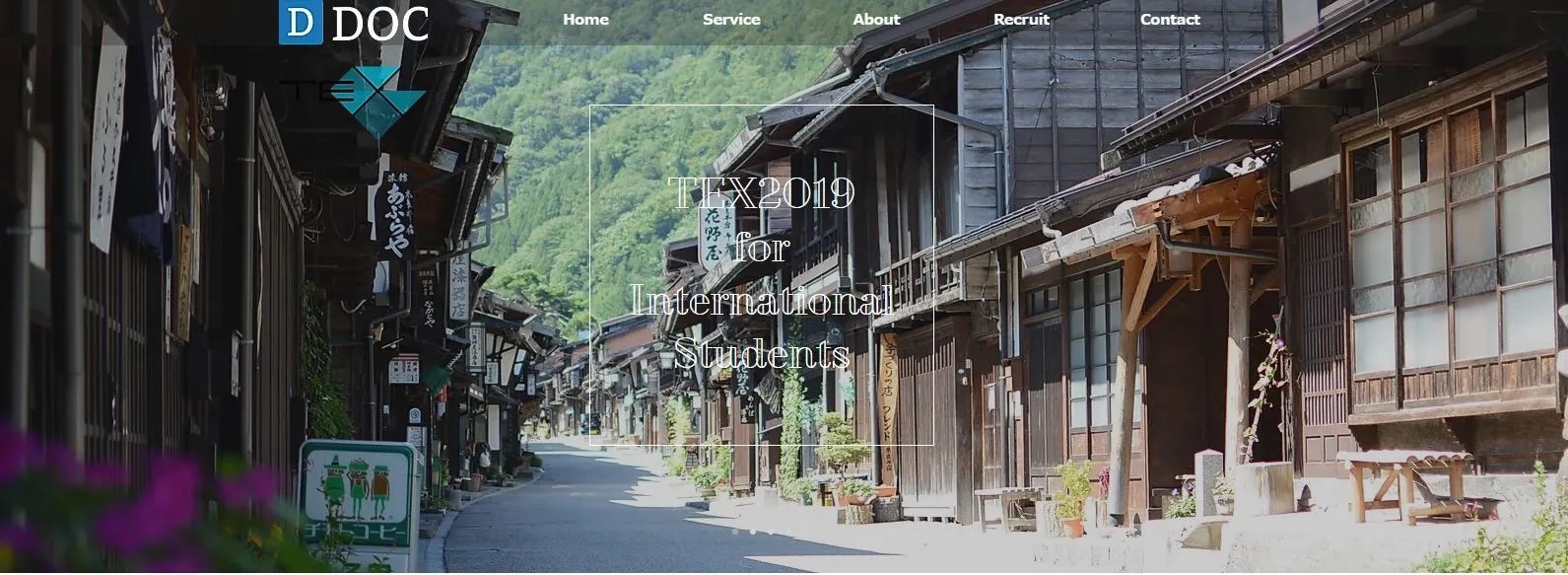
Camp Experience Workshop for International Students and Japanese Companies. The goal of this experience was for foreigners and Japanese to work together into revitalizing the image of Shiojiri City while promoting the well-being of its citizens and preserving their strong traditions. Our group worked by combining the two most recognized crafts of the city, Wine and Laquerware, into a unique product. We have also proposed a new unified LacquerWine Making Festival for attracting new audiences while preserving tradition. Looking forward to see how Shiojiri city will prosper.
Communiplay Children Play Workshop
Date: Oct 2017
Venue: Japan House – SP, Brazil
Roles: Concept, Organization, and Team Coordination
Highlight: International Workshop Japan and Brazil
About
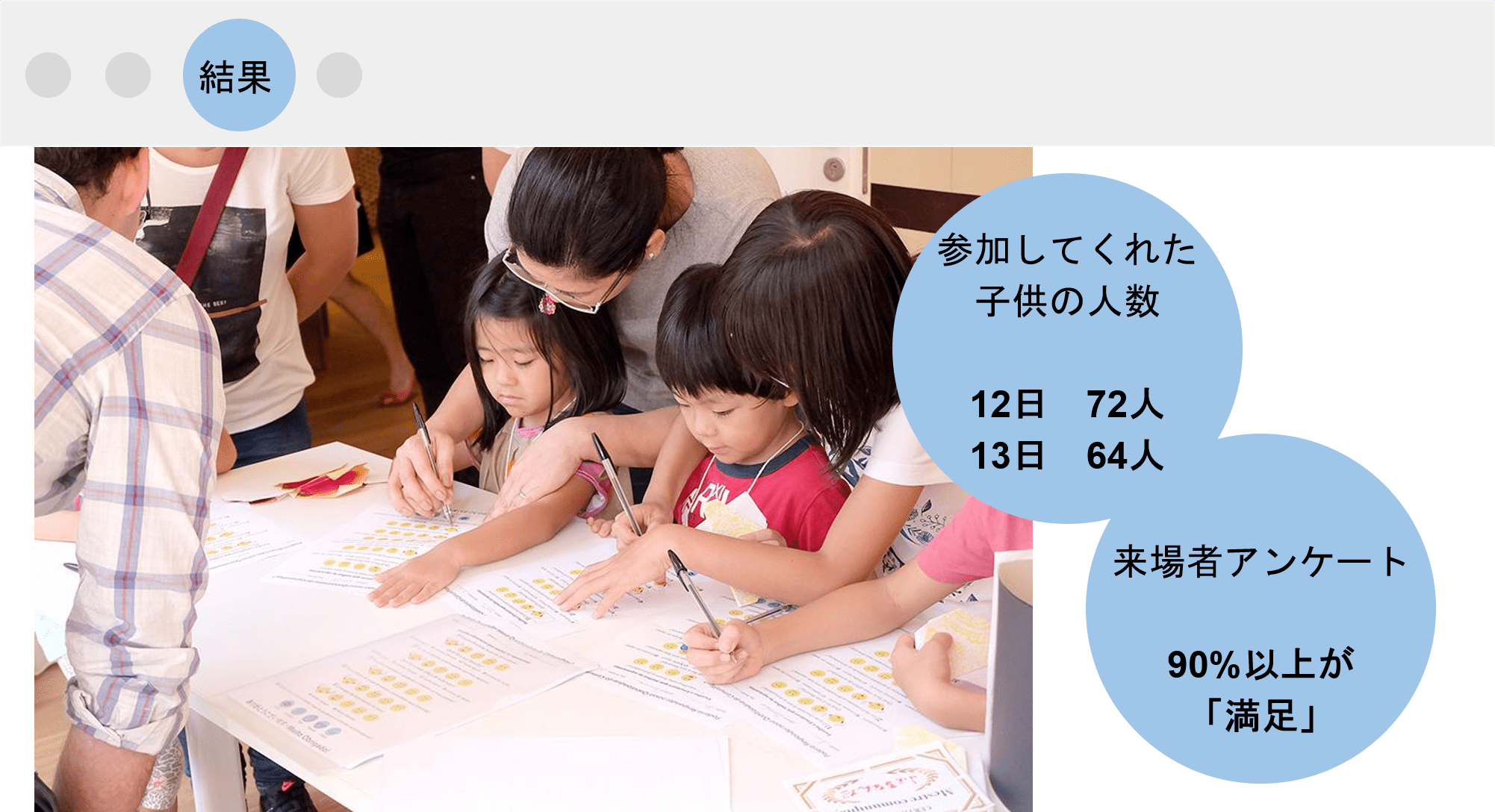
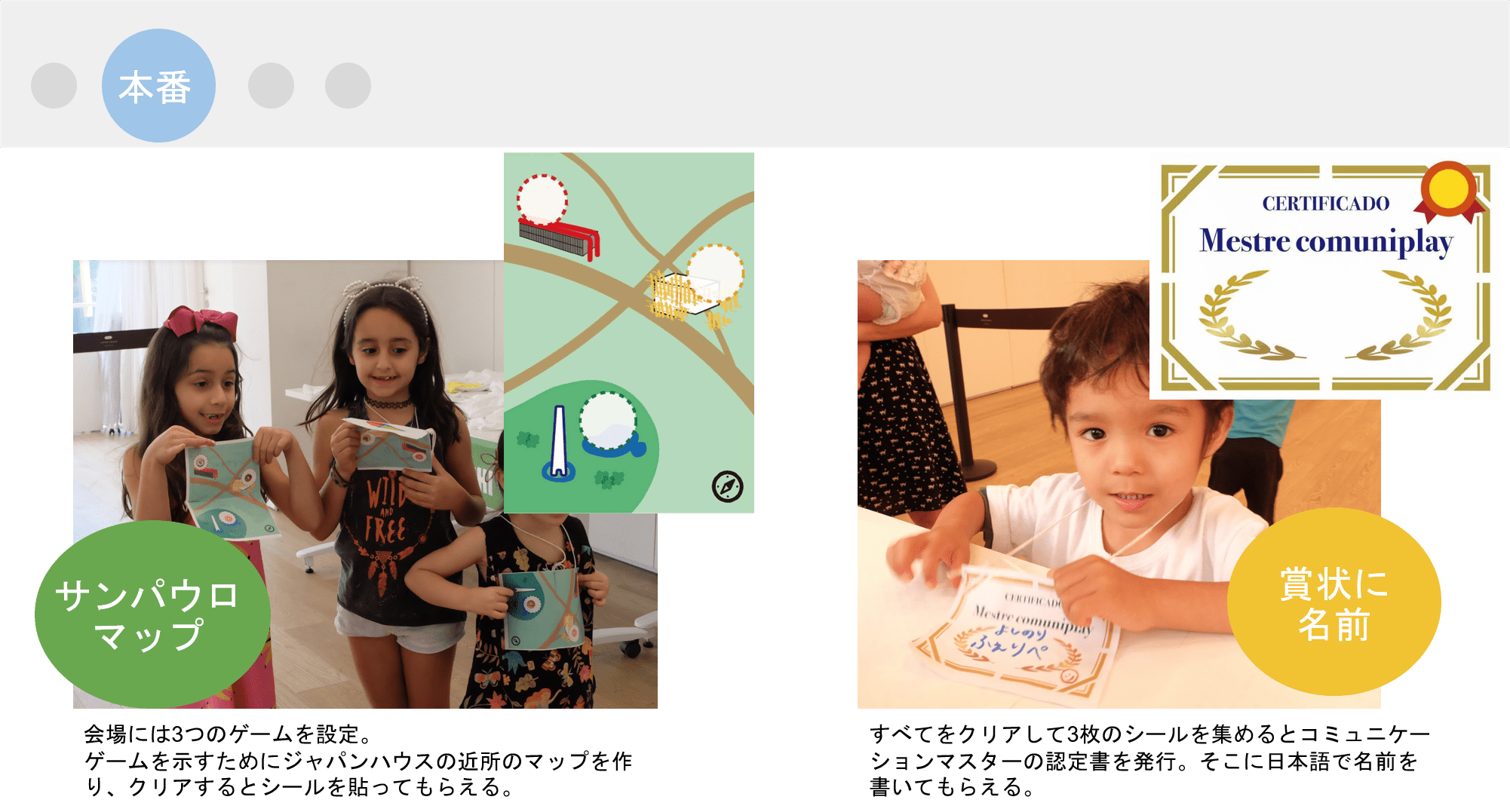
Interactive Exposition for the children’s Day about communication through play. Japanese students from University of Tsukuba developed unique play activities to overcome the language barrier and promote interactions with children. About 130 children joined the Workshop, with the event being considered a success and attracting the attention of Brazilian local media.
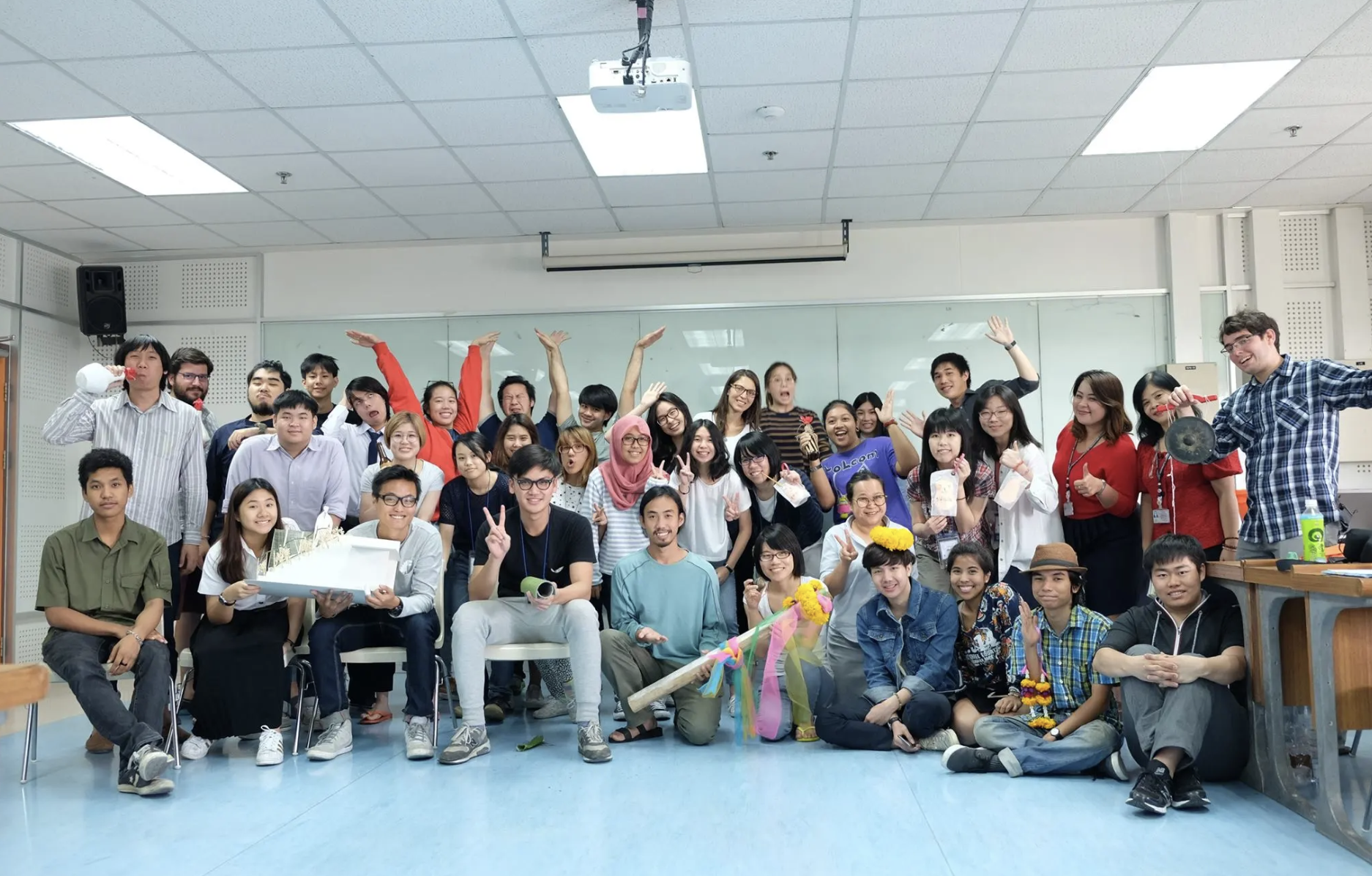

KMUTT x U.Tsukuba Kansei Design
Date: March 2016
Venue: KMUTT Thailand
Roles: Team Leader, Coordination, Guidance
Highlight: International Workshop Japan and Thailand
About
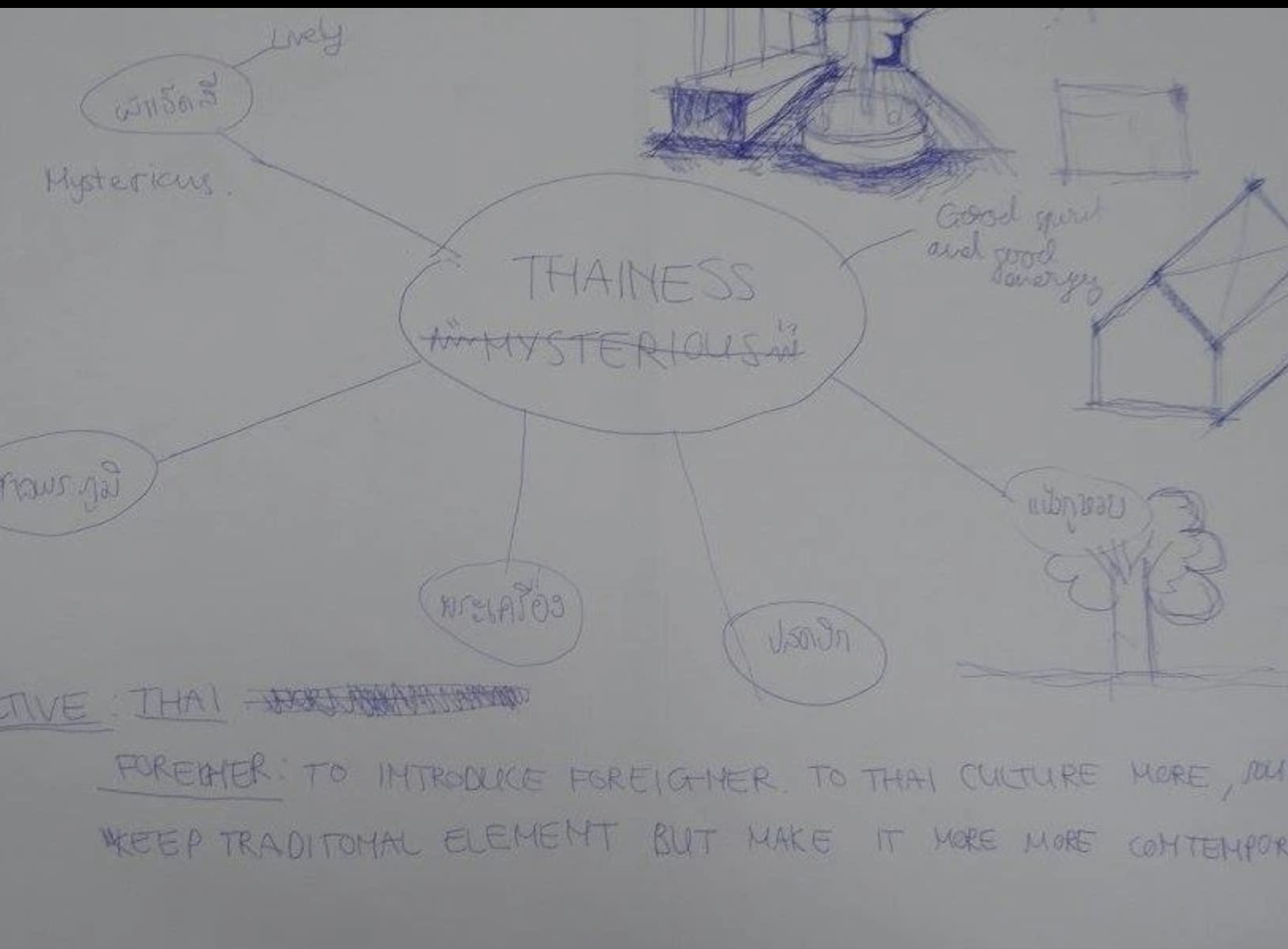
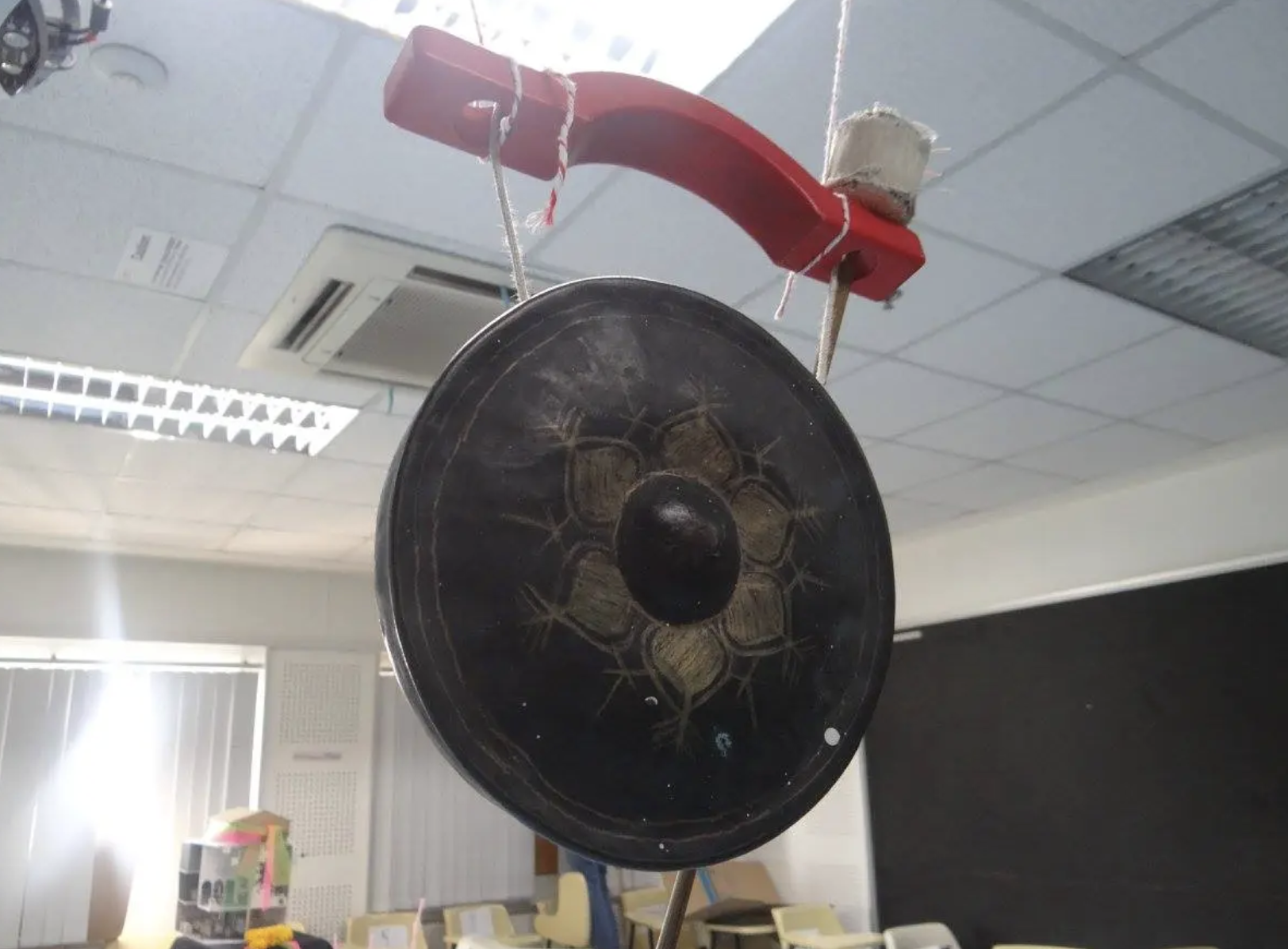
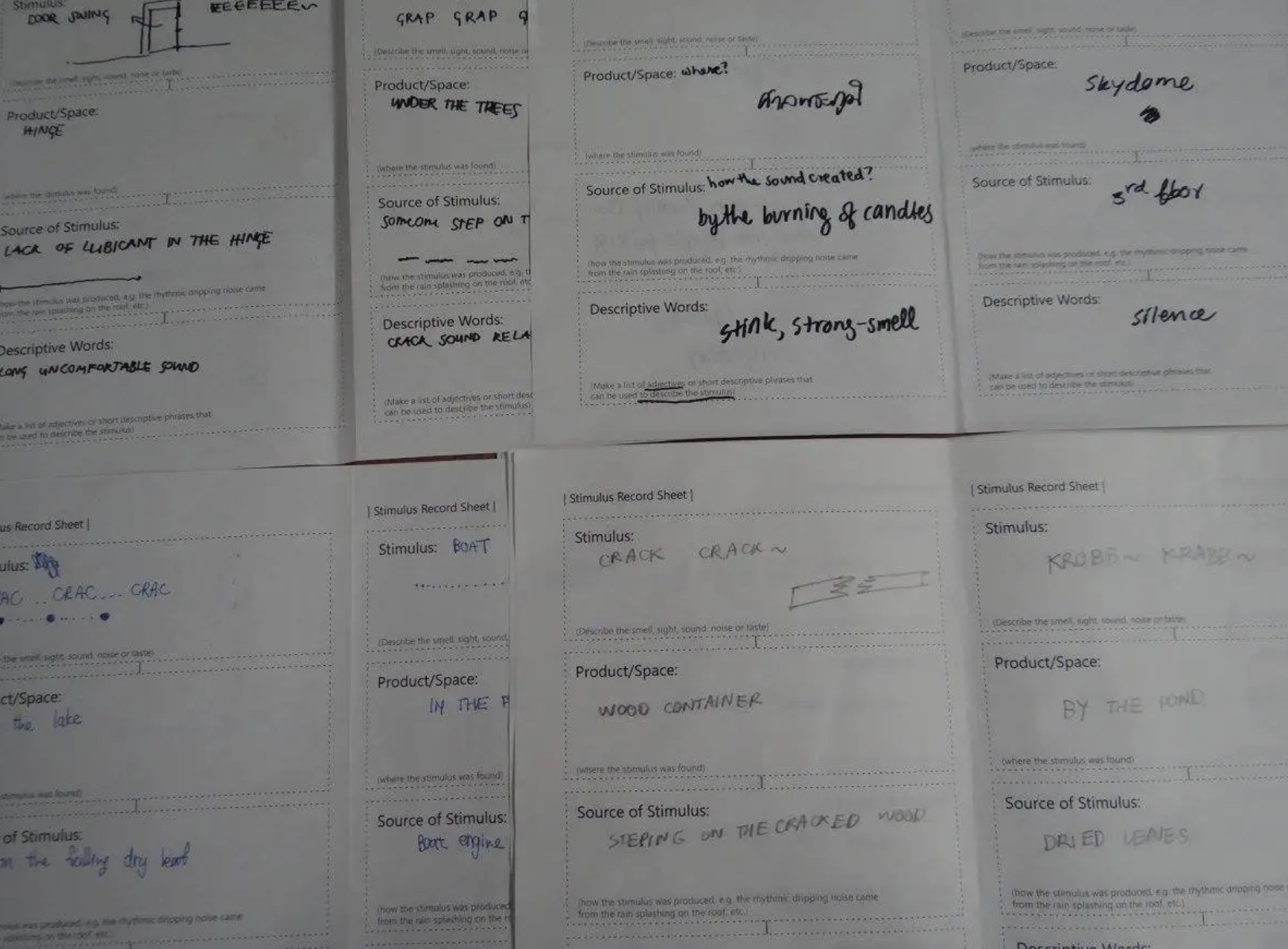
International Workshop developed by Graduate Students of University of Tsukuba for design students of the King Mongkut’s University of Technology Thonburi (KMUTT). The goal of the workshop was to aid students into designing sensory “identity” in product or architectural space using a combination of artistic and scientific approaches, such as the Semantic Differential analysis. The group which I coordinated developed a new Thai Amulet shop concept based on sound stimuli. The sounds would initially generate a feeling of mystery to evolve into a sense of comfort/serenity as people walk in.
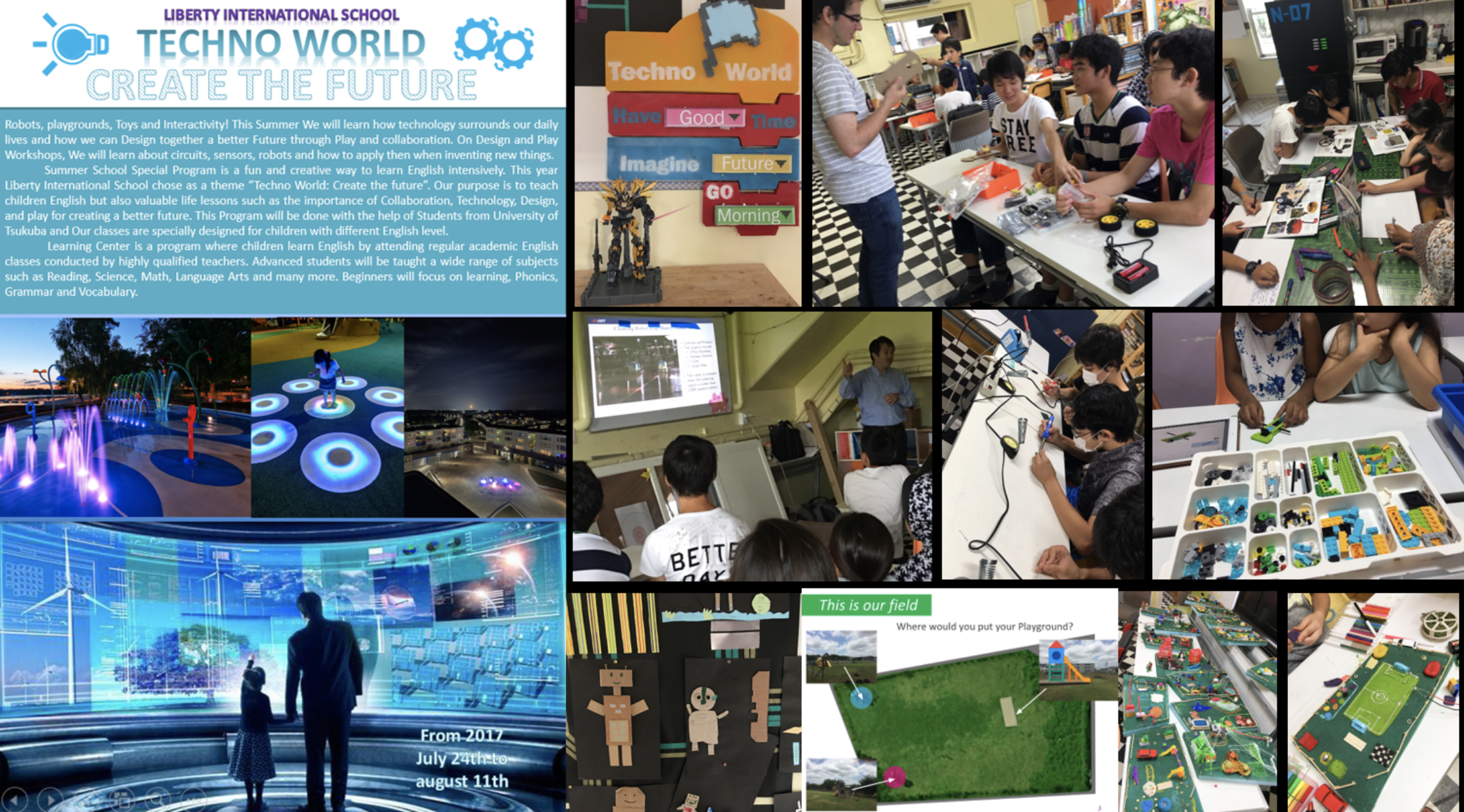
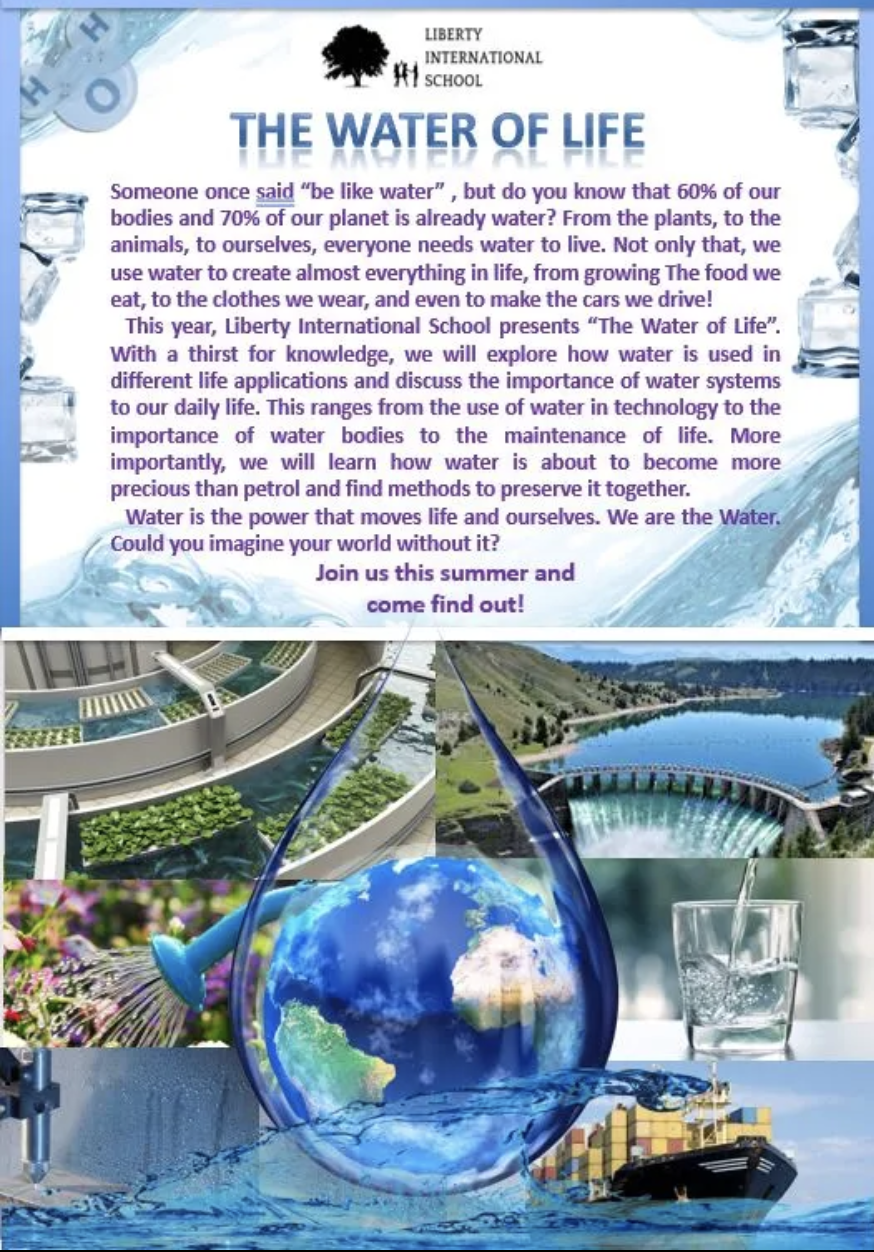

Summer Science Camps
Date: 2016-2019
Venue: Tsukuba, Japan
Roles: Concept, Organization, and Team Coordination
Highlight: International Workshop Japan and Brazil
About
Interactive Exposition for the children’s Day about communication through play. Japanese students from University of Tsukuba developed unique play activities to overcome the language barrier and promote interactions with children. About 130 children joined the Workshop, with the event being considered a success and attracting the attention of Brazilian local media.
UX Design
Graphic, Product and Experience Design projects

Study in Japan Festival Booth Designs
Date: July 2023
Venue: Japan Festival, Anime FriendsBrazil
Roles: Design
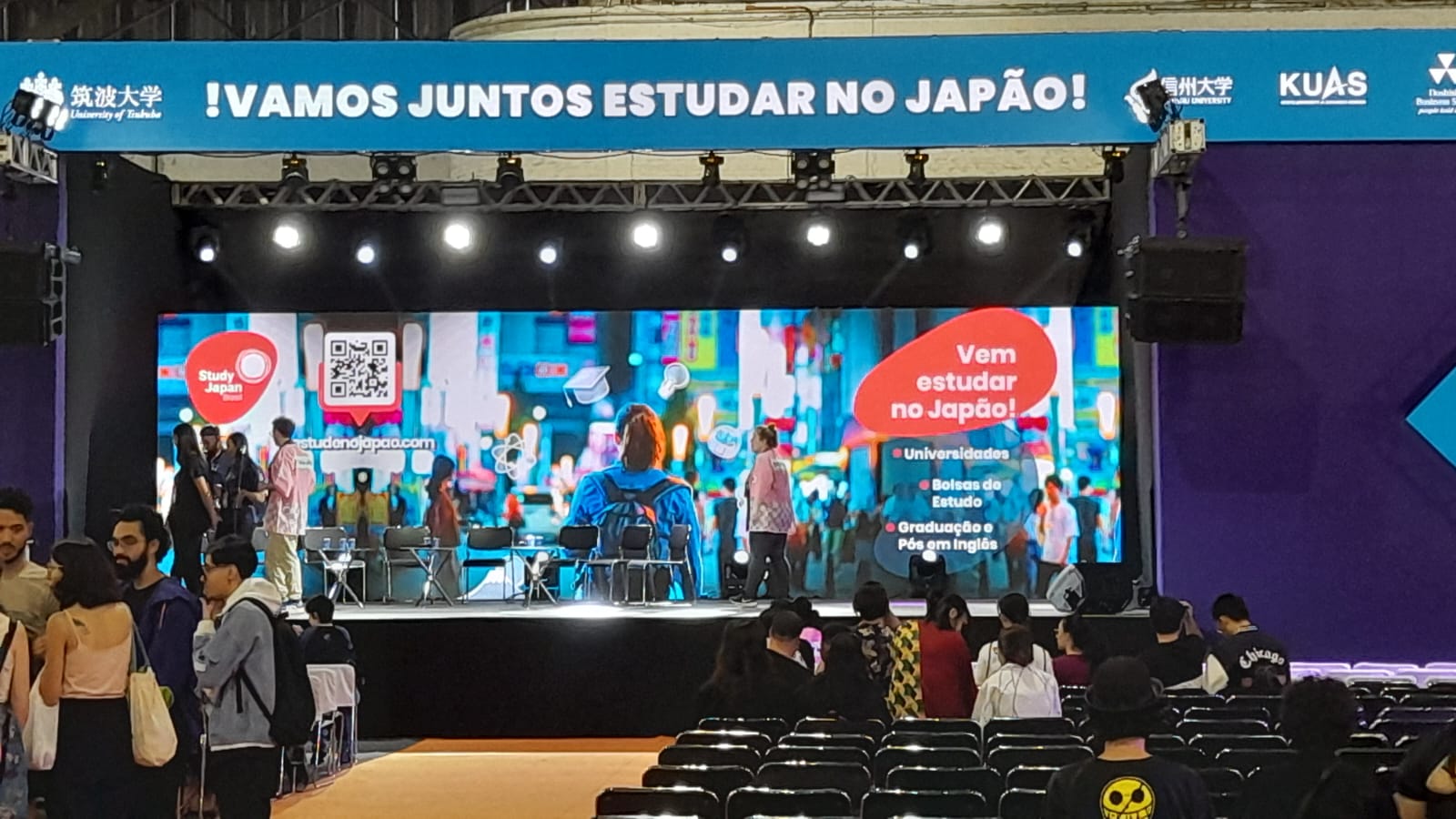
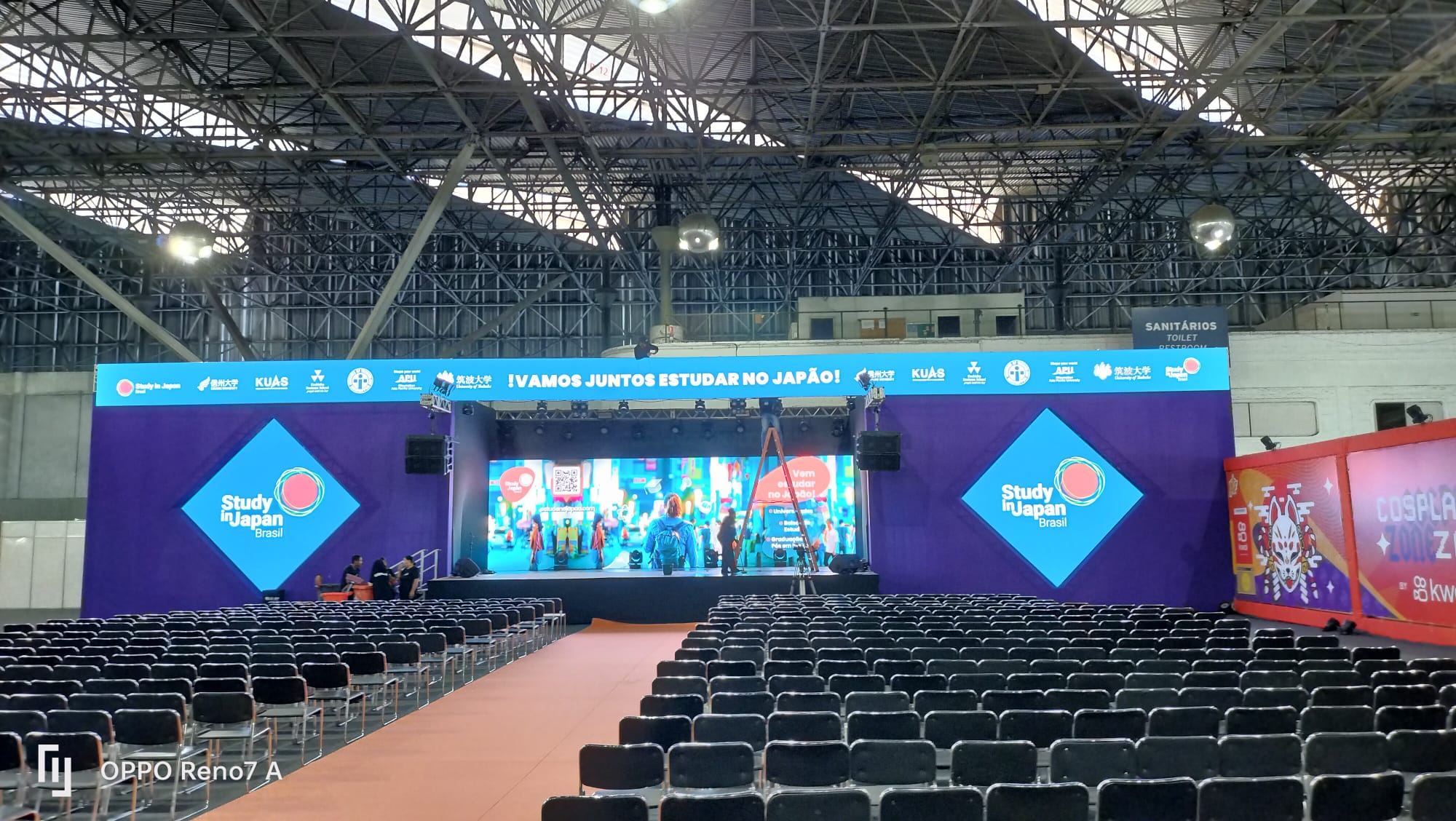
Highlight: Over 3,000 visitors to booth. Studio Like production setting for 500 watchers
About
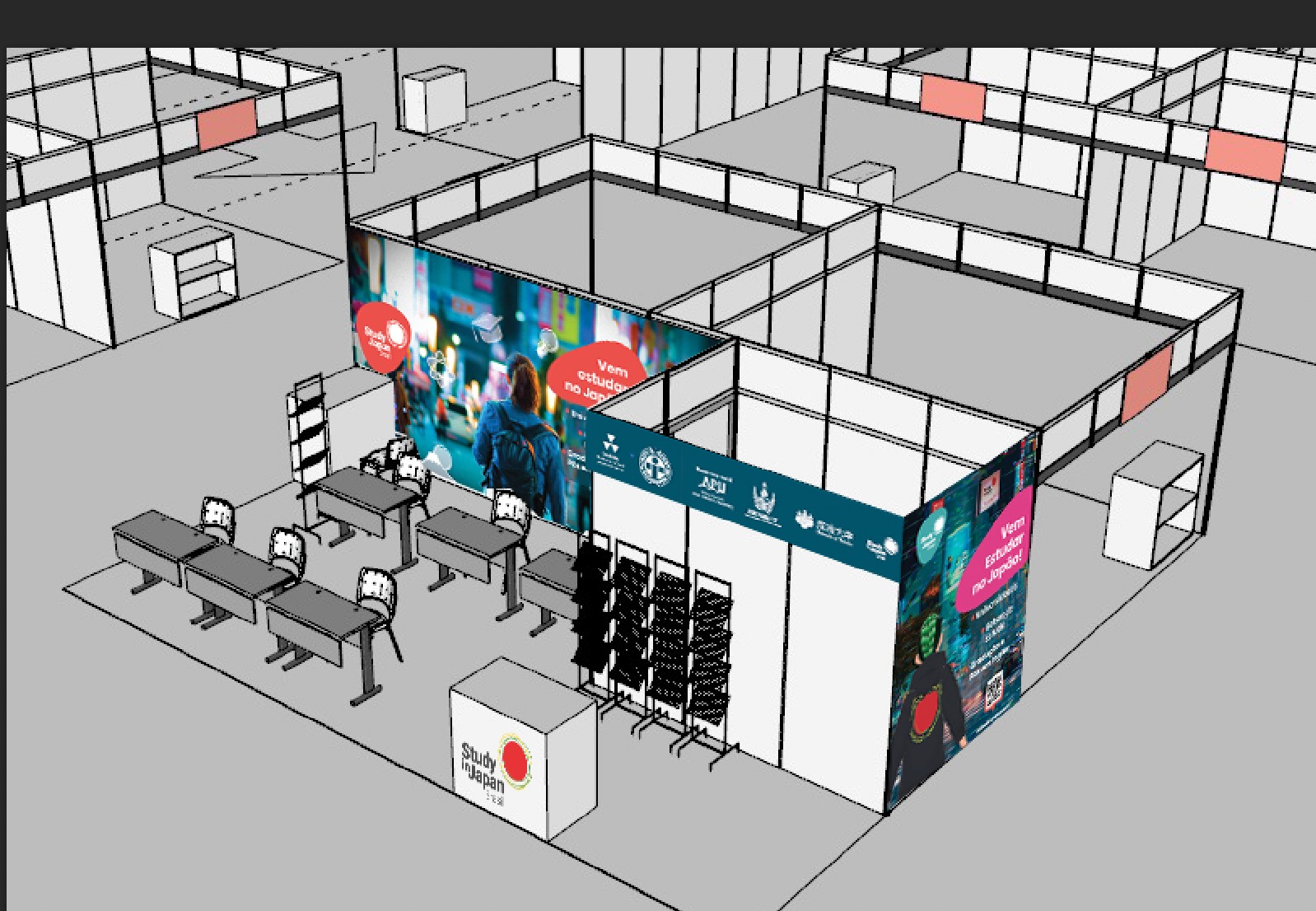
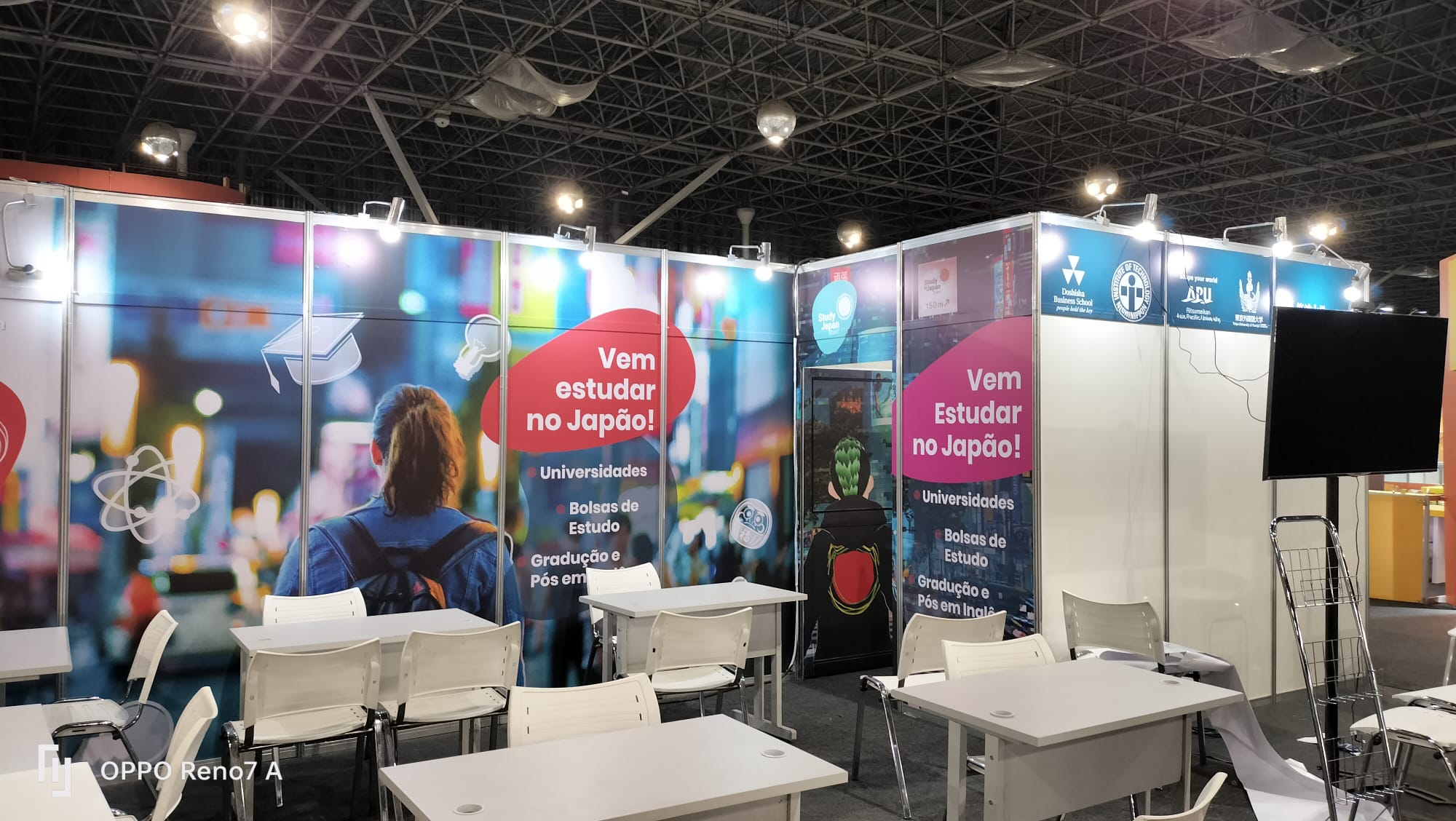
Design of booths and concert area for promoting studying in Japan at Japanese Traditional and pop-culture festivals. In Japan festival we have went with a more traditional image of Japan, highlighting red and Mt. Fuji. At Anime friends festival we used a more contemporary pop image of Japan, highlight tones and blue and city-like urban elements

Study in Japan Brasil and South America Brand
Date: January 2021
Roles: Co-Design with Agatha Rj
Highlight: Unique Logo concept of south-americas and Japan ties
About
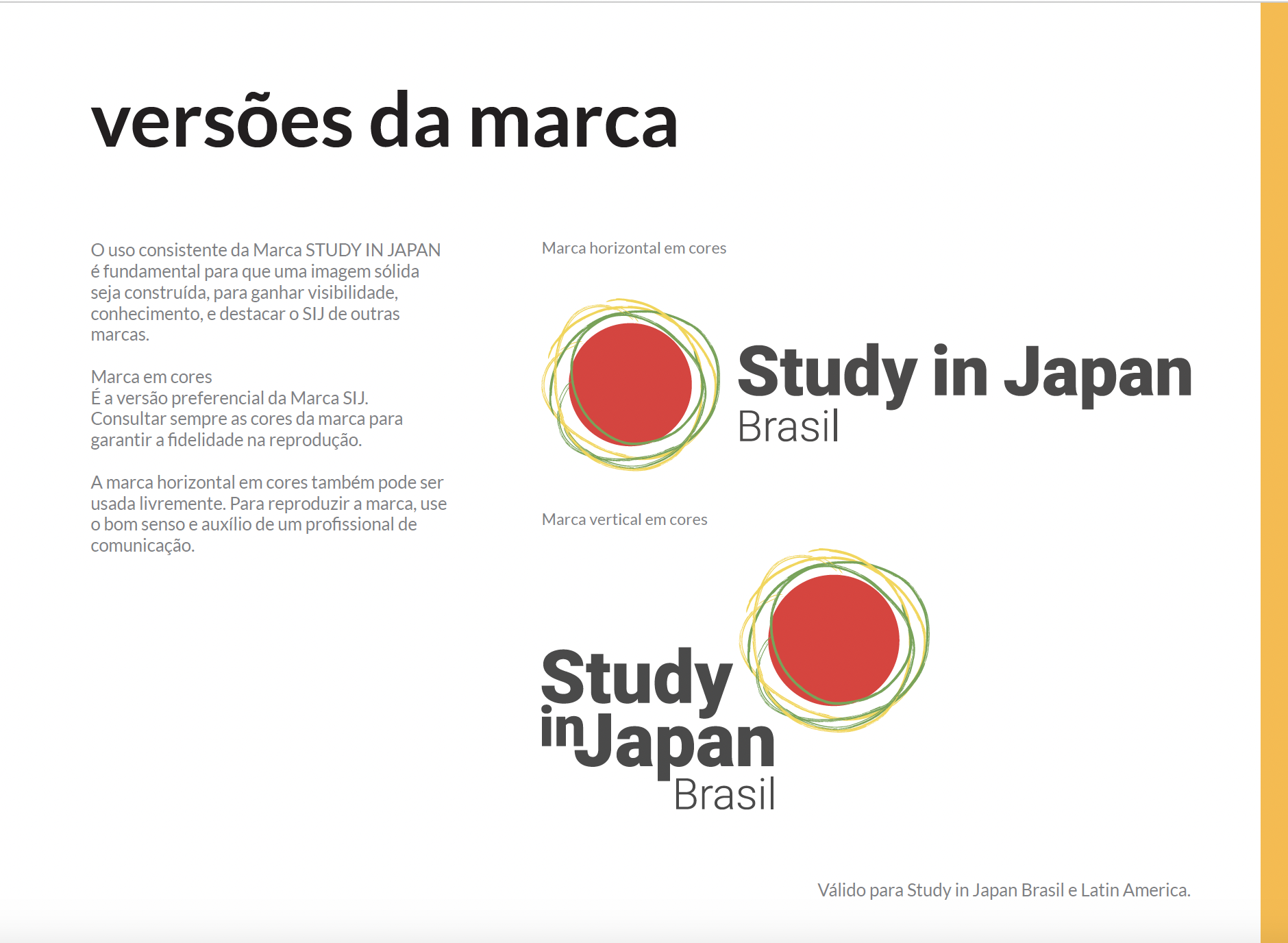
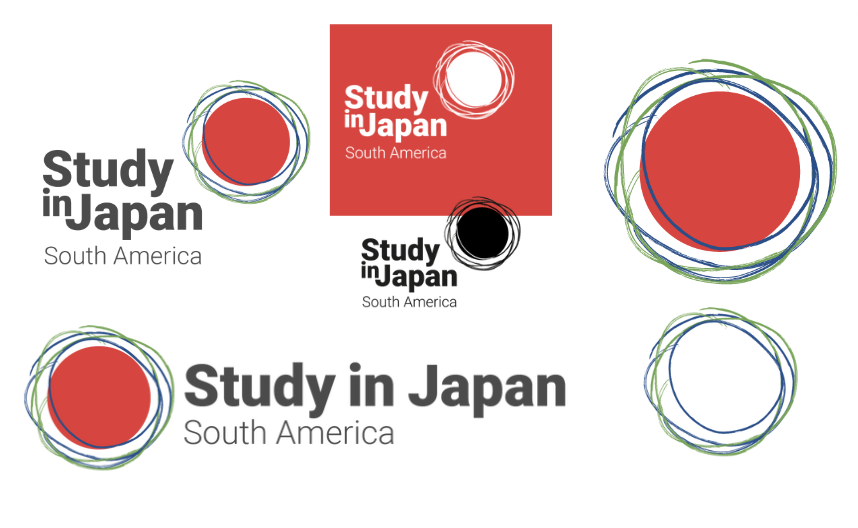
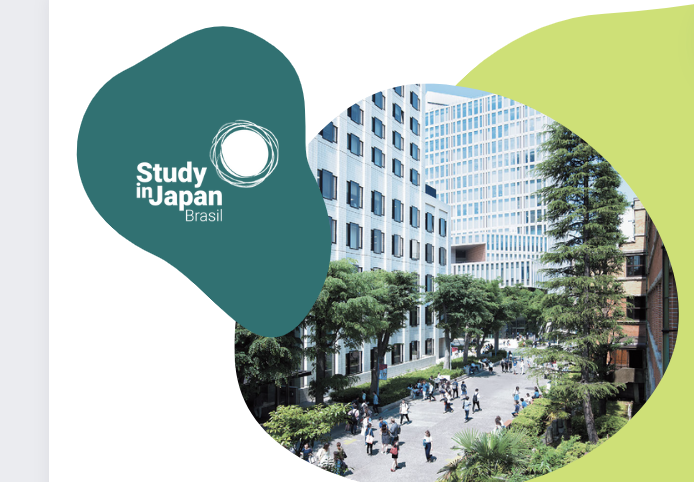
Logo Project initiated in 2020 and concluded in 2021 with partnership of the designer Agatha RJ. Each Study in Japan Regional Devision needed their own brand, with usually the Mt Fuji being used to represent so.
However, a different concept was found more appropriate for South America. The new logo is composed of rings, that connect Japan and South America on their common roots. Colors represent Japan, Brazil, and Mercosul, with the logo being adaptable according to the target region.
Like this logo, Study in Japan will support the connection of talented students with the Japan’s Top Institutions.



Capi and Paca Vtuber Counselors
Date: February 2021
Roles: Concept, Design
Highlight: First Vtuber Study Counselor
About
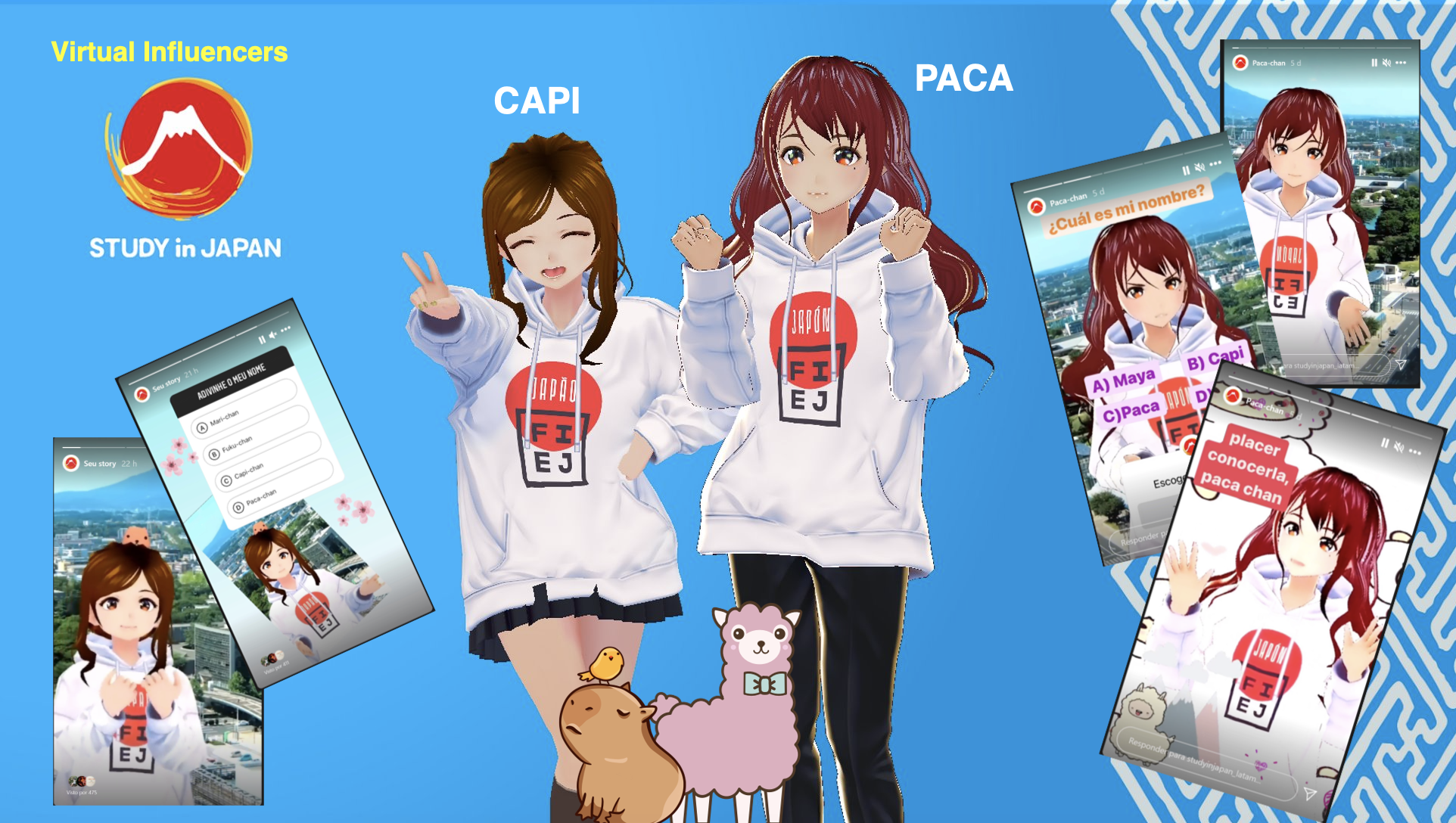
When Recruiting students, most schools in Japan rely on veteran staff and professores. However, our research pointed that young students do not feel confident to talk with experienced professors and may feel intimidated with recruiters.
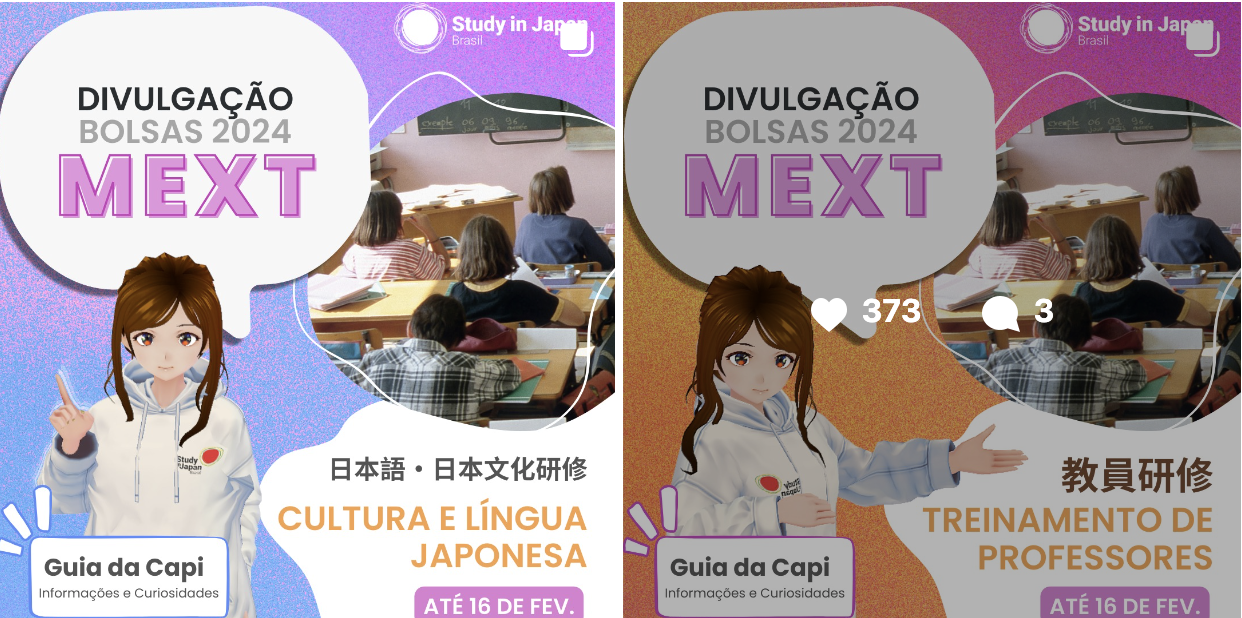
The VTubers Capi and Paca came as a solution to this issue. with an anime-like figure, they represent a typical student in Japan, being easier and more fun to talk. With elements from Brazil and South America
Capi and Paca have been supporting study in Japan for the last three years, joining livestreams, interviews, and recently, with the help of technology, doing live consultations onsite!



Study in Japan SA Web and SNS
Date: 2020-p
Roles: Webdesign, copywriting, content
Highlight: 100,000 added followers 200,000+ monthly Site visits and SNS reach
About
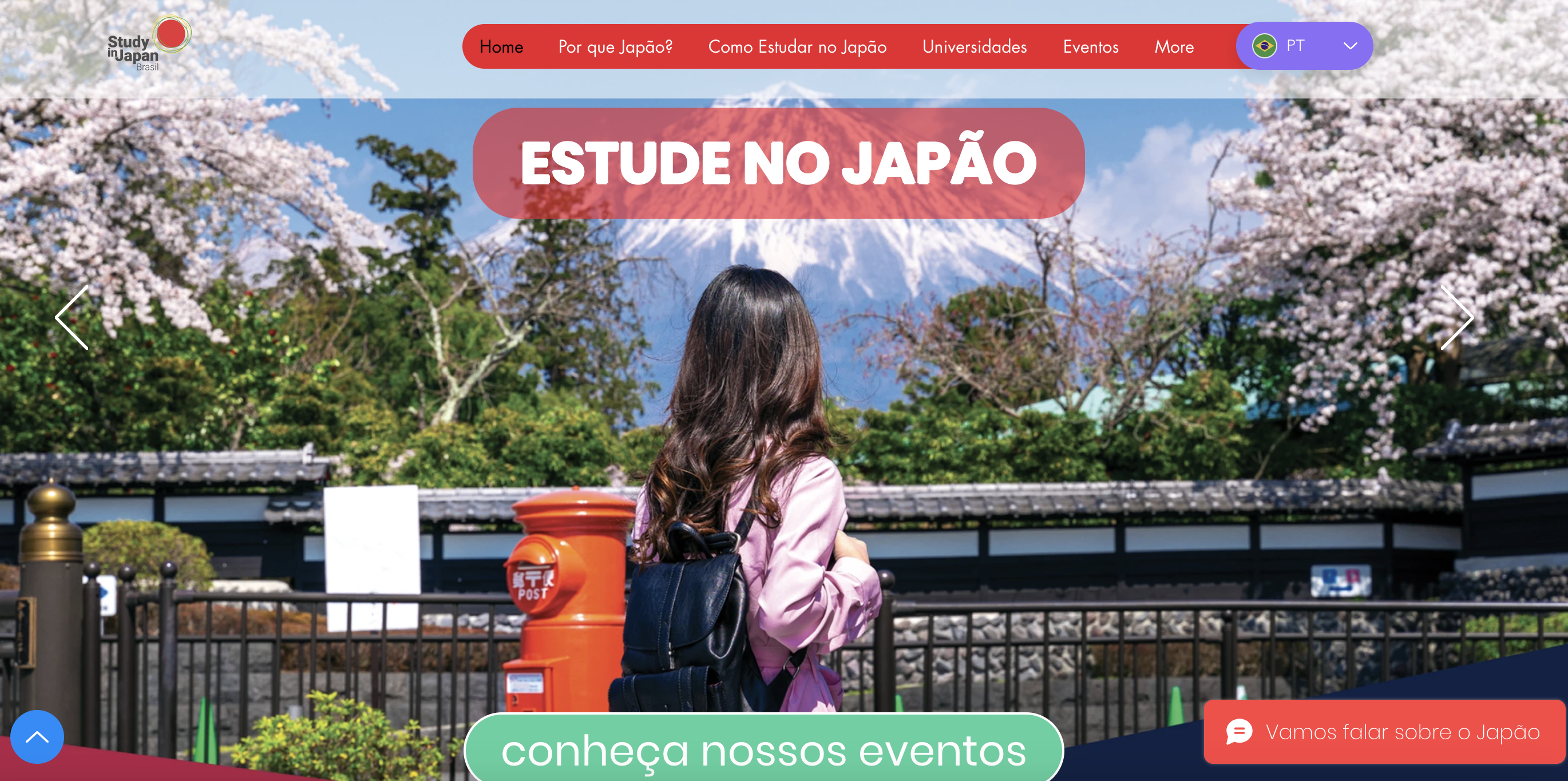
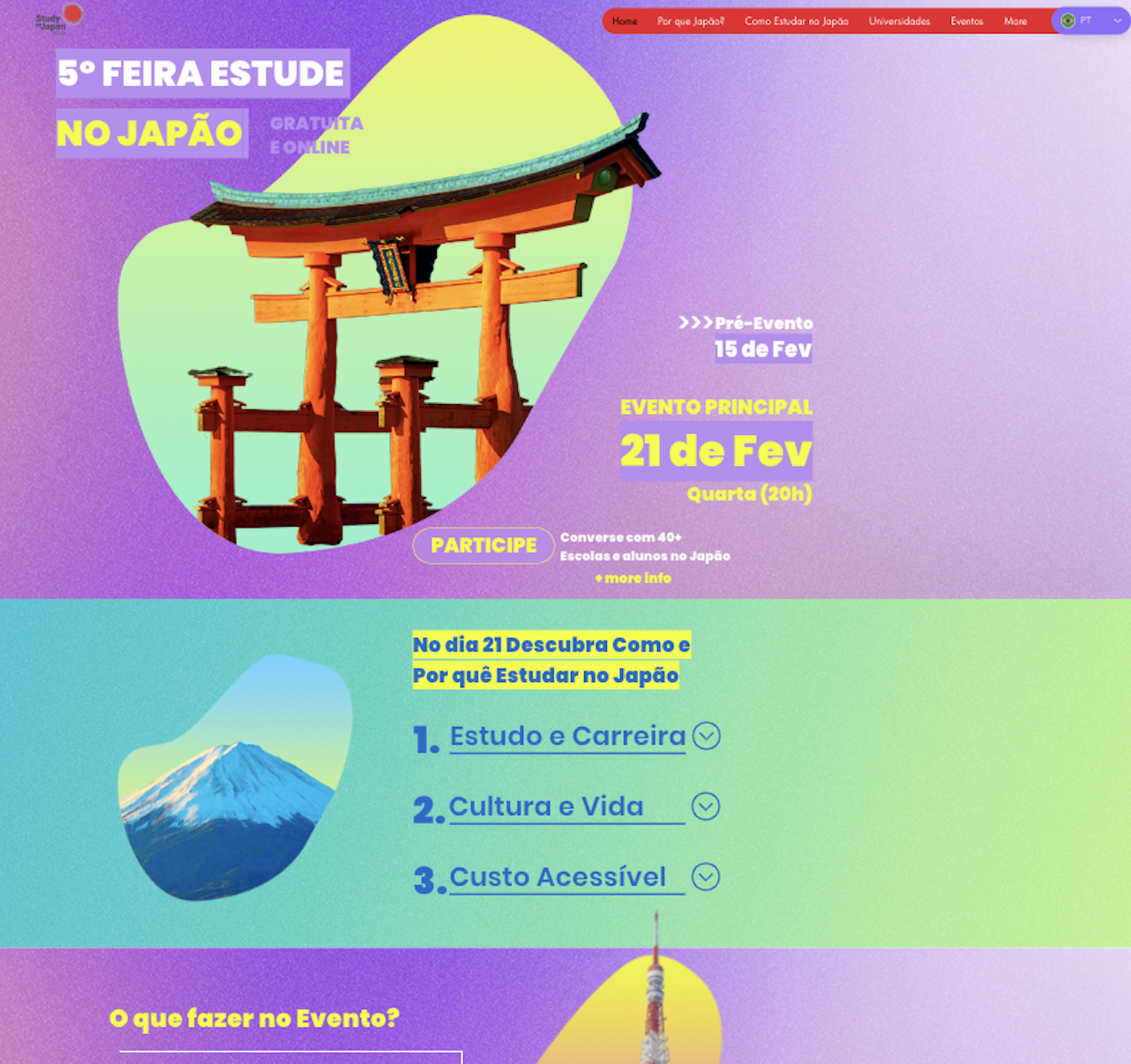
Development of Website and Social Networks for Promoting Japan as a Study Destination. A complete website with a filterable school search database and functional blog was developed. The website has information of over 60 Higher education institutions and its still growing.
With presence in Facebook, Instagram, Twitter, and TikTok, Study in Japan has developed over 1,000,000 posts about Scholarships, Student Experiences, Japan Life Guides, and Institution presentation.

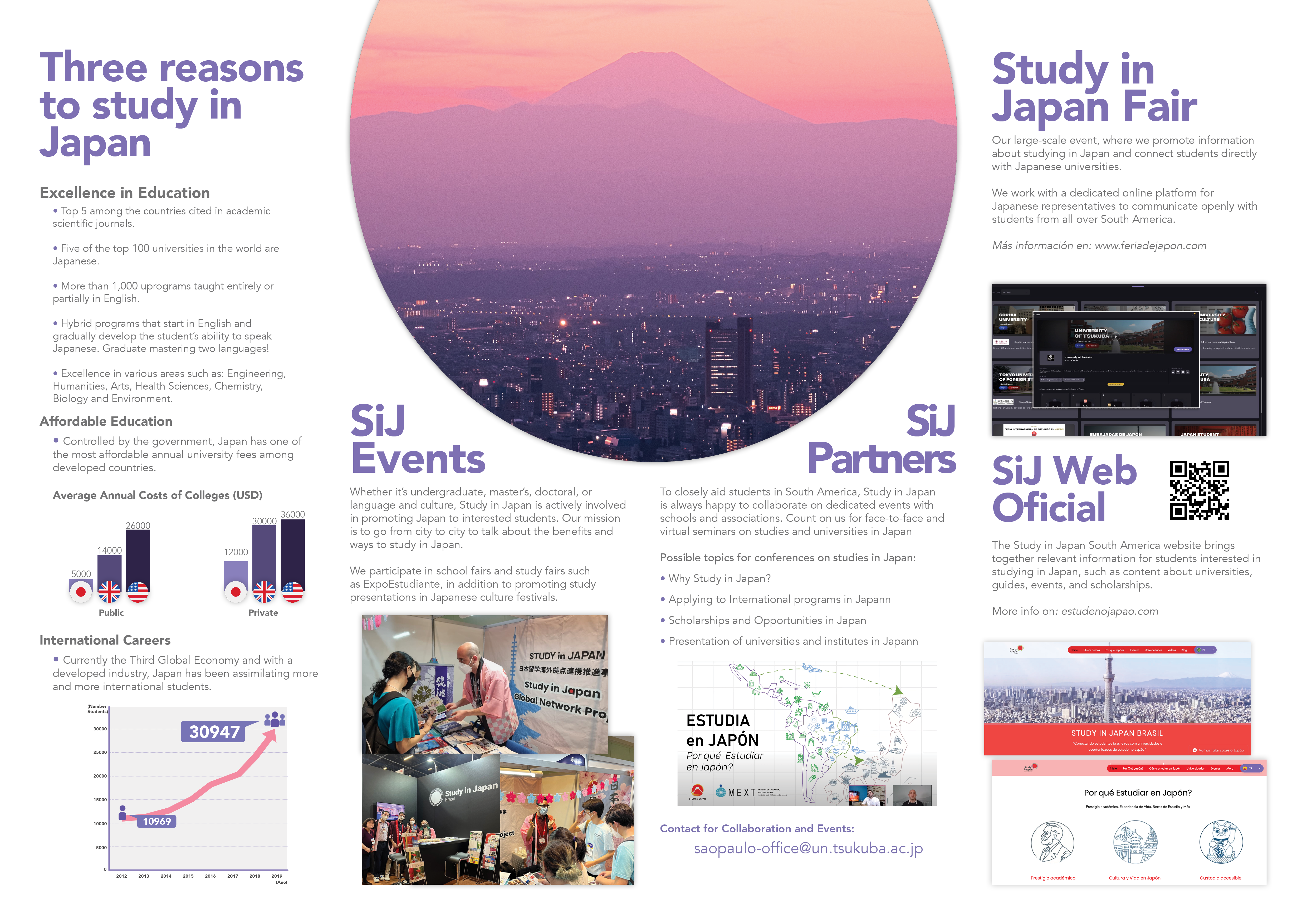
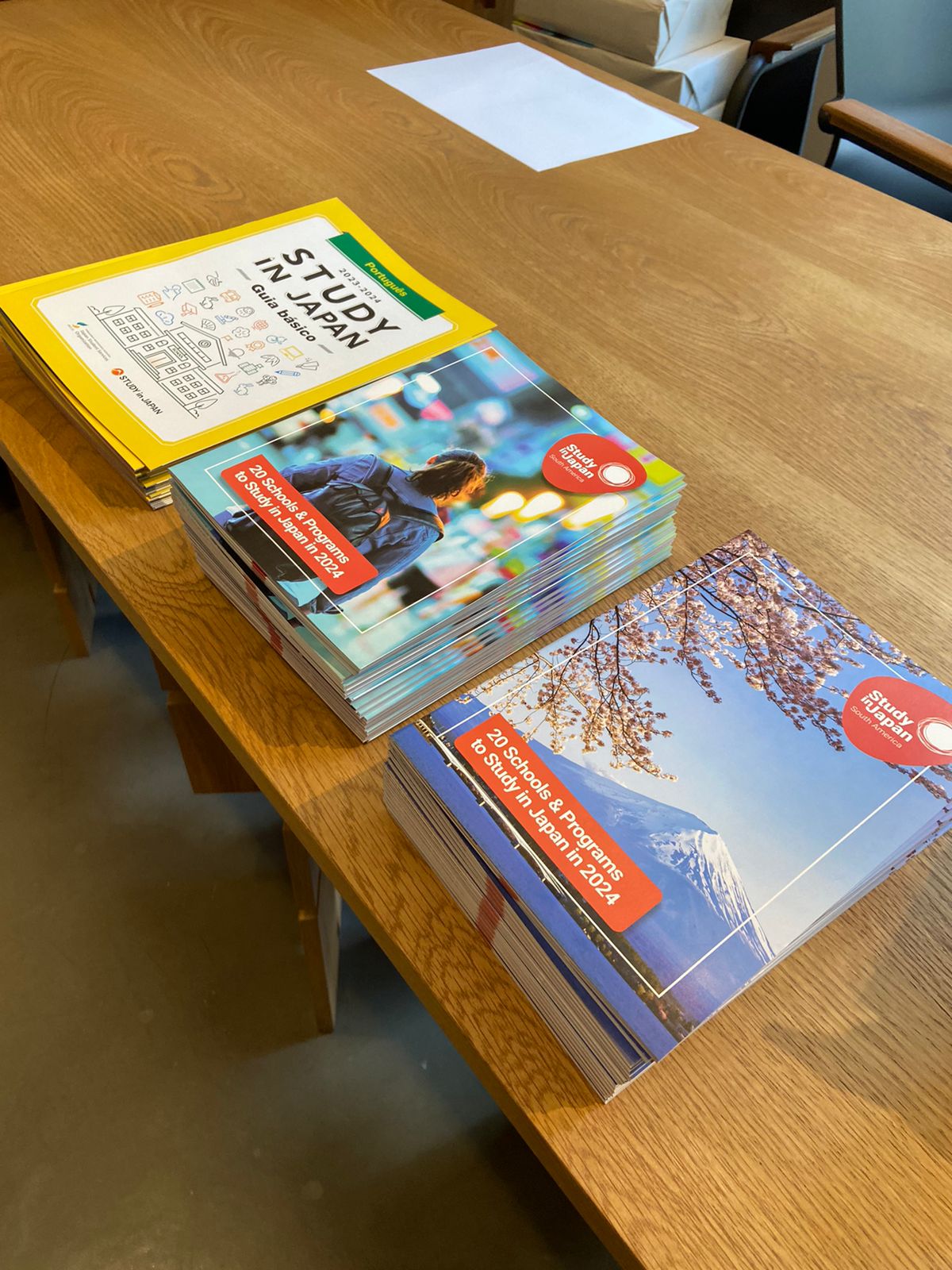
Study in Japan Brochures and flyers
Date: 2020-p
Roles: Co-Design, Art Direction, Layout
Highlight: Yearly Booklet design for sharing Japan Study guide and Promoting institutions.
About
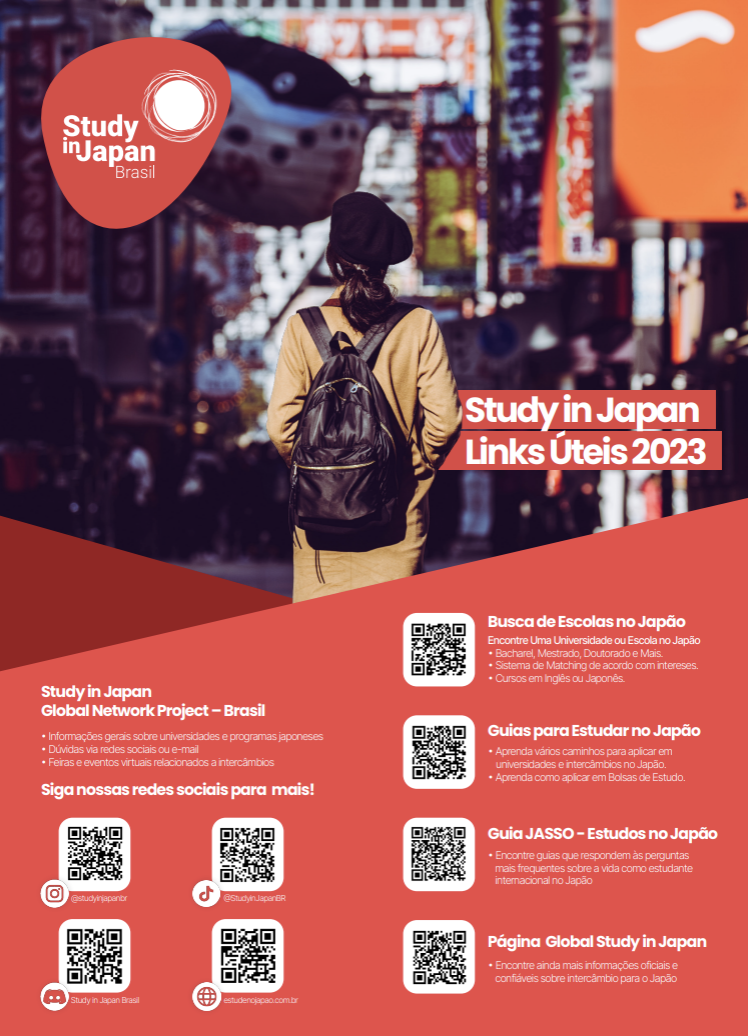
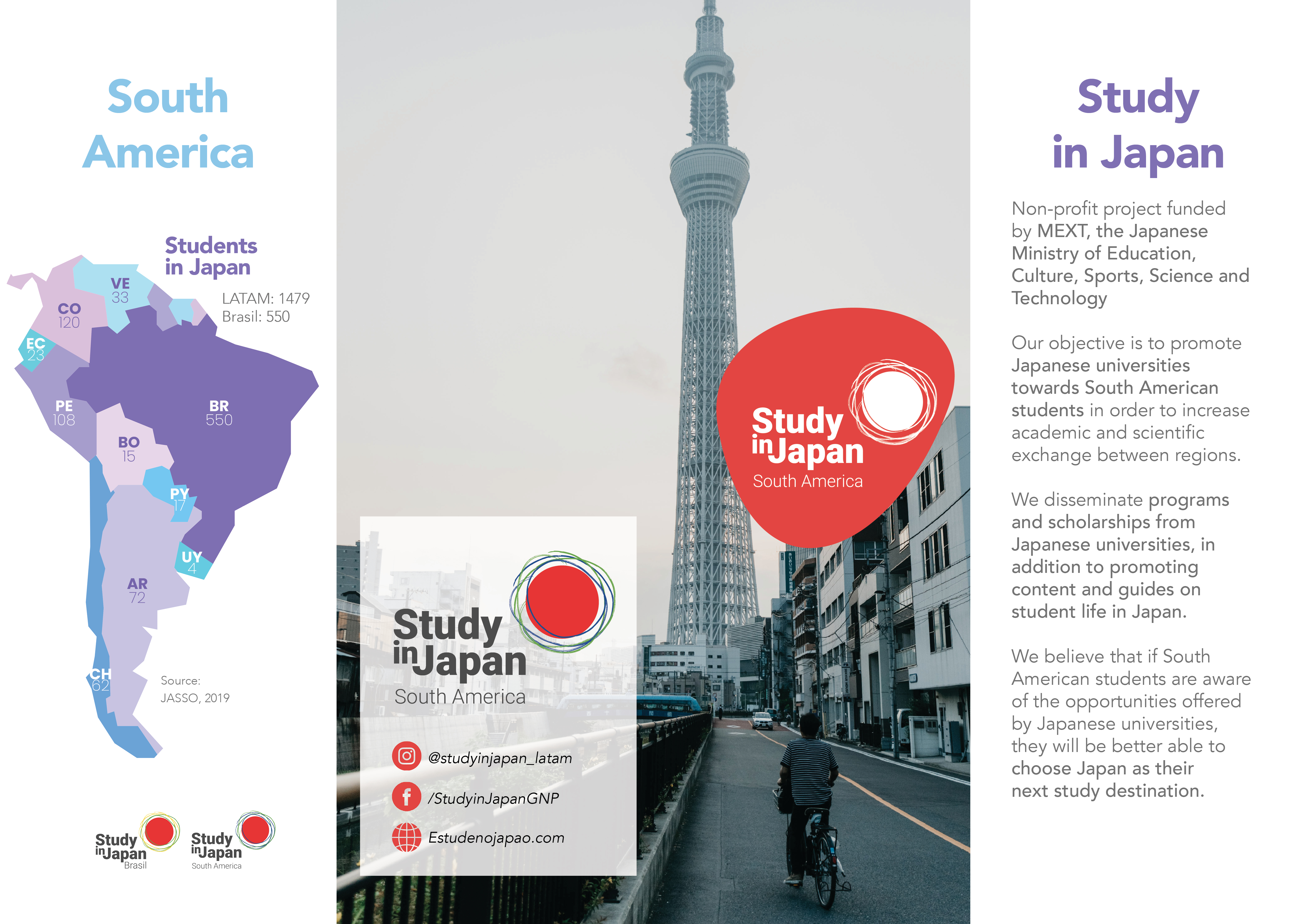
Design of printable material to promote study in Japan. The materials range from Flyers, Institutional folders, Study in Japan Booklet Guides, and Higher Education Institution Catalogues.
Over 50,000 Prints were distributed throughout Latin America in the past 2 years.
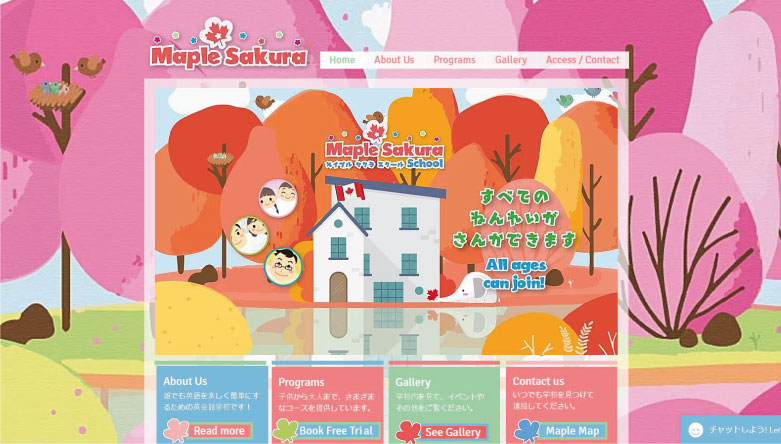


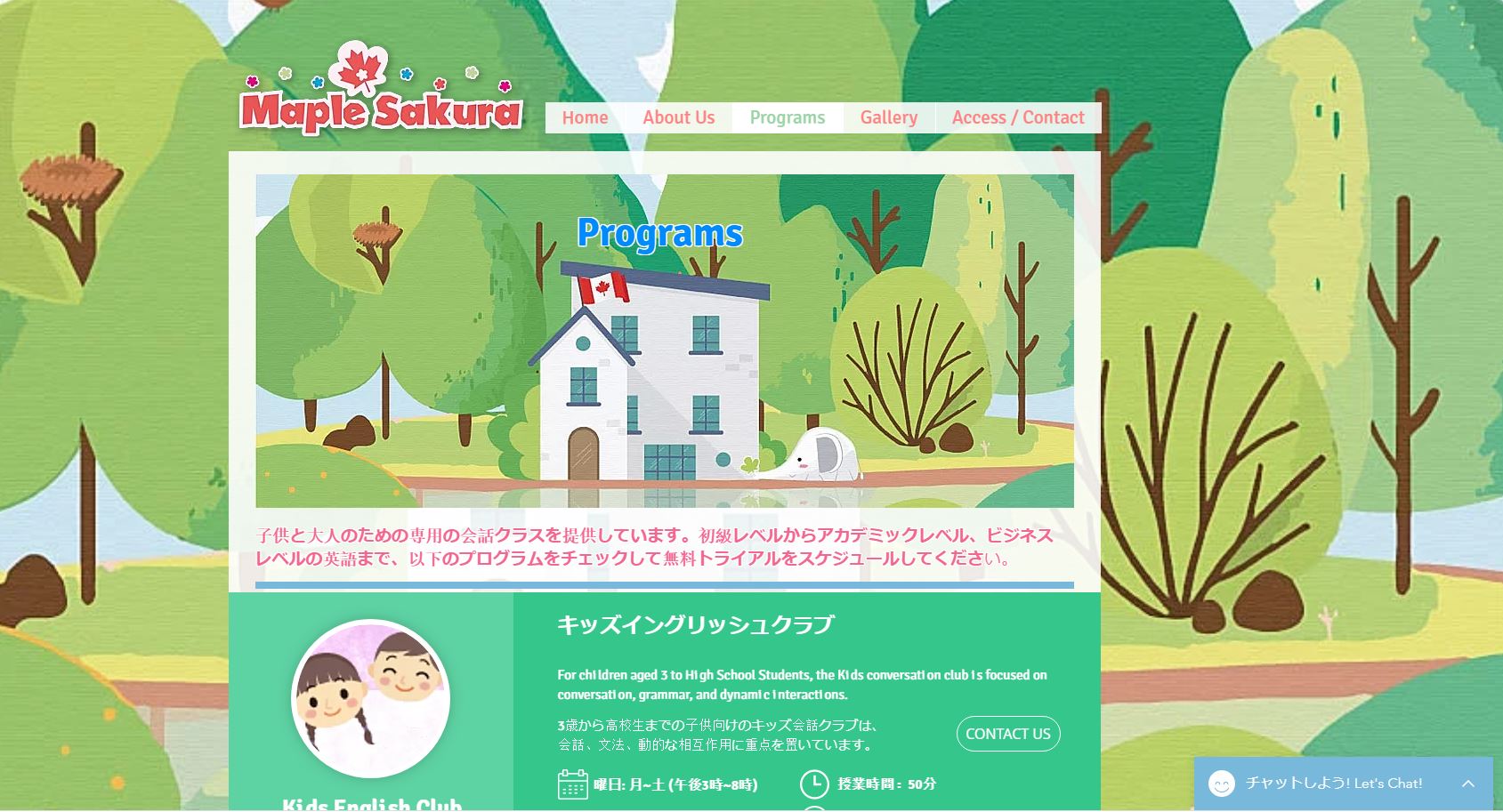
Maple Sakura School Brand and Website
Date: Sept 2019
Venue: Maple Sakura School, Tsukuba, Japan
Roles: Logo, Visual Identity, Website, and SEO
Highlight: 50 monthly inquiries through the Google business page
About
Redesign of Maple Village School brand and Website to give a modern and playful sense for the school method of teaching English. The school bridges the culture of Canada and Japan, originating a brand with elements of both. The school took great inspiration in the four seasons for its visual identity.
More Designs

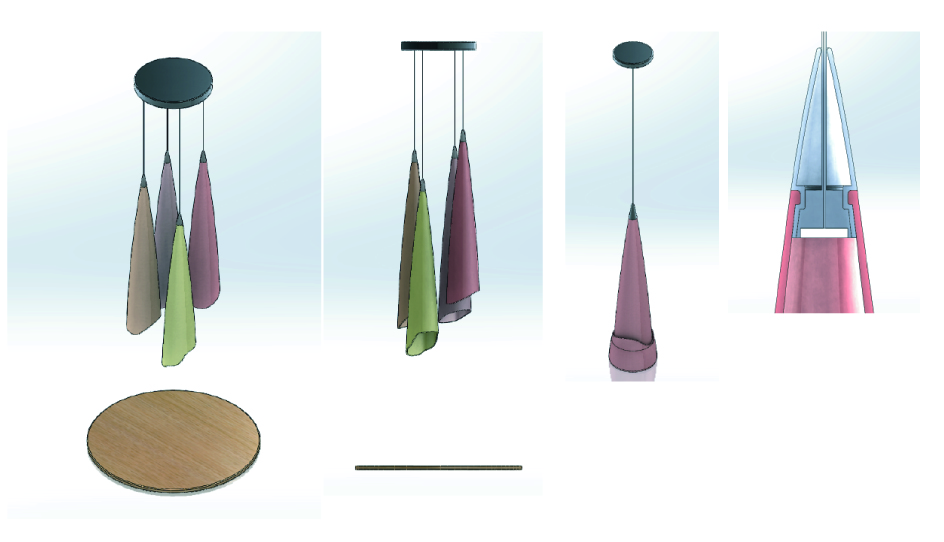
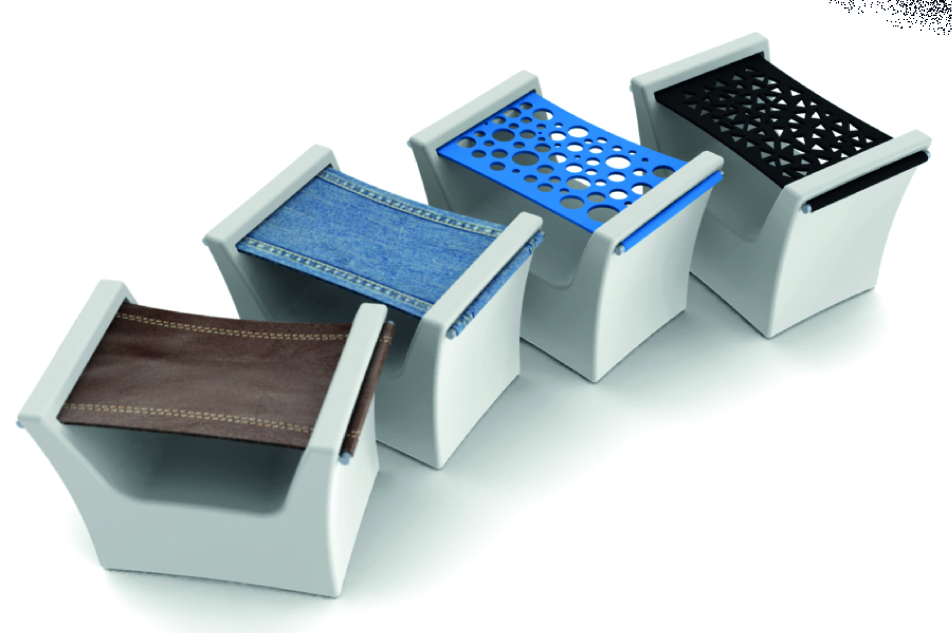
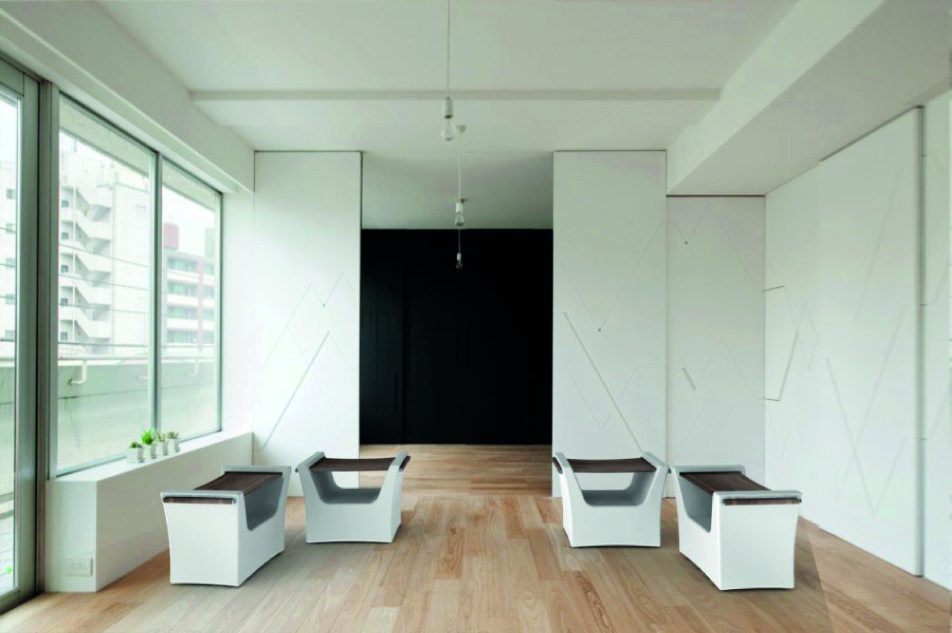
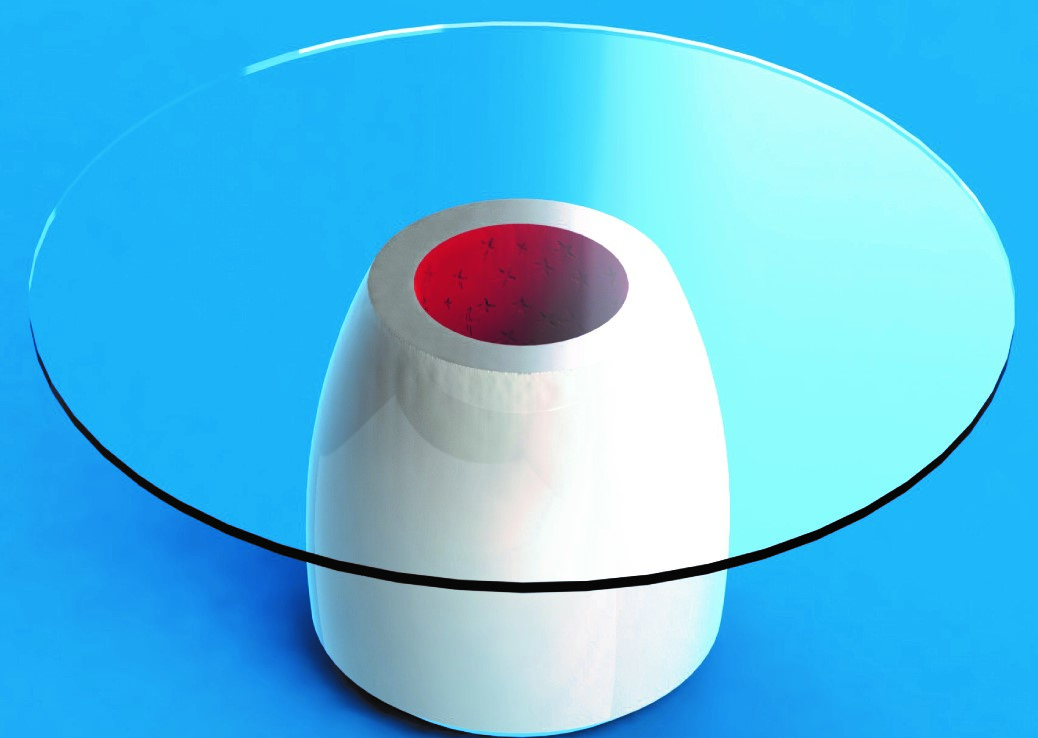
Furniture Design
Date: 2011-2013
Client: Fab Idea Factory
Roles: Product Design, 3D Modelling
About
Series of Furniture Design Projects developed when working at the Fabk Creative Industry. Each Piece possesses unique innovations to stand out as products.
1. Chameleon Chair: The upper seat piece is replaceable, allowing different designs.
2. Tulip Lamp: The shell is composed of silicon rubber, allowing self-design adjustments.
3. Cordel Table: The inner surface is manually embossed, making each piece unique.
A-Maze Playground System
Date: March 2012
Client: Graduation project
Roles: Product and System Design
About
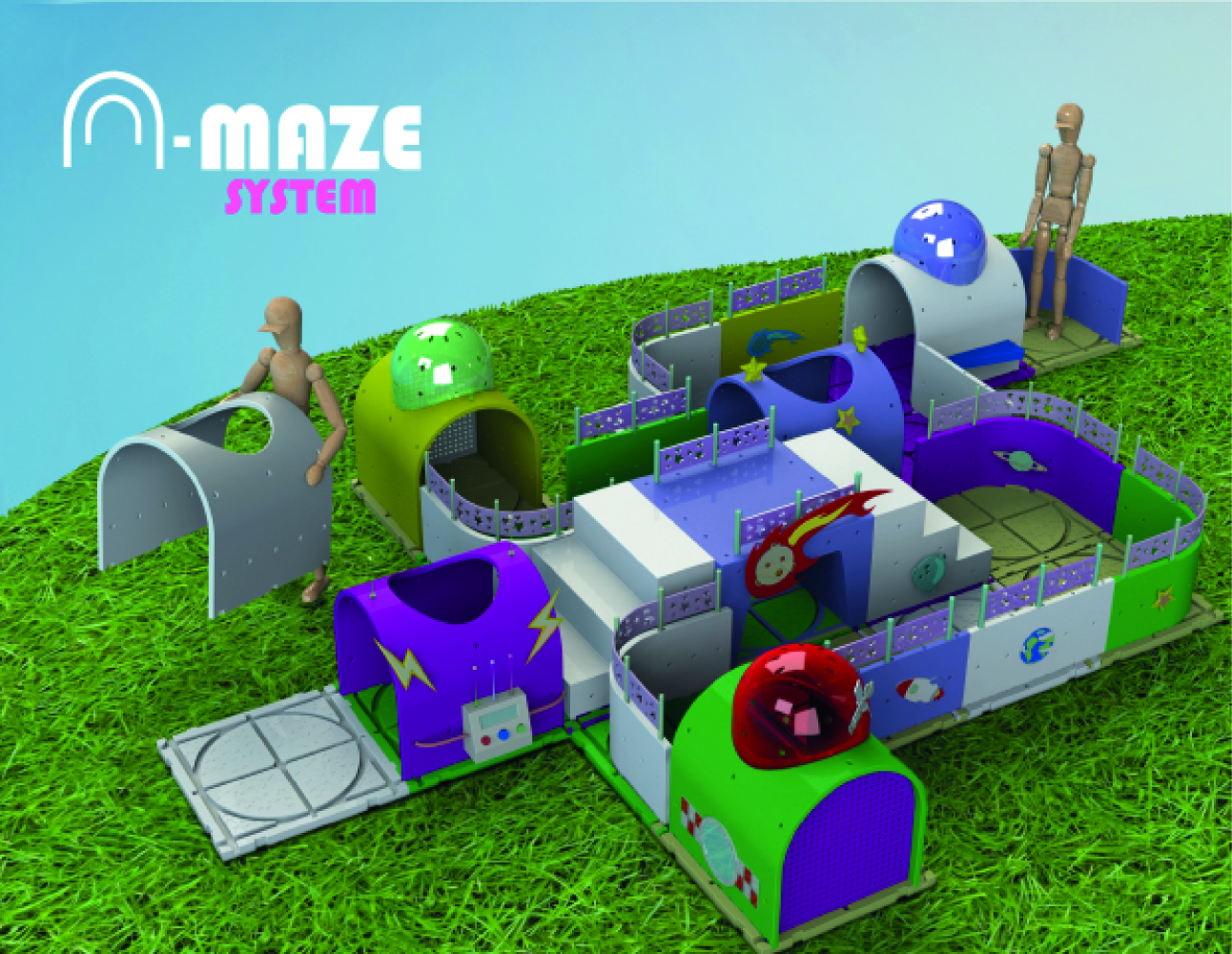
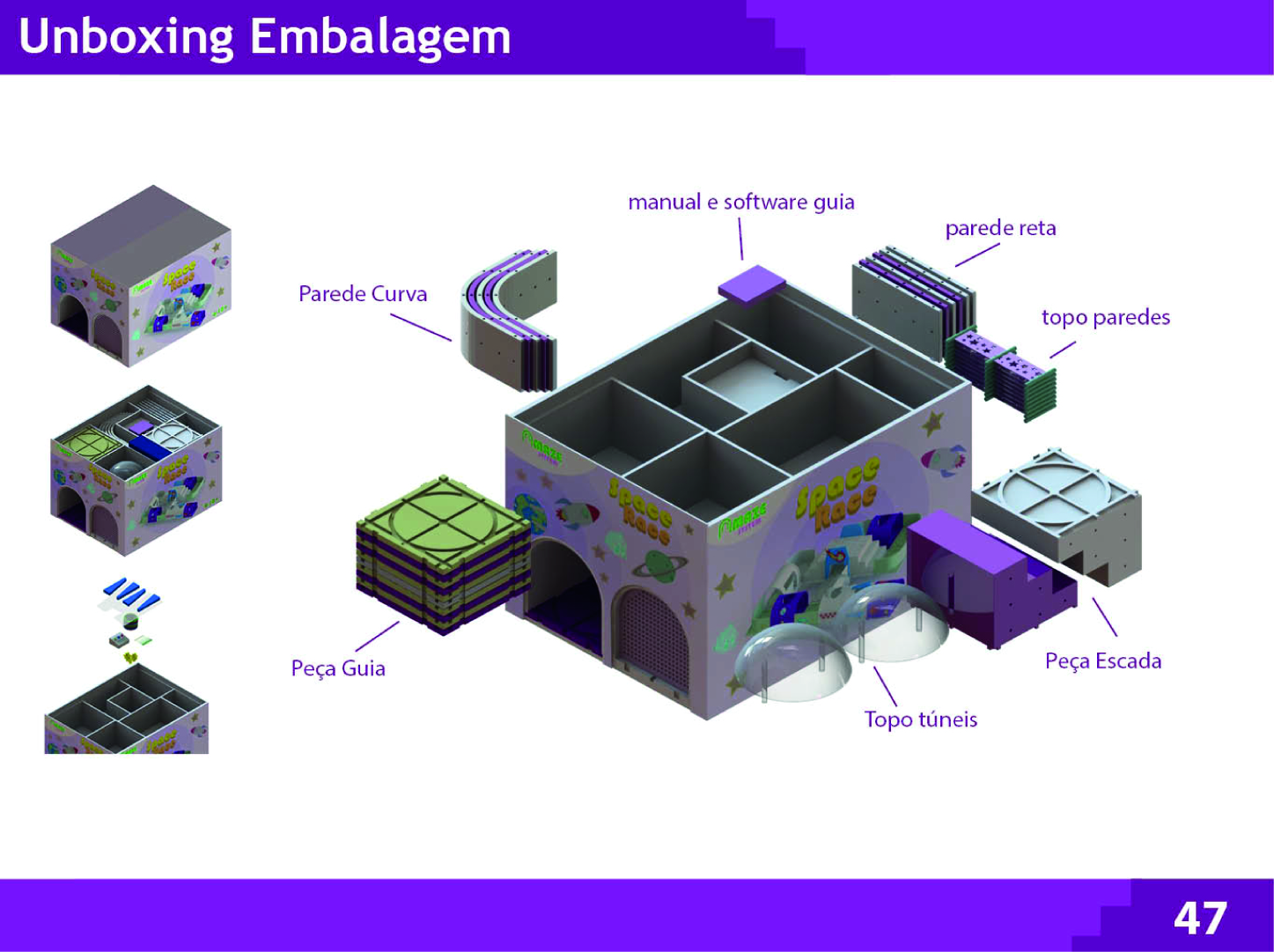
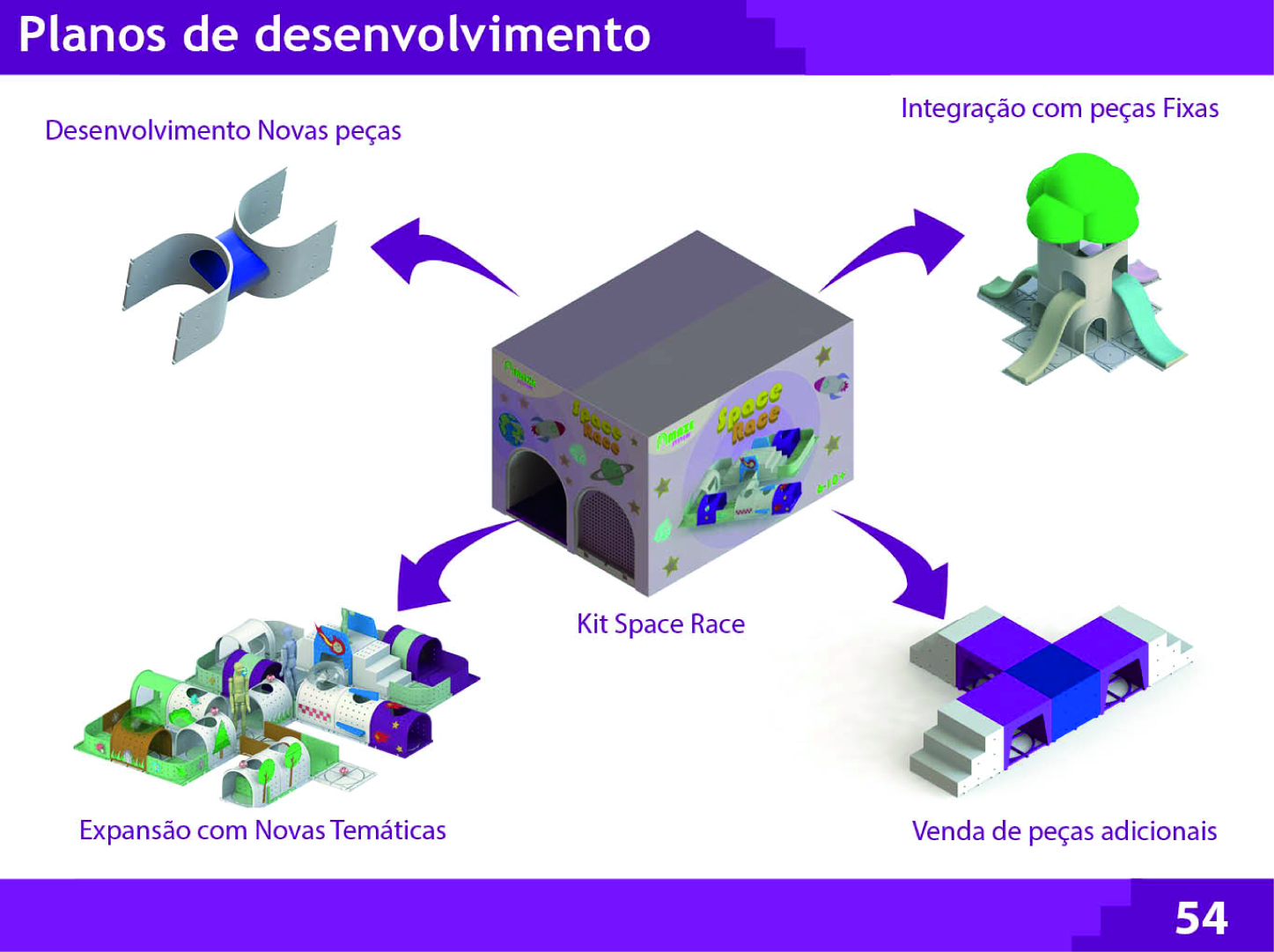
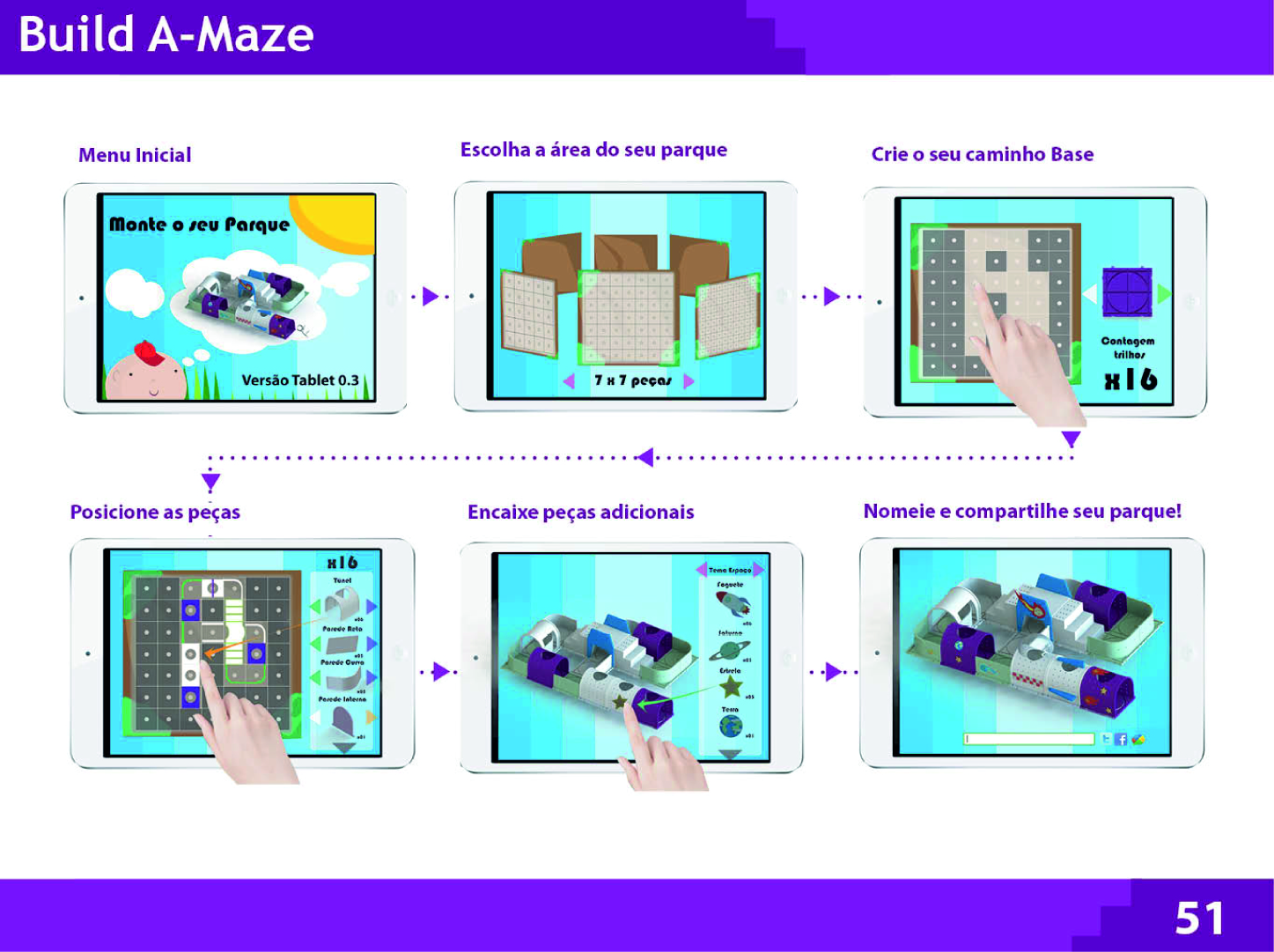
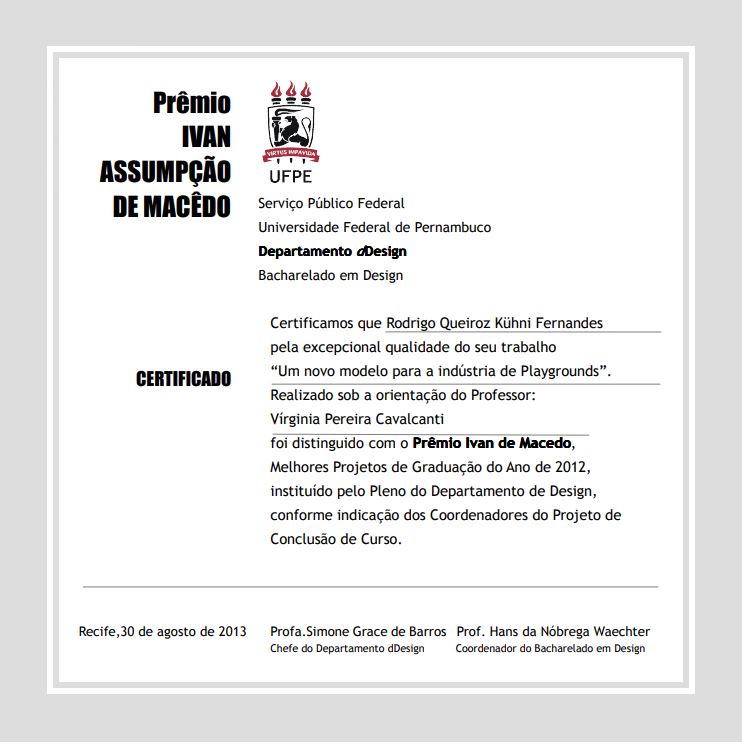
Self-Assembling Playground system that gives children the freedom to create their own mazes and thematic landscapes. This graduation project was a finalist at the IDEA 2014 Design Award and was awarded with the IVAN MACEDO Award for best Design Graduation Project of the year of 2012.






Rodrigo Q. Kühni Fernandes
rqk.fernandes@gmail.com